
24/7 Customer Support

Free returns

Same-day & Next-day Delivery

Quality Guaranteed

Unlock Your Welcome Offers: FREE Delivery | Up to 80% OFF | Free 30-day JoyPlus trial
Download the APP
A tidy home often feels like a constant battle against accumulating clutter. From seasonal clothes and children's toys to garage tools and office paperwork, finding a proper place for everything is key. The right storage boxes can transform a chaotic space into an organised one, but choosing wisely is crucial. Many find their purchases buckle, crack or simply don't fit the space as intended, leading to wasted money and continued frustration.
As a Joybuy Product Recommendation Officer, my role is to help you navigate the market and find practical solutions. This guide will highlight common purchasing pitfalls and break down the essential features to look for, ensuring your next set of storage containers serves you well for years to come.
Before you add any box to your basket, be aware of these frequent issues that can make a seemingly good deal a poor investment.
To make a smart purchase, focus on these three non-negotiable parameters. They will help you filter out subpar options and find a solution that truly meets your needs.
The material dictates a box's durability, suitability for different environments and longevity.
To maximise your space, particularly in smaller UK homes, stacking is essential. For safe and stable stacking, a box needs two things: a strong structure that will not buckle under weight and a lid designed to interlock with the base of the box above it. Look for descriptions that mention reinforced rims or an interlocking design. Secure, clip-on lids are also vital for protecting contents from dust and spills.
One size does not fit all. Measure your space before you buy.
Based on these practical criteria, here are a few options from our catalogue matched to different household needs.
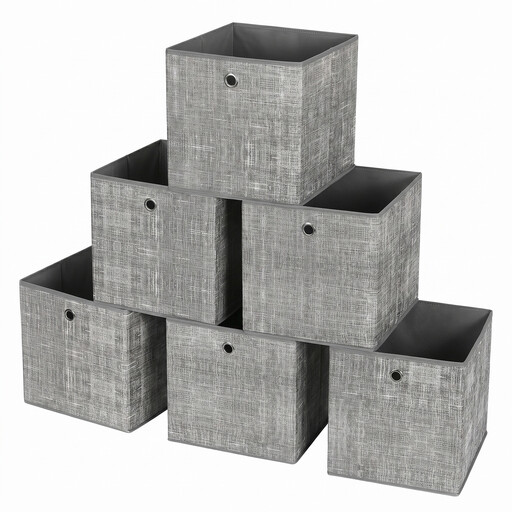
Why This Fits Their Persona: Ideal for those in temporary or smaller living situations. The foldable design means they can be easily stored away when not in use or packed flat for a move. The 30x30x30 cm size is made to fit common cube shelving units, making them a versatile choice for organising clothes, books or general clutter.
These avoid the flimsy material trap by using 80g/m? non-woven fabric reinforced with sturdy cardboard, giving them a stable structure that holds its shape and supports up to 5 kg.
Collapsible design for easy storage; grommet handles for simple retrieval from shelves.

Why This Fits Their Persona: For those needing to store large, heavy or awkward items in a garage, shed, or loft. The huge 175-litre capacity is perfect for power tools, camping gear or Christmas decorations. Integrated wheels make it easy to move, even when fully loaded.
This trunk is built from strong recycled plastic to handle heavy loads. It also avoids the poor lid pitfall with secure clips and holes for a padlock, ensuring contents are safe.
Extra-large 175L capacity; integrated wheels for mobility; lockable for added security.
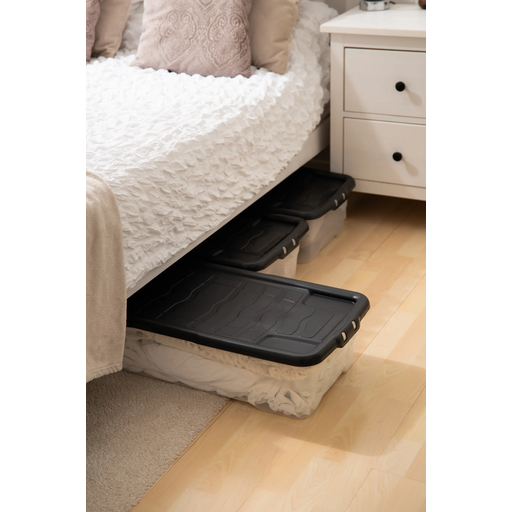
Why This Fits Their Persona: This box is specifically designed to reclaim the often-wasted space under a bed. Its 17cm height is low enough for most frames, and the 30-litre capacity is ideal for storing out-of-season bedding, shoes or children's toys, keeping them dust-free but accessible.
It avoids the misleading dimensions pitfall by being purpose-built for a specific, measured space. The secure clip-on lid ensures contents stay protected, and the clear body allows for easy identification.
Low-profile design for underbed use; made from durable recycled plastic; stackable design.
We have compiled a complete, real-time list of products that fully satisfy these strict selection criteria and UK safety regulations.
Q: How can I prevent plastic storage boxes from cracking over time? A: The primary causes of cracking are overloading and exposure to extreme temperatures. Always check the recommended weight limit and avoid placing excessively heavy items in a single box. Store plastic boxes away from direct sunlight or uninsulated areas like lofts that experience dramatic temperature swings. Choosing boxes made from quality PP plastic with reinforced structures also significantly improves longevity.
Q: Are fabric storage bins a good choice for long-term storage? A: Fabric bins are excellent for organising items within your main living space, such as in a wardrobe or on a bookshelf. However, for true long-term storage (a year or more), especially in a garage, loft or basement, they are not ideal. They do not offer protection from moisture, mould or pests. For archival purposes, a sealed plastic storage container is a much safer choice.
Q: What is the most efficient way to use storage boxes to declutter? A: Start by sorting your items into clear categories (e.g., winter clothes, paperwork, sentimental items). Use labels on every box. For items you need to access regularly, use clear storage tubs so you can see the contents at a glance. Maximise your floor space by using stackable storage boxes and designated shelving units. The goal is to create a system where everything has a home and is easy to find when you need it.