
24/7 Customer Support

Free returns

Same-day & Next-day Delivery

Quality Guaranteed

Unlock Your Welcome Offers: FREE Delivery | Up to 80% OFF | Free 30-day JoyPlus trial
Download the APP
Buying storage and cardboard boxes can seem straightforward until a box collapses, fails to fit a shelf or costs more to send than the item inside. UK homes, student rooms, offices and online shops all have different requirements, so choosing by appearance or price alone can lead to wasted money.
The practical approach is to match the box to its intended use, available space and expected load. Here are the main pitfalls to avoid before ordering.
A stated capacity such as 30L or 84L does not tell you whether a box will fit beneath a bed, inside a wardrobe or on a shelving unit. External measurements also include the lid, walls and handles, while internal dimensions determine what can actually be stored.
Measure the available space first, then compare it with the listed length, width and height. For cardboard packing boxes, check internal dimensions if the contents need a close fit, particularly when shipping products to customers.
Single-wall cardboard boxes are lightweight and convenient, but they are generally more suitable for small or lighter goods. Books, tools and dense household items can place considerable pressure on the base and side walls.
For heavier or long-term storage, consider a rigid plastic storage box with a secure lid. Avoid overloading any container and do not stack boxes beyond a stable height. Product dimensions, material and construction provide more useful information than broad phrases such as “heavy duty” without supporting specifications.
Locking handles, transparent walls and stackable lids are useful in some situations, but not every room needs all three. A clear storage box with lids can make frequently accessed items easier to identify, while an opaque box may be suitable for less-used belongings.
Likewise, flat-packed boxes are convenient for small businesses and online sellers with limited storeroom space. If you need only a few boxes for a one-off move, buying a large pack may leave you with unused packaging.
Corrugated cardboard boxes contain a fluted inner layer between paper liners. B-flute cardboard is approximately 3mm thick in the products featured here, offering a balance between rigidity and low weight.
Single-wall cardboard boxes are suitable for everyday packing, retail packing, storage and shipping of lightweight items. For fragile goods, add suitable internal protection and seal all flaps securely. Cardboard is also useful where recyclable packaging boxes are a priority: the featured Triplast products contain up to 90% recycled content and are described as kerbside recyclable.
Plastic storage boxes are more suitable for repeated use and protection from dust. Polypropylene construction, reinforced corners and a properly secured lid can provide a more rigid storage solution than cardboard, although plastic containers occupy more space when empty.
Use internal dimensions when checking whether an item will fit. Use external dimensions when planning shelving, vehicle loading or courier collection. Remember that cardboard box dimensions may have a manufacturing tolerance; the listed Triplast boxes specify ±10mm.
For under-bed storage, height is especially important. A low-profile box may offer less capacity than a tall container but can use otherwise wasted space. Check the clearance beneath the bed, including any frame supports or castors.
Pack size affects the real cost per box and how much space unused packaging takes up. A pack of five may suit occasional home use, while a pack of 25 is more practical for moving, stock rotation or regular fulfilment.
Flat-packed boxes reduce storage clutter before assembly. Plastic containers, by contrast, may be ready to use but need a dedicated area when empty. Compare the number of boxes, usable capacity and storage footprint rather than focusing only on the ticket price.
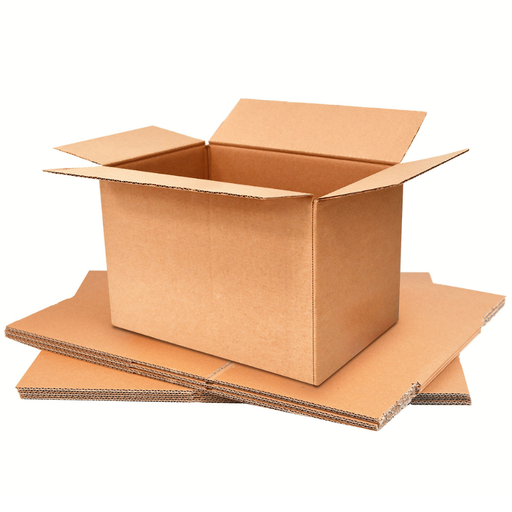
Why This Fits Their Persona: A five-box pack suits renters, students and households needing a small quantity for decluttering, gifting or occasional dispatches.
The stated 229 x 152 x 152mm internal size helps avoid guessing, while the flat-packed format reduces unused storage space.
B-flute, single-wall construction; up to 90% recycled content; FEFCO 0201 four-flap design.
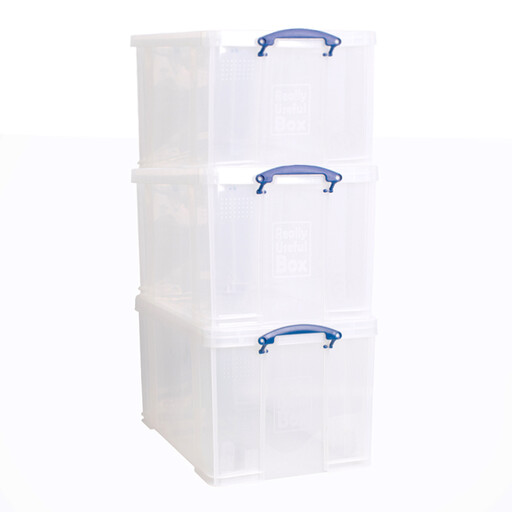
Why This Fits Their Persona: Suitable for households, offices and garages that need substantial capacity, repeat use and easy identification of stored items.
Its 84-litre capacity is paired with external dimensions of 71 x 44 x 38cm, so buyers can plan shelf and floor space accurately.
Pack of three; clear polypropylene boxes; locking handles, reinforced corners and recessed stackable lids.
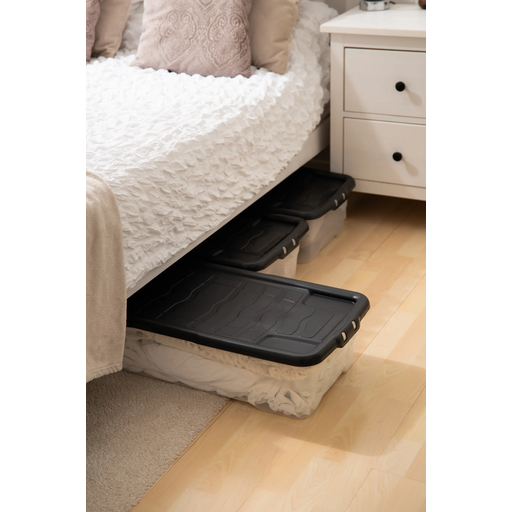
Why This Fits Their Persona: Designed for bedrooms, offices, living rooms and garages where low-height storage is needed for clothing, documents or seasonal items.
The 17cm height supports under-bed use, while the 40 x 60cm footprint makes the required clearance easier to check before purchase.
30-litre capacity; clip-on lid; stackable design; made from recycled plastic.
For house moves, select several sizes rather than filling one large box with dense items. Small corrugated cardboard boxes are useful for books, kitchenware and compact goods, while medium boxes can hold clothing and general household contents. Keep the weight manageable for lifting and label each box clearly.
For boxes for online sellers, match the internal dimensions to the product and allow room for protective material. A box that is substantially larger than its contents may increase void fill and delivery volume. The Triplast 305 x 229 x 152mm format is suited to many small products, components, samples and retail items, while the 101mm cube is intended for smaller goods.
The 203 x 152 x 102mm 8 x 6 x 4-inch format offers another option for compact dispatches. All three formats are supplied in packs of 25, while the 9 x 6 x 6-inch version is also available in a five-box pack. Store unused flat-packed boxes in a dry place and seal assembled boxes securely before transit.
We have compiled a complete, real-time list of products that fully satisfy these strict selection criteria and UK safety regulations.
Plastic storage boxes with lids are generally more suitable where dust resistance, repeated use and stackability matter. Cardboard boxes are lighter, flat-pack efficiently and can be recycled, making them practical for moving, short-term storage and shipping.
Measure the product, then allow enough space for protective packaging without leaving excessive empty volume. Check the box’s internal dimensions, not only the external measurements, and confirm the packed weight before selecting a delivery service.
Avoid overloading, keep cardboard away from damp areas and store all boxes on a stable, level surface. For stackable storage boxes, follow the manufacturer’s stacking guidance and replace any container that becomes cracked, deformed or structurally weak.