
24/7 Customer Support

Free returns

Same-day & Next-day Delivery

Quality Guaranteed

Unlock Your Welcome Offers: FREE Delivery | Up to 80% OFF | Free 30-day JoyPlus trial
Download the APP
A storage ottoman bench can provide seating, concealed storage and a useful footrest in one compact piece. It may work as an end of bed bench, hallway seat, bedroom storage bench or living room footstool. However, attractive upholstery and impressive capacity figures do not always tell the whole story.
Before buying, UK shoppers should look beyond colour and appearance. The wrong dimensions, unsuitable weight rating or difficult-to-clean fabric can make an ottoman inconvenient soon after delivery. The following guide explains the main buying pitfalls and the specifications worth checking before choosing one.
A listing may show a large volume, but the internal compartment can be divided by supports, shaped around hinges or unsuitable for bulky items. A 131-litre ottoman, for example, may be suitable for folded blankets, books and cushions, but not necessarily for large bedding or oversized storage boxes.
Check both the external dimensions and the shape of the internal compartment. Also measure doorways, staircases and the intended position before ordering.
A stated weight capacity usually relates to a specific use and setup. It does not mean the bench should be used as a step ladder, stood on or loaded with heavy items inside. Some products specify a static maximum load, while others provide separate guidance for storage and seating.
The lid should be fully closed before sitting down, and the product should stand on a flat, stable surface. Always follow the supplied instructions rather than relying on the headline figure alone.
Velvet, linen-look fabric and corduroy can create different visual effects, but each requires suitable care. Soft or textured upholstery may show dust, pet hair and spills more readily than a smoother surface. Before choosing a velvet storage ottoman or upholstered storage bench, check whether the cover is removable, machine washable or intended for spot cleaning only.
For homes with children or pets, a practical colour and simple cleaning instructions may be more useful than a purely decorative finish.
A long bench measuring around 110 cm wide, 38 cm deep and 38 cm high can work beneath a bed, along a hallway wall or beneath a window. It may also provide seating for more than one person, but it needs sufficient floor space for the lid to open.
Smaller designs are easier to move around and may suit flats, dressing areas or compact entryways. A cube-shaped foldable ottoman can be stored in a wardrobe when not required, while a longer padded storage chest is more suitable for bedding and shared seating.
Look for structural materials such as MDF panels, reinforced corners and a properly supported lid. Foam padding affects how the bench feels when used as a seat or coffee table ottoman, but thicker padding alone does not determine overall stability.
Metal legs may raise the seat height and leave space beneath the unit, while a panelled base may offer a lower, more enclosed appearance. If you intend to use the product regularly as a hallway bench or end of bed bench, check the assembly requirements and whether the feet include floor-protective pads.
Compare the stated load with your intended use. Some options in this range list capacities from 120 kg to 300 kg. A higher published rating can be relevant for frequent seating, but it does not remove the need to distribute weight evenly or avoid standing on the ottoman.
Where provided, look for relevant information such as BS5852 qualification for upholstered furniture. This should be understood as a product specification, not a substitute for following fire-safety guidance. Keep upholstered furniture away from naked flames and heat sources.
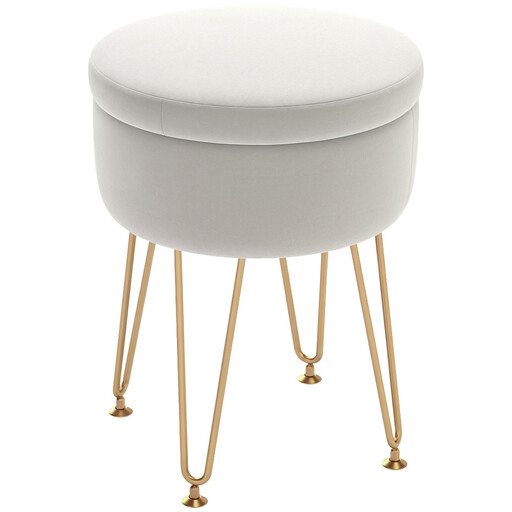
Why This Fits Their Persona: Its compact 33 cm diameter suits smaller bedrooms, flats and dressing areas where a full-width storage bench would take up too much floor space.
The listing states a defined 5-litre storage space and 120 kg maximum load, helping shoppers set realistic expectations rather than assuming it stores bulky bedding.
Compact 5-litre hidden compartment; cushioned top and metal hairpin legs; suitable as a dressing stool, hallway seat or footstool.
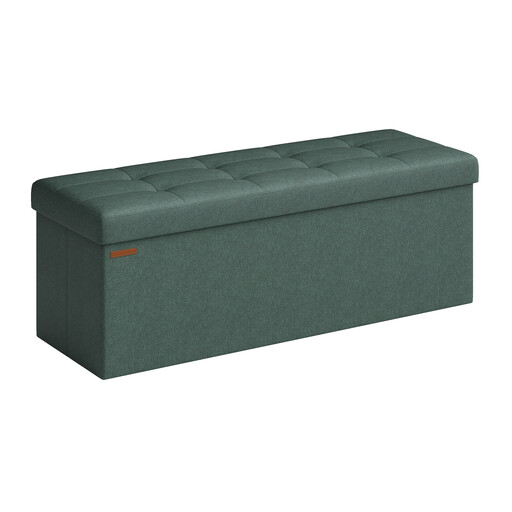
Why This Fits Their Persona: The tufted linen-look finish and long rectangular profile suit shoppers who want concealed storage without a purely utilitarian appearance.
Its stated 131-litre volume, MDF panels and metal corner guards provide clearer information than relying on upholstery or styling alone.
38 x 110 x 38 cm footprint; 300 kg stated maximum capacity; folds for storage and can be used as a seat, footstool or coffee table.
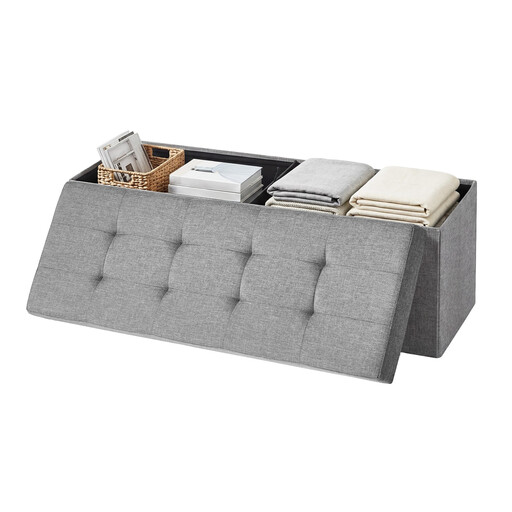
Why This Fits Their Persona: Its long bench format and large compartment are practical for family living rooms, bedrooms and busy hallways where seating and storage are used frequently.
The listing specifies the 300 kg maximum capacity, 131-litre volume and the requirement to close the lid fully before sitting.
Padded linen-look upholstery; MDF construction with reinforced lid corners; foldable format for under-bed or cupboard storage.
We have compiled a complete, real-time list of products that fully satisfy these strict selection criteria and UK safety regulations.
Yes, provided its width and depth leave enough clearance around the bed. A bench around 110 cm wide can suit many bedrooms, but measure the gap and check that the lid can open fully without hitting the mattress or nearby furniture.
Lifespan depends on frequency of use, load, assembly and care. A foldable design is convenient for occasional storage, but it should not be repeatedly overloaded or dragged across the floor. Tighten fixings where instructed, avoid standing on the lid and clean the upholstery according to the manufacturer’s guidance.
No. A standard ottoman, pouffe footstool or coffee table ottoman has no ongoing electricity cost. The main maintenance considerations are fabric cleaning, protecting the floor and keeping the internal compartment free from excess weight or damp items.