
24/7 Customer Support

Free returns

Same-day & Next-day Delivery

Quality Guaranteed

Unlock Your Welcome Offers: FREE Delivery | Up to 80% OFF | Free 30-day JoyPlus trial
Download the APP
A storage ottoman bench can solve two everyday problems at once: it provides somewhere to sit while putting on shoes, and it hides items that would otherwise clutter a hallway, bedroom or living room. However, attractive upholstery and a large capacity figure do not automatically make a bench suitable for your home.
Before buying, look beyond colour and promotional wording. The most useful checks concern the bench’s actual dimensions, internal organisation, construction, weight rating and intended use. This guide explains the common pitfalls and compares practical options for different UK households.
A bench may look spacious in photographs, but thick panels, padding and internal supports reduce the available storage area. A long ottoman can also be too deep for a narrow hallway or too low to work comfortably at the end of a bed.
Measure the intended space, including clearance for opening the lid. For a hallway, check that the bench will not obstruct doors, radiators or the normal walking route. For a bedroom, leave enough space to open the lid fully without hitting the bed frame.
Some listings show a high maximum static capacity, but this normally assumes the lid is fully closed and the load is distributed properly. It should not be interpreted as permission to stand on the bench, place oversized items inside or use it as a step.
Look for clear instructions about sitting, lid positioning and weight limits. A padded storage bench should be used on a stable, level floor, with the lid completely fitted before anyone sits on it.
A velvet storage ottoman can add texture and colour, while a PU-covered seat or laminated cabinet may be simpler to wipe clean. In homes with children, pets or muddy footwear, a delicate-looking surface may require more care than expected.
Check the material description and care guidance before ordering. Fabric upholstery can collect dust and marks, whereas smooth finishes may be more practical near an entrance. Also confirm whether self-assembly is required and whether the package includes all panels and hardware.
A useful starting point is the available floor area rather than the storage volume. Common uses include:
For example, a 110 x 38 x 38 cm foldable bench is relatively long but only 38 cm deep, making it suitable for many spaces where a deeper storage chest would be intrusive.
A hidden storage bench with one large compartment is useful for blankets, cushions and books. Smaller compartments or removable boxes make it easier to organise socks, accessories and other items that can disappear in a large cavity.
If the primary purpose is footwear, compare a dedicated shoe storage bench with a conventional ottoman. A shoe cabinet with pull-down drawers can keep shoes enclosed and offers a more vertical solution, while an upholstered bench provides a seat as well as storage.
Particleboard and MDF are common furniture materials. Check the thickness and reinforcement details where available, especially around the lid and corners. Hinges, metal corner guards and reinforced panels can help the structure remain stable during normal use, but they do not remove the need to follow the manufacturer’s instructions.
For upholstered furniture sold in the UK, check the listing and supplied information for relevant product compliance details, warnings and care instructions. Do not assume that a fabric, foam or finish meets a particular standard unless the seller provides the applicable information.

Why This Fits Their Persona: A practical option for renters, students and smaller households needing a seat and shoe storage in one compact unit. Its 80 cm width suits many entrances, halls of residence and flats.
The specifications separate open shoe shelving from the concealed compartment, making the storage arrangement clearer than a single capacity claim.
Measures 30 x 80 x 44 cm, includes three storage areas, two alloy hinges and a stated 136 kg static capacity.
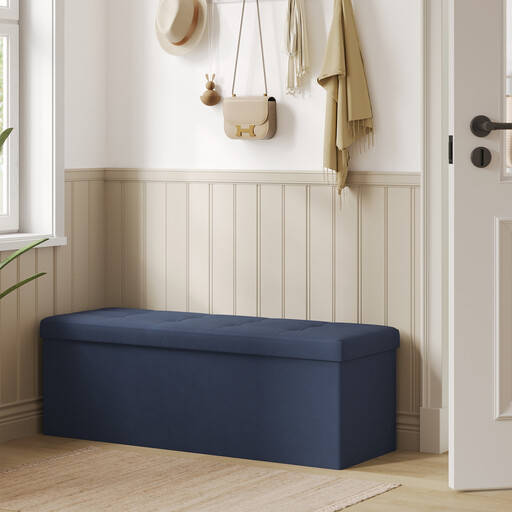
Why This Fits Their Persona: Suitable for buyers who want upholstered furniture that can move between a bedroom, living room or hallway and be stored flat when necessary.
The folding construction addresses occasional-use and storage needs, while the listing specifies that the lid must be fully covered before sitting.
Provides 131 litres of stated volume, two extra storage boxes and high-density foam padding in a 110 x 38 x 38 cm frame.
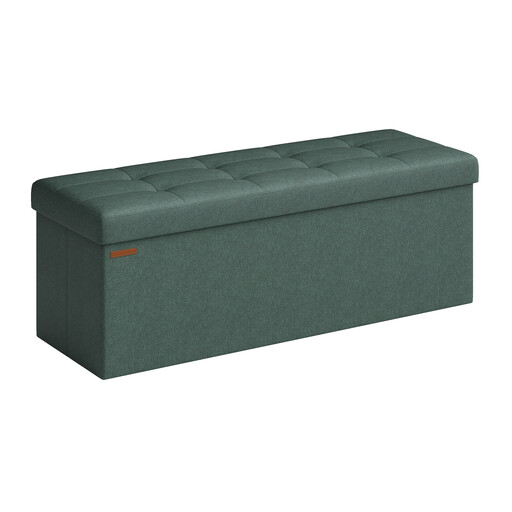
Why This Fits Their Persona: A long storage chest for households storing bedding, pillows and blankets, particularly at the end of a bed or beneath a window.
The listing gives a defined 131-litre capacity and states that oversized or excessively heavy items should not be placed inside.
Uses MDF panels, metal corner guards and a linen-look tufted cover, with a stated 300 kg maximum static capacity.

Why This Fits Their Persona: A narrow white shoe cabinet suits flats and busy hallways where enclosed footwear storage matters more than a padded seat.
Its stated 24 cm depth makes it easier to assess for narrow entrances, while the drawer layout avoids mixing footwear with blankets or household items.
Measures 115 x 60 x 24 cm and has three pull-down drawers, each listed as holding approximately three to four pairs of shoes.
We have compiled a complete, real-time list of products that fully satisfy these strict selection criteria and UK safety regulations.
Yes, provided its depth and lid clearance suit the space. For a narrow entrance, measure the route from the front door to the nearest wall and check that the bench will not interfere with doors or daily movement. A shoe storage bench is generally more practical than a deep ottoman if footwear is the main requirement.
Lifespan depends on frequency of use, load, assembly and care. A foldable design is convenient for occasional seating and compact storage, but it should be opened on a level surface and used within its stated capacity. Avoid dragging it when loaded and do not sit on it with the lid partly open.
A storage ottoman bench does not normally require electricity, so its ongoing cost is limited to cleaning and ordinary maintenance. Upholstery may need more frequent care than a smooth cabinet surface. Before purchase, compare the material, cleaning instructions and the type of items you intend to store.