Ranked strategy all-rounders
If you use one screen for maps, build orders, unit controls and other PC games, assess a 27-inch QHD monitor with adaptive sync. Check how your games scale their interfaces as well as whether your PC can run them at QHD.


For ranked strategy games on a PC, a 27-inch QHD monitor with adaptive sync and a native 165–180Hz refresh rate is a useful starting point when readable maps and interfaces matter alongside smooth panning. Consider a faster OLED model if motion and dark-scene presentation matter more to you, or 4K if your PC can sustain the resolution and frame rate you intend to use. Check the chosen input, cable and desk fit before deciding.
If you use one screen for maps, build orders, unit controls and other PC games, assess a 27-inch QHD monitor with adaptive sync. Check how your games scale their interfaces as well as whether your PC can run them at QHD.
If your PC can deliver high frame rates and motion clarity is a priority, a high-refresh QD-OLED model is worth considering. MSI’s MAG 271QP QD-OLED X28 is one such QHD option; its OLED panel-care requirements remain part of the decision.
If you need to position the display around your seated setup, examine stand adjustment and mounting options before choosing a panel. The Health and Safety Executive advises placing the screen directly in front of you, with its top at eye level and the display about an arm’s length away.
Choose when: You want QHD space for strategy-game interfaces and a monitor that also serves regular desktop use and other PC games.
Accept: A DisplayHDR 400 label does not promise OLED-like dark-scene contrast; an advertised overclocked refresh rate may also have connection requirements.
Choose when: Very high refresh, low stated pixel-response time and dark-scene presentation are priorities you will use.
Accept: Follow the exact model’s OLED-care guidance, particularly when games keep interface elements in fixed positions.
Choose when: You specifically want a 4K game view or sharper desktop text and your PC can sustain your intended settings.
Accept: A dual-mode monitor may reach its highest advertised refresh rate at a lower resolution. Joybuy’s KTC M27P6 listing, for example, describes 160Hz at 4K and 320Hz at Full HD.
| Concern | What to check | Who this matters to |
|---|---|---|
| Map and interface readability | Check native resolution, screen size, game interface scaling and whether your PC can run the game at that resolution. | If I need the map, minimap and unit panels visible together, I put usable workspace ahead of maximum refresh rate. Around 36% of consumers would make readability their primary concern. |
| Smooth panning and scrolling | Check native refresh rate and adaptive-sync compatibility at your chosen resolution and input. | When camera movement is central to my matches, I want my PC and monitor to deliver frames smoothly, including when frame output varies. Motion would come first for around 29% of consumers. |
| Desk fit for longer sessions | Check viewing distance, stand adjustments and, if using an arm, the VESA mount pattern and monitor weight. | If I play for long stretches, I need the screen to sit properly in front of me rather than adjusting my position around the stand. Around 21% of consumers would prioritise desk fit. |
| HDR and dark-scene presentation | Look for a named VESA DisplayHDR tier rather than relying on generic HDR wording; review panel-care terms for OLED. | If dark scenes and other media matter as much as ranked play, I care about the panel’s image presentation, not just its refresh figure. This would be the leading concern for around 14% of consumers. |
An overclocked mode can require a particular connection. LG specifies a DisplayPort 1.4-capable graphics card and DisplayPort 1.4 cable for the 27GS85Q-B’s 200Hz mode.
Compare the native and overclocked rates, then check your graphics output and planned cable against the mode you want to use.
VESA DisplayHDR tiers have defined certification requirements; generic HDR wording does not identify which tier, if any, a monitor meets.
If HDR matters to you, check for a named certification and compare the stated tier rather than judging by the word HDR alone.
A low stated response time does not settle whether OLED suits games with persistent interface elements. MSI describes OLED Care 2.0 and a panel-refresh process for its MAG 271QP QD-OLED X28.
Read the exact model’s care instructions and warranty terms alongside its motion and image specifications.
A tilt-only stand may not place the screen where you need it. Dell lists a tilt stand for the G2725D, while Health and Safety Executive guidance recommends a screen position directly in front of you, with the top at eye level.
Measure your seated eye height and desk depth; if you expect to use an arm, confirm mounting compatibility and monitor weight.
A compatible arm or changes to the desk arrangement may be needed if the supplied stand cannot achieve the position you need.
The 27GS85Q-B is a 27-inch QHD Nano IPS example for consumers comparing native high refresh with an optional faster mode.
The EX2710Q is a QHD IPS option for consumers weighing monitor positioning and built-in audio alongside gaming specifications.
The MAG 271QP QD-OLED X28 represents a QHD route for consumers who particularly value very high refresh and OLED image characteristics.
The G2725D is a 27-inch QHD Fast IPS example for consumers considering a 180Hz display without making HDR the main criterion.
These QHD monitors cover high-refresh OLED and IPS choices for ranked strategy play. Compare each model’s connection requirements and desk-positioning options with the features you intend to use.
 Image unavailable
Consider this QHD OLED model if high-refresh motion is a priority alongside strategy-game workspace.
The product name lists 2560 × 1440 resolution, 240Hz, 0.03ms response time and Adaptive-Sync. Confirm that your GPU, cable and chosen input can deliver the QHD refresh rate you want, and review the model’s OLED-care and warranty terms.
 Image unavailable
This is another QHD OLED choice for consumers prioritising a high refresh rate for movement between parts of the map.
The product name specifies a 27-inch QHD display, 240Hz and 0.03ms response time. Check the resolution and refresh rate supported by your chosen input, and read the OLED-care and warranty terms before deciding.
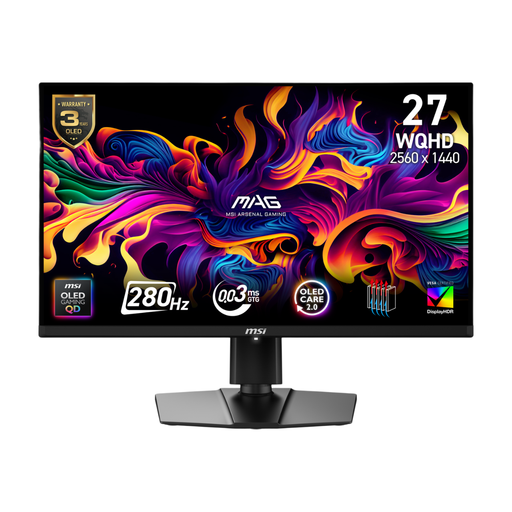 Image unavailable
Consider this model when QHD workspace, very high refresh and a named HDR certification all matter to your choice.
MSI specifies 2560 × 1440, 280Hz, 0.03ms GtG and DisplayHDR True Black 400. Check your connection’s supported QHD refresh rate and follow MSI’s OLED Care 2.0 and panel-refresh guidance.
 Image unavailable
This IPS model suits consumers looking for QHD interface space and high-refresh panning without choosing an OLED panel.
The product name lists WQHD, 180Hz, 0.5ms response time and Adaptive Sync. Check the refresh rate available through your preferred input and whether its stand or a compatible mount will place the screen suitably on your desk.
 Image unavailable
This QHD IPS option is relevant if you want a 27-inch strategy-game workspace and are considering a refresh rate above the other IPS choices shown here.
The product name specifies 2560 × 1440 and 220Hz. Confirm which input, cable and GPU output support your intended mode, and check the stand’s positioning options for your desk.
No: 4K offers more pixels, but it also places greater demands on your PC than QHD. A 27-inch QHD high-refresh monitor is a practical starting point if you want map and interface space alongside smooth panning; consider 4K after checking the settings and frame rate your PC can sustain.
No: those refresh rates are choices for consumers who particularly value high-refresh motion, not requirements for ranked strategy play. QHD monitors in LG’s, BenQ’s and Dell’s cited ranges offer 165–180Hz native or listed refresh rates; the result you see still depends on your PC and connection.
Check the exact monitor mode, graphics output and cable before relying on the advertised figure. LG says its 27GS85Q-B needs a DisplayPort 1.4-capable graphics card and DisplayPort 1.4 cable for the 200Hz overclocked mode.
Position it directly in front of you, with the top of the screen at eye level and the display about an arm’s length away, in line with Health and Safety Executive guidance. If the supplied stand cannot achieve that position, check height adjustment or a compatible mount before buying.
Use an appropriate electrical-waste route rather than treating the display as ordinary household waste. GOV.UK explains that the waste electrical and electronic equipment framework aims to reduce electrical equipment being incinerated or sent to landfill; check available collection or recycling options where you live.