Detail-focused astronomy viewers
If you have a 4K or HDR TV, check the programme’s available picture quality as well as the device. Roku notes that a compatible TV is needed to benefit from 4K resolution or HDR.


Choose a streaming device around the flat’s TV, viewing habits and network, rather than treating 4K support alone as the deciding feature. A compact stick may suit a simple setup, while Roku’s Headphone Mode offers a route to quieter viewing and an Ethernet-capable box is worth considering when a cable can reach the TV. Any 4K or HDR benefit also depends on the programme, connection and compatible display.
If you have a 4K or HDR TV, check the programme’s available picture quality as well as the device. Roku notes that a compatible TV is needed to benefit from 4K resolution or HDR.
If TV-speaker sound would disturb flatmates, a model with a suitable headphone feature may matter more than another picture format. Roku’s mobile-app Headphone Mode requires the mobile device and Roku to share a wireless network.
If playback struggles when several people are online, consider whether a wired connection can reach the TV or whether the household’s wireless equipment suits the device you choose.
Check the existing TV and the programmes you intend to watch, then decide which shared-flat concern should take priority.
| Concern | What to check | Who this matters to |
|---|---|---|
| Picture detail and HDR | Check the programme’s quality label and whether the TV and its chosen HDMI input support the intended 4K or HDR format. | If planetary footage is my main reason for upgrading, I want the programme and TV to make use of the device’s picture formats; around 31% of consumers put picture compatibility first. |
| Quiet viewing | Check the exact model’s headphone method and whether it needs an app, a particular remote or a shared wireless network. | Late-night viewing should not rely on the living-room speakers when flatmates are asleep; roughly 31% of consumers prioritise a workable quiet-viewing arrangement. |
| Connection reliability | Test the connection during busy viewing hours and see whether Ethernet can reach the TV. For Netflix UHD, Netflix recommends at least 15 Mbps. | When other flatmates are online, I want playback that remains dependable rather than assuming a new streamer will fix the connection; about 23% of consumers make network reliability their first concern. |
| Simple setup | Check HDMI access, power requirements and whether a separate box or network cable would fit the room. | In a shared living room, I may need a device that is straightforward to install and remove; around 15% of consumers place a low-clutter setup first. |
A 4K or HDR streamer cannot deliver those picture formats unless the programme, display and relevant connection support them. Roku specifically notes the need for a compatible TV.
Check the TV model and intended HDMI input before choosing. Google says its Google TV Streamer (4K) requires a certified HDMI 2.1 cable sold separately.
A different streamer will not by itself resolve slow or unstable broadband. Netflix recommends at least 15 Mbps for its UHD streams.
Check connection performance when the flat is normally busy. If a cable can reach the TV, compare Ethernet-capable models with wireless-only options.
Roku’s mobile-app Headphone Mode requires the phone or tablet and Roku to be on the same wireless network; the TV speakers are muted while it is active.
Check the precise model and the headphones, app or remote needed before relying on private listening.
TV Licensing states that a TV Licence is required to watch live TV through streaming services and to watch BBC iPlayer, whether live or on demand.
Before using either in a shared flat, check whether a licence covers your viewing arrangements at the address.
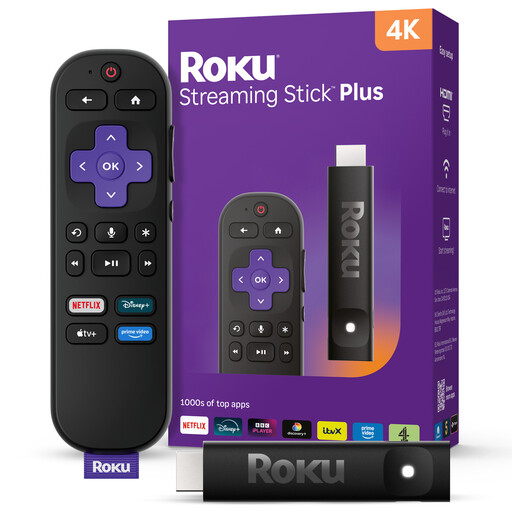
Roku’s Streaming Stick Plus is relevant when a compact device and headphone viewing matter in a shared room.
The Fire TV Stick 4K Plus is a compact route for households considering Wi-Fi 6 support.
Google TV Streamer (4K) suits consideration when a cable can reach the TV and a separate streaming box fits the room.
Apple TV 4K (3rd generation) Wi-Fi + Ethernet is relevant to households considering an Ethernet-capable box alongside Apple devices.
These Roku 4K streaming sticks are options for a compact shared-TV setup. Check the exact variant’s headphone arrangement if quiet viewing is your deciding requirement.
 No image available
Consider this stick if a compact 4K device fits your shared TV. Check the TV and programme compatibility, and confirm this variant’s private-listening method if you need headphones.
 No image available
Consider this 4KPlus stick if a stick-style device suits the room. Before choosing it for late-night viewing, confirm the exact remote and headphone requirements; also check the HDR formats and network connection you need.
TV Licensing says a TV Licence is required for live TV through streaming services and for BBC iPlayer programmes, live or on demand. If you share a flat, check whether an existing licence covers your own viewing arrangements before using those services.
No: the programme and applicable service tier must offer 4K, and the TV, streamer and connection must support it. For Netflix UHD, Netflix recommends an internet speed of at least 15 Mbps.
Some can, but the TV’s USB port must supply enough power. Roku warns that some TV USB ports cannot power its Streaming Sticks and advises using a suitable wall-powered USB adaptor in that case.
Choose an exact device model whose headphone method works with your setup. Roku’s mobile-app Headphone Mode sends audio to headphones connected to a phone or tablet on the same wireless network as the Roku device, while muting the TV speakers.