Households keeping a usable older TV
If the screen still suits you, check its HDMI input and display capabilities before choosing an external player. Roku and Google describe HDMI-connected routes for their streaming devices.


Keep the existing television if it has a usable HDMI input and its picture, sound and controls still meet your needs: a streaming stick adds app-based viewing without replacing the screen, while a box may suit a set-top arrangement or a model-specific need for Ethernet. Replace the television if the screen itself is the problem. An HDMI cable or adapter can help connect a player, but cannot supply streaming apps on its own.
If the screen still suits you, check its HDMI input and display capabilities before choosing an external player. Roku and Google describe HDMI-connected routes for their streaming devices.
For a bedroom, kitchen or guest-room screen, straightforward setup and a usable remote may matter as much as picture formats. Check accessibility functions on the exact device and the apps you intend to use; Amazon and Google document different device-level options.
If picture capability or the available network connection is the sticking point, decide whether a suitable player can meet the need before replacing the display. A 4K player cannot make an HD screen show 4K; Ethernet availability also depends on the player model.
Decide whether the television itself is worth keeping, then check the connection, essential apps and everyday controls. Treat an HDMI cable or adapter as a connection accessory for a chosen playback device, not as a source of apps.
Choose it when: A working HDMI-equipped screen meets your viewing needs and you want a player that connects at the TV.
Bear in mind: The screen still sets the limit for resolution and HDR, and the stick needs power.
Choose it when: You prefer a set-top device or need Ethernet on a model that provides it.
Bear in mind: It takes up space, and a wired connection is not a feature of every variant.
Choose it when: The existing screen has no usable HDMI route, or its picture, sound or condition no longer meets your needs.
Bear in mind: You will be choosing a new display and built-in streaming platform together.
Choose it when: The selected player and television have a confirmed connection requirement that a suitable cable or adapter meets.
Bear in mind: An accessory does not provide a streaming platform or internet connection.
| Concern | What to check | Who this matters to |
|---|---|---|
| Existing TV compatibility | Find a usable HDMI input and check the screen’s resolution and HDR capability if those formats matter. | I want to keep a working TV, so I need to know whether it can accept a player before choosing one. Around 33% of consumers put compatibility first. |
| Setup and controls | Check power, account and phone requirements, remote operation, and the accessibility features needed on the exact device. | On a secondary screen, I need setup and everyday navigation to be manageable for the people using it. Roughly 27% of consumers make this their primary concern. |
| Picture and connection | For 4K or HDR, check the display, player, content and connection; check exact-model Ethernet support if a wired connection matters. | I want a particular picture format or a wired connection, but it only helps if the rest of my setup can use it. About 20% of consumers prioritise these capabilities. |
| Screen replacement | Assess the current TV’s input, picture, sound and condition separately from its lack of built-in apps. | If the display itself no longer meets my needs, adding apps will not resolve that problem. Around 20% of consumers put the replacement decision first. |
A player can connect to an HDMI-equipped HD television, but 4K and HDR viewing need a display that supports those formats.
Check the television’s capabilities before choosing hardware for higher picture formats.
A cable or adapter can make a required connection; it does not add apps or streaming playback hardware.
Choose the playback device first, then check its connection requirements. Roku says its Streaming Stick plugs directly into HDMI, while Apple lists a separate HDMI cable requirement for Apple TV 4K.
App and service availability can differ by platform and device, and can change.
Check each essential service’s current UK availability on the exact platform and model before purchasing.
In the UK, TV Licensing says a licence is required to watch live TV through a streaming service and to use BBC iPlayer, regardless of the device.
Check the household’s licence position before using either viewing route on a new player.
Streaming-player options for an HDMI-equipped television, including sticks that plug directly into the port.
Chromecast with Google TV and Google TV Streamer options for households prepared to use Google’s setup route.
HDMI streaming sticks with voice-remote options and device-level accessibility features.
Apple TV 4K boxes for households choosing a set-top device, with Wi-Fi-only and Wi-Fi + Ethernet variants.
These Roku sticks are options for adding streaming to an existing television with a usable HDMI input. Choose between them only after checking the screen’s capabilities, the controls you need and the current UK availability of your essential apps.
 No image available
A stick option for adding app-based viewing to an HDMI-equipped TV. If voice control or private listening matters, check the listed remote functions against your needs; also confirm the TV’s picture capabilities and your essential apps.
 No image available
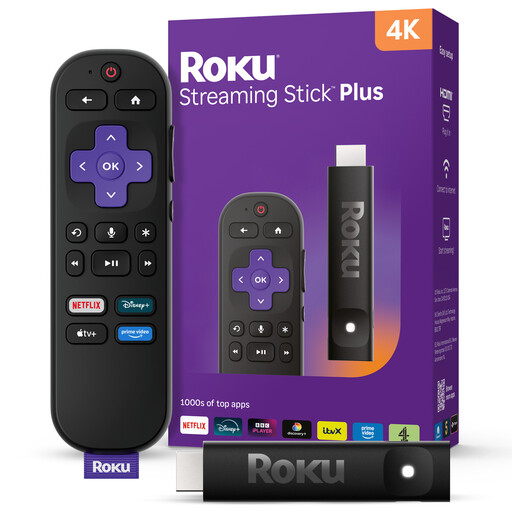
A 4K-labelled streaming-stick option for an existing HDMI-equipped TV. Check which picture formats the screen can display, and confirm the remote functions and essential UK apps before buying.
No, if it has a usable connection for a compatible external player. Roku says its streaming players work with televisions that have HDMI, and Google’s setup guidance also calls for an HDMI-equipped display; a cable alone will not add apps.
No. A 4K player does not change the television’s resolution. Google’s guidance also makes 4K viewing conditional on a compatible display, content and internet connection.
Not necessarily. Service availability can depend on the app, platform and device. Check the current UK listing for every service your household considers essential on the exact model you plan to buy.
Check the exact player’s screen reader, captions and remote options against the needs of its users, then check relevant app features separately. Amazon documents VoiceView for Fire TV, while Google documents TalkBack and other Google TV accessibility options; availability varies by device and service.
A streaming device does not change the viewing rules. TV Licensing says you need a licence to watch live TV through streaming services or to use BBC iPlayer on any device; check the household’s position before doing either.