Organisers planning portions for a group
Check the tin size and stated servings before deciding how many cans to bring, then consider the cups you will use and any other food being served.


For a hot soup service, compare tins of the same size and plan quantities around their stated servings. Choose a recipe that suits your guests, check the ingredient label on every tin, and arrange suitable hot holding before serving outdoors.
Check the tin size and stated servings before deciding how many cans to bring, then consider the cups you will use and any other food being served.
Check the ingredients on the tins you buy. A vegetarian cream-of-tomato soup can still contain milk or cream.
Plan how the soup will be heated, held hot and served; buying tins alone does not provide an outdoor serving setup.
Start with the portion plan, then check whether the recipe and serving arrangements work for the group.
| Priority | What to check | Your needs |
|---|---|---|
| Portions | Compare tin weights on the same basis. Check the stated servings and the size of the cups you will use. | I need enough soup for the expected guests, allowing for whether bread or other food will be served. |
| Ingredients | Read each current ingredient and allergen label. The cream-of-tomato products described by Sainsbury’s, Heinz and M&S include milk ingredients. | Guests need to be able to check what is in their soup; a vegetarian label does not answer a dairy-free question. |
| Hot service | Arrange equipment to heat the soup and suitable equipment to hold it hot. Food Standards Agency catering guidance specifies 63°C or above for hot holding. | For an outdoor buffet, I need a way to serve hot soup without leaving a large pan merely warm. |
The cream-of-tomato tins described in the Sainsbury’s, Heinz and M&S product information include milk ingredients. A shared pot without its packaging also makes it harder for guests to check the ingredients.
Read the labels on the tins purchased and keep that information available throughout service. If a dairy-free option is needed, check its own label rather than relying on a vegetarian designation.
Food Standards Agency catering guidance says hot-holding equipment should be preheated and used to hold food hot, not to cook or reheat it. Hot food on display should be held at 63°C or above.
Heat the soup before transferring it to suitable preheated holding equipment. The Agency’s guidance permits food to be displayed outside hot holding for up to two hours on one occasion; plan service around that limit.
Suitable hot-holding equipment may be needed for buffet service.
These references concern particular 400g cream-of-tomato tins, not every soup made by each brand.
Sainsbury’s 400g Cream of Tomato Soup is an own-label option labelled as two servings.
Heinz has standard and No Added Sugar 400g cream-of-tomato variants in the Sainsbury’s listings.
M&S describes its 400g Cream of Tomato Soup as a tomato-and-double-cream recipe suitable for vegetarians.
This 400g cream-of-mushroom tin is an option if you are considering a flavour other than the cream-of-tomato soups discussed above. Check its label and your serving arrangements against the needs of your group.
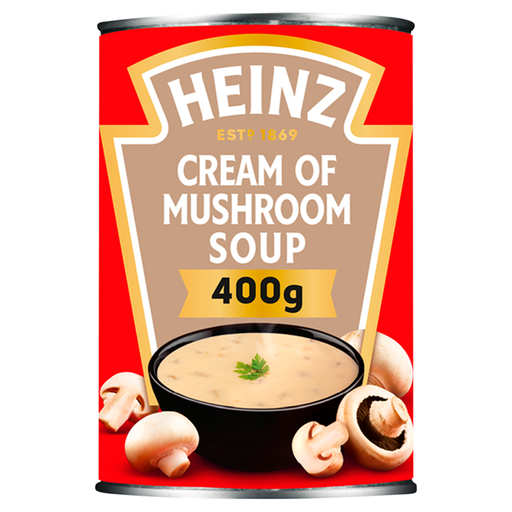 Image unavailable
For a street party serving mushroom soup, check the current tin’s serving and allergen information before planning quantities. Heating the soup and holding it hot outdoors are separate steps.
Sainsbury’s labels its 400g Cream of Tomato Soup as two servings. Use the serving count on each soup you buy as a starting point, then allow for your cup size, guest numbers and any other food being served.
Yes, if you can heat and hold it appropriately. Food Standards Agency catering guidance says hot food on display should be held at 63°C or above; hot-holding equipment should be preheated and must not be used to cook or reheat the soup.
No: the Sainsbury’s, standard Heinz, Heinz No Added Sugar and M&S products described here include milk or cream ingredients. Check the label on every tin purchased, particularly when serving guests who need to avoid milk.
Follow the storage instructions on the tin you actually use and plan how any unused soup will be handled after service. Keep the packaging available so you can check its directions rather than applying another product’s instructions.