What should you check?
Decide whether “strong” means a noticeable tea base after adding milk or a more prominent spice flavour. Then choose a pack and preparation that suit how often the second home is used.
| Priority |
What to check |
Your needs |
| Tea taste with milk |
Check for black tea and an explicit milk-use or strong-tea description. Teapigs describes its Assam chai as strong and spicy and gives a brew time of 3 minutes or more. |
I add plenty of milk and still want to taste both the tea and spices. I would try one pack in my usual mug before buying more. |
| Spice flavour |
Read the named ingredients rather than treating “extra spice” as a measure of tea strength. Twinings describes Ultra Spice as robust and bold-spiced; that does not establish how strong its tea base will taste with milk. |
A pronounced spice flavour matters to me, but I do not want to assume it means a stronger black-tea cup. |
| Caffeine |
Check whether the blend contains black tea or is labelled caffeine-free. Teapigs identifies caffeine in its black chai; Pukka identifies its Spiced Vanilla Chai as caffeine-free. |
Some visitors want chai spices in the evening without a black-tea base, while others specifically want black chai. |
| Storage between visits |
Choose a manageable pack, keep it sealed and dry, and check whether the exact product has individual envelopes. Pukka says its envelopes protect tea bags from air and moisture. |
The tea may sit in the cupboard between stays, so I would rather test a small pack than open several at once. |
| Ingredients for guests |
Read the current ingredient list and any precautionary allergen statement on the exact pack. Blends differ: Clipper lists black tea, cinnamon, orange peel, cloves and fennel seed in its Indian Chai. |
I need to know what is in the shared tea cupboard before offering a blend to guests with ingredient preferences or allergies. |
Chai brand references
These examples distinguish particular chai blends and their stated features; they do not describe every product made by each brand.
Teapigs
Its Assam black-tea chai is positioned by Teapigs for a strong, spicy cup with plenty of milk.
- The 15-tea-temple pack gives a smaller starting quantity, and Teapigs instructs drinkers to brew it for 3 minutes or more.
- The blend contains caffeine; its stated strength is a brand description, not an independent taste comparison.
Twinings
Twinings describes its Chai Ultra Spice Black Tea as robust, with a bold spicy taste.
- The Ultra Spice product comes in a 20-envelope format, with a three-minute infusion instruction from Twinings.
- A bold spice description does not establish that its tea base will taste stronger than another blend after milk is added.
Clipper
Clipper Organic Indian Chai is a 20-bag black-tea blend with named spices and disclosed proportions for some ingredients.
- Its listed ingredients include cinnamon at 17%, cloves at 8% and fennel seed at 5%.
- Those ingredient proportions do not establish how strong the tea will taste in a milk-heavy mug; try the intended preparation before stocking multiple packs.
Pukka
Pukka has distinct chai routes: Original Chai contains black tea, while Spiced Vanilla Chai is described as caffeine-free.
- Pukka describes Original Chai as suitable with or without milk and says its individually wrapped envelopes protect tea bags from air and moisture.
- A caffeine-free herbal blend does not provide a black-tea base. Check the packaging of the exact Pukka product before relying on individual wrapping for storage.
Joybuy chai option
This herbal chai is an option for visitors who want chai spices without caffeine alongside, rather than in place of, a strong black-tea chai.
 No image available
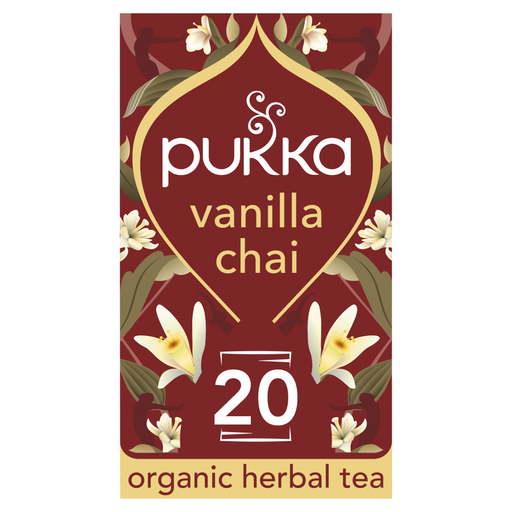
Pukka Vanilla Chai Herbal Tea, 20 sachets, 40g
A caffeine-free herbal chai for visitors who want a spiced option without black tea. The listed blend includes cinnamon, ginger, liquorice, fennel, cardamom and vanilla. Check the pack’s brewing directions and wrapping if preparation or storage between visits matters to you; do not rely on this blend alone for a tea-led chai cup.
Joybuy
Common questions
What should I look for in a chai I drink with milk?
Look for a black-tea blend explicitly positioned for milk, then try it with your usual mug size and milk quantity. Teapigs describes its Assam chai as strong and spicy and suitable for lots of milk; its brew instruction starts at 3 minutes or more.
Is chai always caffeinated?
No. Teapigs says its black-tea chai naturally contains caffeine, while Pukka describes Spiced Vanilla Chai as caffeine-free. Check the exact blend rather than assuming all products labelled chai use the same tea base.
Should a second home have both black and caffeine-free chai?
Stock both if visitors want different caffeine options. Use a black-tea chai for someone seeking a tea-led cup and a separately labelled caffeine-free herbal chai for someone who wants the spices without black tea.
How should I keep chai between visits?
Keep it sealed and dry, and start with an amount you expect to use. Pukka says its individually wrapped envelopes protect tea bags from air and moisture, but check whether the exact pack you buy has that format.
What should I check before offering chai to a guest with allergies?
Read the ingredients and any precautionary allergen statement on the current, exact pack before serving it. Recipes vary between blends; the Food Standards Agency explains that precautionary allergen labelling, such as a “may contain” statement, communicates a possible unintended presence of a regulated allergen rather than listing an intended ingredient.


