Hosts who do not know what equipment the cottage has
Instant decaf gives guests a hot-water option without relying on a cafetière, grinder or compatible pod machine.


If you cannot confirm the cottage’s coffee equipment, choose an instant decaf with an explicit bold or intense flavour description: guests can make it with hot water, while ground coffee, beans and pods need matching equipment. Treat strength as a flavour cue, not a caffeine measurement, and check the pack if a guest needs to avoid caffeine entirely.
Instant decaf gives guests a hot-water option without relying on a cafetière, grinder or compatible pod machine.
Look for a product-specific bold or intense flavour description. Nescafé’s coffee-strength guidance says strength numbers generally describe flavour intensity rather than caffeine content.
Ground coffee or whole beans become practical choices when the cottage has the appropriate brewer and, for beans, a grinder. Check the pack’s preparation guidance for the method you intend to use.
Start with the equipment guests can use, then choose the flavour description and pack size that fit the stay.
| Priority | What to check | Your needs |
|---|---|---|
| Preparation | Instant coffee needs hot water. Check for a cafetière or filter machine before choosing ground coffee; beans also need a grinder, and pods must match the machine. | I want guests to be able to make decaf even if the cottage has only a kettle. |
| Flavour | Look for a bold or intense description on the specific product. Treat an intensity number as that brand’s flavour cue, not a cross-brand caffeine scale; Nescafé’s strength guidance distinguishes flavour intensity from caffeine content. | A pronounced coffee taste matters more to me than a smooth, balanced description. |
| Caffeine expectations | Read the current pack’s decaf and caffeine information if a guest has a strict limit. Do not use a roast or strength description to estimate caffeine content. | I need to avoid suggesting that decaf means no caffeine at all. |
| Pack size | Consider the number of coffee drinkers, length of stay and pack size together. Nescafé lists Original Decaf in 100g, 190g and 300g jars; serving measures can vary. | For a shared stay, I would rather choose a usable format and suitable pack size than assume a fixed number of cups per jar. |
A bold-tasting decaf is not necessarily higher in caffeine. Nescafé’s strength guidance relates the scale primarily to flavour intensity.
Choose bold or intense wording for flavour; check the pack separately when caffeine content matters to a guest.
Pods require a compatible system, so guests may be unable to use capsules that do not fit the cottage’s machine.
Confirm the machine and capsule system before buying pods, and keep an instant option if that setup is uncertain.
Incompatible capsules may go unused during the stay.
Whole beans need grinding and a suitable brewing method; ground coffee also needs preparation equipment that suits the pack guidance.
Check the cottage inventory before choosing either format. If a grinder or brewer is absent, guests would need access to that equipment to prepare the coffee.
These descriptions concern the cited decaf products and ranges, not every coffee sold under each brand.
Nescafé describes Original Decaf instant coffee as bold and intense and lists 100g, 190g and 300g jars.
Kenco describes its Decaf instant range as balanced and rounded, with an intensity rating of 7.
The Taylors Decaffe ground coffee described by Joybuy is a roast-level-4, 100% Arabica option with a smooth, balanced profile.
Tesco lists own-label decaf instant and ground coffee, including Decaffeinated Classic Coffee 200g and Finest Decaffeinated Colombian Ground Coffee 227g.
Sainsbury's lists a 227g Taste the Difference Colombian Decaff whole-bean coffee with filter-machine and cafetière preparation guidance.
M&S describes Gold Decaf Instant Coffee as freeze-dried with a medium-roast flavour.
These instant coffees suit a cottage where guests have hot water but the brewing equipment is uncertain. Their flavour descriptions differ; the list does not compare brewed-coffee or pod options.
 No image available
This soluble decaf is an option for guests making coffee with hot water. The pack is 300g; Nescafé describes its Original Decaf range as bold and intense, which is a manufacturer flavour claim rather than an independent taste finding.
 No image available
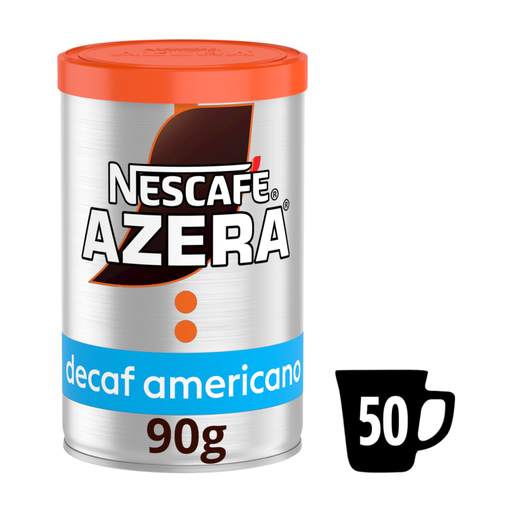
This instant decaf Americano can be prepared with hot water when no brewer is available. It comes in a 90g pack; its full-bodied description is a product flavour claim, not an independent comparison with other decafs.
 No image available
This 100g instant decaf can be made with hot water for cottage self-service. Kenco describes its Decaf range as balanced and rounded with an intensity rating of 7; check the current 100g pack before relying on that range description for this size.
No. Nescafé’s coffee-strength guidance says strength numbers generally describe flavour intensity rather than caffeine content. Use bold or intense wording to choose a taste, not to estimate caffeine intake.
Instant decaf is the straightforward hot-water option. Choose ground coffee, beans or pods only after confirming the appropriate brewer, grinder or compatible capsule system.
Yes, if the ground coffee is suitable for a cafetière and the cottage has one. Follow that coffee’s pack instructions rather than assuming the same measure and brewing time suit every product.
No: do not assume decaf contains no caffeine. If a guest has a strict caffeine limit, check the current product pack and follow their individual clinical advice rather than using a strong-flavour description as a guide.
Consider the number of coffee-drinking guests, the length of their stay and whether they can prepare the format you choose. Nescafé lists Original Decaf jars of 100g, 190g and 300g, but serving measures vary, so pack weight alone does not establish a fixed number of mugs.