Stalls serving decaf tea with milk
If milk is part of the usual order, test the tea in the actual cup and settle on a repeatable brewing time before service. Twinings and Clipper provide brewing guidance for their respective decaf blends.


For a strong-tasting decaf black tea, shortlist blends whose makers describe them as robust or full and rich, then test them with the cup size and milk quantity you will use at the stall. Twinings says four minutes gives its English Breakfast Decaffeinated tea more punch; Clipper gives a two-to-four-minute range for its Organic Everyday Decaf and offers a 250-bag catering pack. Those descriptions are not a like-for-like strength comparison, so choose the pack size and serving routine alongside the flavour.
If milk is part of the usual order, test the tea in the actual cup and settle on a repeatable brewing time before service. Twinings and Clipper provide brewing guidance for their respective decaf blends.
A known bag count makes it easier to plan portions. Tesco lists 160-bag decaf packs, while Clipper describes its 250-bag Organic Everyday Decaf as a catering format.
Choose a product clearly labelled decaffeinated rather than assuming that every alternative to regular tea is decaf. If residual caffeine matters to a customer, check the exact pack and manufacturer information rather than describing decaf as caffeine-free.
Start with a brew you can serve consistently, then work out how many tea bags the event calls for. Test flavour using the milk and cup size you expect to use.
| Priority | What to check | Your needs |
|---|---|---|
| Flavour with milk | Check the maker’s blend description and brewing instructions. Twinings describes its English Breakfast Decaffeinated as robust and suggests four minutes for more punch; Clipper describes Organic Everyday Decaf as full and rich and specifies two to four minutes. | I want a decaf black tea whose flavour works with the milk and cup size used at my stall, so I will try that serving combination before choosing one. |
| Bag count | Estimate cups for the event and compare that number with the stated bag count. Tesco lists 160-bag Yorkshire Tea, PG Tips and Tetley decaf packs; Clipper offers a 250-bag catering pack. | I would rather plan portions from a stated bag count than discover during service that the pack will not cover the expected orders. |
| Decaf labelling | Check that the exact product is labelled decaffeinated black tea. If a precise residual-caffeine figure matters, consult the current pack or manufacturer information; do not equate decaf with caffeine-free. | Some customers will ask specifically for decaf black tea, and I need to describe what I serve without promising zero caffeine. |
Yorkshire Tea, Twinings and Clipper use different flavour descriptions; those descriptions are not a like-for-like taste test, particularly once milk is added.
Brew shortlist teas in the intended cups, using the planned water, brewing time and milk quantity. Describe the drink according to what you can substantiate about the product and your serving method.
The Food Standards Agency says a new food business must register with its local authority at least 28 days before trading. Whether a particular occasional stall is a food business depends on its activity and circumstances; GOV.UK guidance on community and charity events also notes that supplying or handling food can bring an activity within food-business rules.
Describe your planned set-up and frequency to the relevant local authority, and check event requirements with the organiser. If food-business allergen rules apply, prepare information about ingredients offered with the tea, including milk.
Decaffeinated labelling alone does not establish a zero-caffeine claim. A precise figure matters especially when a customer asks about residual caffeine.
Use the product’s decaf description and check its current packaging or manufacturer information before making a more specific caffeine statement.
These references concern the named decaf products and pack formats, not every tea made by each brand.
Yorkshire Tea describes its decaf blend as flavour-packed, while Tesco lists a 160-bag, 500 g pack.
Tesco lists Tetley decaf tea in a 160-bag, 500 g format.
Tesco lists PG Tips Decaf Black Tea in a 160-bag, 464 g pack.
Twinings describes its English Breakfast Decaffeinated blend as robust and says a four-minute brew gives it more punch. The referenced product is a 20-envelope pack.
Clipper describes Organic Everyday Decaf as a full, rich blend containing Assam tea and presents its 250-bag product as a catering pack.
These decaf tea packs offer different stated quantities for a car boot sale stall. Compare their pack sizes with expected orders, and trial the brew you intend to serve with milk.
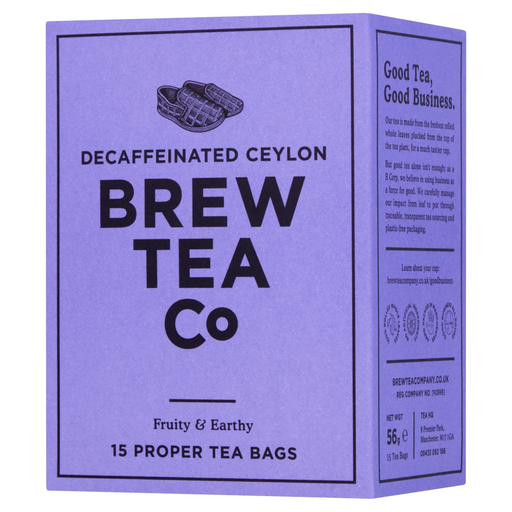 No image available
The stated 15-bag count makes this a pack to consider for a small service or a brew trial. Check the pack’s brewing instructions and try it with the cup size and milk quantity planned for the stall.
 No image available
With 80 bags stated on the pack, this option lets you compare expected cups with a known quantity. Trial the tea with your intended milk quantity before deciding whether its flavour suits service.
 No image available
This 250 g decaf pack is another tea to trial in the stall’s usual cups with milk. Check its bag count before estimating how many portions the pack will provide.
Try a decaf black tea whose maker describes it as robust or full and rich, then test it with your planned cup size and milk quantity. Twinings suggests four minutes for more punch from its English Breakfast Decaffeinated tea; Clipper specifies two to four minutes for Organic Everyday Decaf. Neither description establishes that one tea is stronger than the other.
No: a decaffeinated label alone does not establish that a product contains zero caffeine. If a customer needs a precise residual-caffeine figure, check the current packaging or manufacturer information for the exact tea being served.
If your activity is a food business, the Food Standards Agency says you must register with your local authority at least 28 days before trading. Ask the relevant local authority how your planned frequency and set-up are treated, and check the organiser’s requirements; do not assume a temporary stall is automatically exempt.
If your stall is a food business serving non-prepacked drinks, prepare information about any mandated allergens present, including milk when it is added. GOV.UK guidance on food at community and charity events says food businesses must provide allergen information for non-prepacked food. Keep ingredient packaging available so you can check what you serve.
Choose by the number of cups you expect to serve and how you will store and portion the tea. A small pack can be used for a pre-event brew trial; for larger demand, Clipper describes its 250-bag Organic Everyday Decaf as a catering pack, while Tesco lists several 160-bag decaf options.