Shops preparing drinks for customers
Choose ground coffee for the counter’s espresso, moka, filter or cafetière method before assessing whether its flavour suits customers who ask for a bold cup.


Start with ground coffee intended for the shop’s brewing equipment, then use its roast or intensity description to shortlist a bold-tasting cup. Lavazza, for example, lists Espresso Barista Intenso at 9/10 intensity for espresso and moka; that label describes sensory character, not caffeine content, so trial-brew any choice with the shop’s usual recipe and consider a gentler or decaffeinated alternative.
Choose ground coffee for the counter’s espresso, moka, filter or cafetière method before assessing whether its flavour suits customers who ask for a bold cup.
A strong-tasting main coffee need not be the only choice. A gentler or decaffeinated option gives customers another flavour or caffeine choice without treating an intensity label as a caffeine measurement.
Individually portioned filters can simplify one-cup service. Tesco lists Rombouts Original One Cup Filters as medium roast and intensity 3/5, so their format serves a different priority from an explicitly bold coffee.
Match the brewing method first, then compare flavour descriptions and trial-brew promising coffees with the recipe used at the counter.
| Priority | What to check | Your needs |
|---|---|---|
| Bold flavour | Check the roast description and the maker’s intensity label. Lavazza describes intensity as a measure of sensory character, not caffeine; scales from different brands are not interchangeable. | I want a fuller-tasting cup, but I need to know how it tastes when brewed to our usual recipe. |
| Brewing method | Check that the pack names the counter’s equipment. Lavazza specifies espresso and moka for Espresso Barista Intenso; do not assume the same grounds suit a filter machine or cafetière. | Our coffee needs to work with the equipment staff use throughout service. |
| Choice of drinks | Compare the main coffee’s description with any gentler or decaffeinated option. Check each product’s brewing instructions rather than assuming a different flavour or caffeine choice uses the same preparation. | Some customers may want a bold cup; others would rather choose something gentler or decaffeinated. |
| Made-to-order drinks | Check allergen information for the finished drink, including additions such as milk, syrups and toppings. GOV.UK says retail and catering food businesses must provide allergen information for non-prepacked food and drink. | If we make drinks to order, I need staff to give accurate information about what goes into each one. |
Lavazza describes intensity in terms of a coffee’s sensory character. Its 9/10 label does not establish how customers will perceive an illy coffee labelled 7/9.
Use each label to make a shortlist, then taste the coffees using the shop’s equipment and usual recipe before settling on a regular offering.
Lavazza says its ground coffees are prepared for particular brewing methods; Espresso Barista Intenso is described for espresso and moka.
Identify whether the counter uses espresso, moka, filter, cafetière or a one-cup filter, and check the product’s stated preparation before buying.
A made-to-order drink may also contain milk, syrup or toppings. GOV.UK’s food-business guidance requires allergen information for non-prepacked food and drink.
Keep information for each finished drink up to date and make sure staff can use it when answering customer questions.
An intensity label describes flavour, not a standard caffeine amount. The European Food Safety Authority says its general caffeine assessment does not cover people affected by a medical condition or interactions with medicines.
Describe taste and decaffeinated choices accurately; refer individual medical questions to a healthcare professional rather than drawing conclusions from an intensity score.
Lavazza UK lists intensity-labelled ground coffees, including Espresso Barista Intenso at 9/10 for espresso and moka.
illy UK describes its 250 g Ground Espresso INTENSO as a bold roast, labelled 7 of 9 for intensity and intended for Italian espresso.
Tesco lists Rombouts Original One Cup Filters as a medium-roast, intensity-3/5 option prepared over a cup with hot water.
Sainsbury’s lists Taylors of Harrogate Rich Italian Roast Ground Coffee in a 200 g pack.
Tesco lists Finest ground coffees including Colombian Supremo and Sumatra Mandheling.
Sainsbury’s lists Fairtrade Italian Espresso Coffee at strength 5 in a 227 g pack, alongside other ground-coffee options.
These ground coffees offer pack sizes and flavour options to consider for the shop’s counter. Check the brewing directions on each pack and trial-brew a candidate before making it the regular bold-tasting coffee.
 No image available
For a counter considering a darker-tasting coffee, this is a 200 g ground-coffee pack. Check its brewing directions against the shop’s equipment and trial-brew it before choosing it as the regular cup.
 No image available
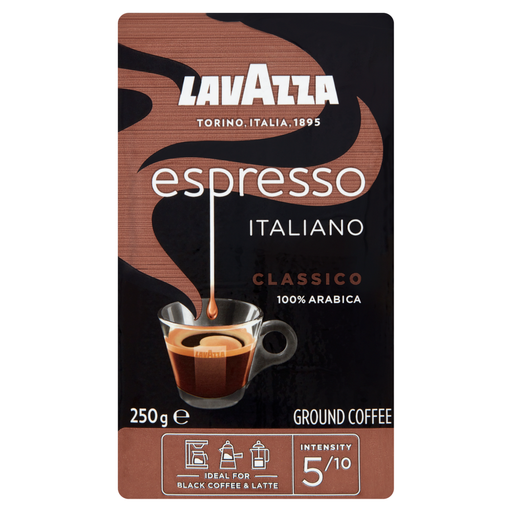
This 250 g ground coffee is an option to assess when choosing the counter’s usual cup. Confirm the pack’s brewing methods and taste it with the shop’s recipe rather than assuming it will meet an extra-bold preference.
 No image available
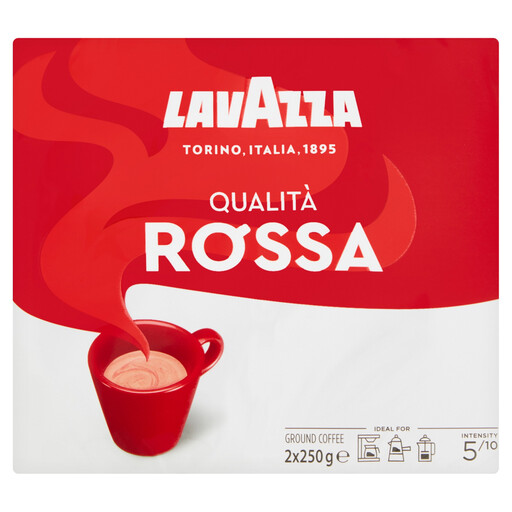
This 500 g ground-coffee pack may suit a shop assessing a larger pack for routine service. Check the stated brewing methods and trial-brew it: the flavour sought for a bold cup depends on how the shop prepares it.
An intensity label does not tell you the caffeine content. Lavazza uses intensity to describe a coffee’s sensory character, so compare caffeine information separately rather than interpreting a bold-flavour label as a caffeine measure.
Lavazza identifies Espresso Barista Intenso Ground Coffee as intended for espresso and moka. If the shop uses a filter machine or cafetière, check the product’s preparation instructions instead of assuming it suits that equipment.
A gentler or decaffeinated option gives customers another choice if the shop can accommodate it. Describe each option by its actual flavour and product information; a strong-taste label alone does not indicate its caffeine content or individual suitability.
The information must cover the finished drink, not just the ground coffee. GOV.UK says retail and catering businesses must provide allergen information for non-prepacked food and drink; account for ingredients such as milk, syrups and toppings when maintaining information staff give customers.