For reviewing restored archive audio beside colleagues, start with wired, closed-back studio headphones if room noise and sound spill are concerns. An open-back model makes more sense at a quiet, private listening position where a wider stereo perspective matters more than isolation; whichever design you choose, check its connection and listen with familiar material before using it for restoration decisions.
Who these choices suit
Shared-desk restoration reviewers
If you inspect edits and tonal balance near other people, a closed design is the more relevant starting point for managing room noise and potential playback spill. Sony, beyerdynamic, Audio-Technica and Shure each describe isolation-focused monitoring models, though fit and isolation will depend on the particular headphones.
Long-session archive listeners
If review sessions run for extended periods, consider how the earcups fit, where the cable runs and whether worn parts can be replaced. The manufacturers describe different cable arrangements across their models, so check the exact package rather than assuming all studio headphones are supplied alike.
Private-room spatial reviewers
If you can listen somewhere quiet without disturbing others, an open-back model may suit work focused on stereo or spatial placement. Sony positions the MDR-MV1 for spatial and stereo mixing, while beyerdynamic describes a wider stereo image for its open DT 900 PRO X.
What matters when choosing
Closed-back studio headphones
Choose when: colleagues share the area and isolation matters during review.
Trade-off: beyerdynamic describes its closed DT 700 PRO X as having a tighter, more focused image than its open DT 900 PRO X.
Open-back studio headphones
Choose when: the listening position is quiet and private, and judging stereo or spatial placement takes priority.
Trade-off: an open design is a less direct fit when you need the isolation that beyerdynamic attributes to its closed model.
| Concern |
What to check |
Who this matters to |
| Shared-space isolation |
Check whether the exact model is closed-back and how its earcups fit; an over-ear description alone does not establish its monitoring design. |
If colleagues are nearby, I want room noise to distract me less and playback to spill as little as practical. Around 36% of consumers put shared-space isolation first. |
| Restoration detail |
Compare familiar archive material through your usual audio chain; a published response range or a balanced-sound claim alone cannot establish restoration accuracy. |
When judging edits, ambience and stereo placement, I need to recognise changes without relying solely on an unfamiliar sound signature. Roughly 29% of consumers prioritise restoration detail. |
| Fit and upkeep |
Assess earcup fit for longer sessions, then check supplied cable lengths and the availability of replacement wear parts. |
Repeated listening makes comfort and practical cabling important to me, even if another model has more appealing specifications. About 21% of consumers make fit and upkeep their primary concern. |
| Connection to the review setup |
Identify your device’s headphone output and confirm the plug, any supplied adapter and the required cable reach. |
I need a secure connection to my existing recorder, interface or computer without a lead pulling across a neighbouring workspace. Around 14% of consumers put connection compatibility first. |
Buying pitfalls
-
Choosing open-back headphones before checking the room
An expansive presentation is not the same thing as isolation. Beyerdynamic contrasts the isolation of its closed DT 700 PRO X with the wider image of its open DT 900 PRO X, a distinction that matters when other people share the space.
Choose an open design for this task only after considering both nearby colleagues and the noise around your listening position.
-
Using a wide frequency range as proof of accuracy
A published specification or manufacturer sound description does not, by itself, show how a particular headphone will present clicks, hiss or tonal changes in your review setup.
Use those descriptions to narrow the choice, then listen to familiar reference material through the equipment you normally use for restoration decisions.
-
Overlooking the cable and plug
The studio models described by Sony, beyerdynamic, Audio-Technica and Shure differ in supplied leads, adapters and cable arrangements. A suitable acoustic design can still be awkward to use if its lead does not reach your interface safely.
Check your device’s output, the cable route and the contents of the exact package before ordering.
A different adapter or cable may be needed if the supplied connection or length does not suit the setup.
Brands to consider for this task
Sony
Sony’s MDR-M1 and MDR-MV1 illustrate different choices for the same review task: a closed monitor model for isolation-led work and an open model positioned for spatial and stereo work.
- Sony describes the MDR-M1 as having effective isolation, two detachable cable lengths and replaceable earpads.
- The open-back MDR-MV1 is better considered for a quiet, private position than as the default at a shared desk.
beyerdynamic
The PRO X range presents a closed-versus-open choice: DT 700 PRO X for isolation-focused monitoring and DT 900 PRO X for an open stereo presentation.
- beyerdynamic lists the wired DT 700 PRO X at 48 ohms with detachable 1.8 m and 3 m cables.
- Its account of the closed model’s tighter image and the open model’s wider image is a manufacturer comparison, not an independent listening test.
Audio-Technica
The ATH-M50x is a closed, circumaural monitoring option to consider when isolation and a choice of cable lengths matter at the desk.
- Audio-Technica describes passive isolation and three detachable cables, including 1.2 m and 3 m straight cables.
- If restrained tonal presentation is important for restoration work, audition familiar material rather than treating the brand’s bass description as a neutrality measurement.
Shure
Shure positions the closed-back SRH840A for critical listening and monitoring where reducing background noise is useful.
- Shure describes a circumaural fit, a detachable locking cable, two supplied cables and a 6.3 mm adapter.
- Check that its cable arrangement and fit suit your particular interface and listening sessions.
Joybuy products for desk listening
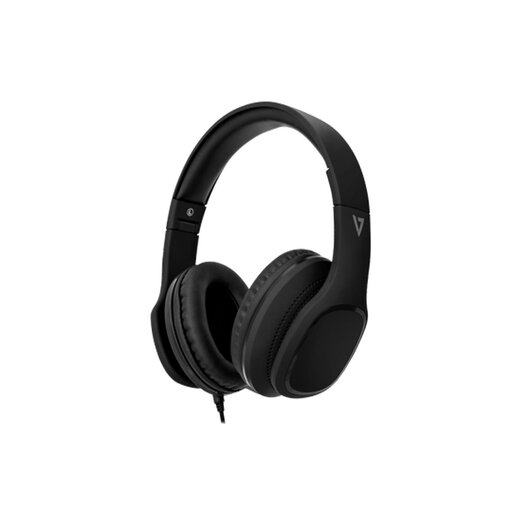
This wired over-ear option has connection and isolation features relevant to desk listening. For restoration decisions, assess its sound with familiar material rather than assuming it has the response of a studio monitor.
 No image available
V7 HA701-3EP Wired Over-Ear Headphones with Inline MEMS Mic
Consider these for wired desk listening where the listed passive isolation is relevant; compare familiar recordings before relying on them for restoration sign-off.
The product information specifies 40 mm drivers, a detachable 1.8 m cable with a 3.5 mm connection and 32 Ω nominal impedance. Check that the plug and cable reach suit your review device and desk layout.
View on Joybuy
Common questions
Can I use open-back headphones at a shared desk?
Use them if the position is sufficiently quiet and their sound will not disturb nearby people; otherwise, closed-back headphones are the more relevant starting point for isolation. Beyerdynamic describes isolation for its closed DT 700 PRO X and a wider stereo image for its open DT 900 PRO X, but that comparison does not measure sound leakage for every model.
Do I need a 3.5 mm or 6.3 mm connection?
Match the plug to the actual output on your recorder, audio interface or computer before buying. Sony, beyerdynamic, Audio-Technica and Shure describe adapters or cable options for the models discussed here, but check what comes with the exact version you order and whether the cable reaches your listening position.
What should I do if headphones bought from a UK retailer are faulty?
Contact the selling trader, explain the fault and keep your order details. The Consumer Rights Act 2015 concerns UK consumer goods; a fault claim is distinct from a change-of-mind return, and the appropriate remedy depends on the circumstances.
How should I dispose of unwanted wired headphones?
Check your local authority’s or retailer’s electrical-recycling arrangements for the collection method available to you. The UK Waste Electrical and Electronic Equipment Regulations 2013 address marking electrical equipment with the crossed-out wheeled-bin symbol; check the product marking and local disposal instructions rather than assuming ordinary household waste is appropriate.


