Table-based study groups
If several people discuss material around one laptop, look for stated pickup coverage that fits their seats. Full-duplex operation is also worth checking when participants need to speak without taking turns.


Choose a study-group speakerphone by the number of people sharing it, their seating spread, the room and the device they use to join calls. A compact model can suit up to four people sitting close together, while a regular table group should check stated pickup coverage and full-duplex operation. Even with noise-handling features, room layout and placement still matter.
If several people discuss material around one laptop, look for stated pickup coverage that fits their seats. Full-duplex operation is also worth checking when participants need to speak without taking turns.
If sessions move between home and study spaces, consider the usual group size alongside the device’s carrying arrangements, power needs and connection options.
If calls take place near other conversations or in reflective rooms, consider microphone placement and the room itself as well as the speakerphone’s stated noise-handling features. Shure notes that room materials, size and layout can affect call quality.
Choose when: One person usually joins, or up to four people sit close together and take the device between locations; Yealink positions its CP700 for meetings of up to four.
Trade-off: That four-person positioning does not establish suitability for a larger group spread around a room.
Choose when: Several people regularly speak around one table; for example, Jabra specifies a pickup range of up to 2.5 m for the Speak2 75.
Trade-off: A stated range still needs to fit the seating layout, and reflective or noisy rooms can affect the call.
| Concern | What to check | Who this matters to |
|---|---|---|
| Hearing everyone at the table | Compare the exact model’s stated pickup range or group capacity with your seating spread; check whether full duplex is specified. | When several of us share one device, quieter contributors need to be heard without moving towards it. Around 31% of consumers would put group coverage first. |
| Room noise and echo | Check the stated microphone and noise-handling features, then try the device in the room you plan to use. | A shared or reflective room can make our discussion difficult for remote members to follow. Keeping speech intelligible would be the main concern for around 25% of consumers. |
| Connecting to the call | Confirm the laptop port and the exact model’s connection options; select and test it as both microphone and speaker in the meeting app. | If one person hosts each session, we need the group’s audio to use the intended device rather than the laptop’s built-in microphone. Around 25% of consumers would prioritise a dependable setup. |
| Moving between study spaces | Check the usual group size against the model’s stated capacity, along with its carrying and power arrangements. | For occasional sessions in different places, I want something practical to carry without choosing capacity the group rarely needs. Portability would come first for around 19% of consumers. |
A microphone count does not tell you how far apart participants can sit or whether conversation can flow both ways.
Compare the exact model’s stated pickup area and full-duplex specification, then try it with the group in its usual seating arrangement.
A laptop or meeting app may continue using its built-in microphone or speakers after an external device is connected.
Select the speakerphone for both input and output in Zoom or Microsoft Teams, then use the app’s audio test before the session.
Yealink positions the CP700 for meetings of up to four people; that is a different use case from a larger group seated farther apart.
Base the choice on the number and spread of people normally present, not an occasional one-person call.
Shure notes that room materials, size and layout can affect call quality, regardless of the speakerphone chosen.
Use a quieter space where possible, place the unit among the participants and test the complete setup before an important discussion.
Jabra’s Speak2 75 is a portable model with published specifications relevant to a group seated around a table.
The PowerConf range includes portable models aimed at personal and group calls.
HP positions Poly Sync models for settings ranging from personal workspaces to small and medium conference rooms.
EPOS positions the EXPAND 40 as a portable speakerphone for group meetings.
Yealink positions the CP700 for portable use and meetings of up to four people.
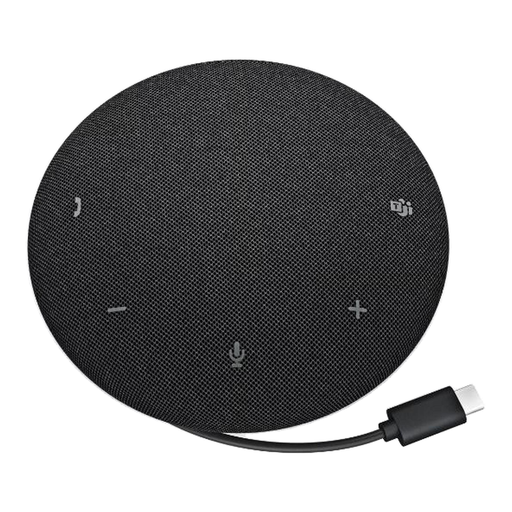
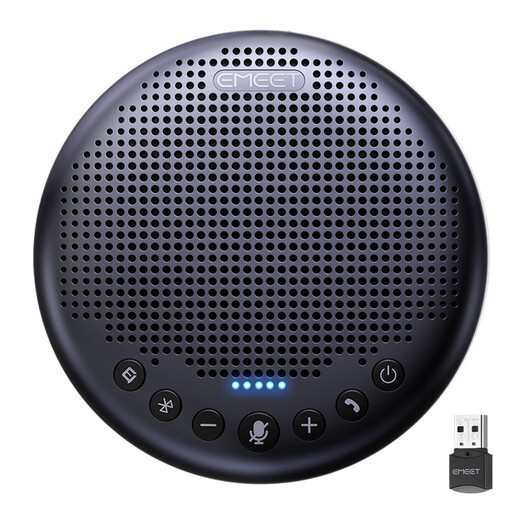
These two speakerphones offer different ways to join a shared study-group call: a wired model for a laptop-centred setup and a Bluetooth model with stated all-round voice pickup. Check each device against your group’s seating and connection needs.
 No image available
Consider this wired model if the group normally joins from one laptop. Check that the laptop has a suitable connection and can sit within cable reach; if participants often speak at once, confirm whether the model supports full duplex.
 No image available
For participants seated around a device, the product title specifies eight microphones and 360° voice pickup, as well as a 5 W speaker. Check the coverage of one unit for your group and confirm the connection and switching options you need.
Use Zoom’s speaker-and-microphone test before joining the call. Select the speakerphone separately for output and input if necessary, then check that you can hear the test and that the intended microphone is working.
Choose the speakerphone as both Speaker and Microphone in Teams’ device settings. Microsoft Support also describes a test-call option, which you can use before the study group joins.
Not necessarily: Shure notes that room size, layout and materials can affect call quality. Keep participants within the model’s stated pickup area and try the setup in the actual room.
Use an electrical-recycling or retailer take-back route where available rather than treating the device as ordinary rubbish. GOV.UK describes the UK’s waste electrical and electronic equipment rules as supporting recovery, reuse and recycling.