
24/7 Customer Support

Free returns

Same-day & Next-day Delivery

Quality Guaranteed

Unlock Your Welcome Offers: FREE Delivery | Up to 80% OFF | Free 30-day JoyPlus trial
Download the APP
Buying a stunt scooter for a child, teenager or adult can seem straightforward, but appearance-led marketing often hides the details that affect control, durability and value. A freestyle scooter needs to handle repeated impacts, while a model intended mainly for commuting may not be suitable for bar spins, tailwhips or ramps.
Before choosing a trick scooter, watch for three common pitfalls:
For freestyle use, look for a non-slip aluminium deck, a robust fork and a handlebar-and-clamp system designed for repeated movement. T-6061 aluminium is commonly used in stunt scooter decks because it offers a practical balance between low weight and structural strength. Steel components can add rigidity, although they may increase the scooter’s overall weight.
A one-piece fork reduces the number of moving joints around the front wheel. A double or triple clamp helps secure the handlebar, which is important when practising spins and landings. These features do not remove the need for inspections, but they can provide a more suitable platform for a beginner stunt scooter or intermediate rider.
110mm scooter wheels are a common choice for skate-park riding. They offer a useful balance between responsiveness and rolling speed, while smaller 100mm wheels can feel manageable for some younger beginners. Solid polyurethane wheels are puncture-resistant and require less upkeep than inflatable tyres.
Bearing grades such as ABEC-7 and ABEC-9 describe manufacturing tolerances, not a complete measure of ride quality. ABEC-9 bearings appear on several VOKUL models in this selection, while the Stunted scooters use ABEC-7 bearings. Keep bearings dry, remove dirt from around the wheels and avoid pressure washing, which can force moisture into the components.
A scooter for ages 8+ should match the rider’s height, confidence and intended location. Younger riders may benefit from a lighter scooter with a lower handlebar, while a scooter for teens or adults needs sufficient height and a suitable weight capacity.
Always check the product listing rather than relying on a generic “pro scooter” label. The products below list weight limits of up to 100kg or 220lb, but the riding experience will still depend on the rider’s body size and technique. Helmets, knee pads, elbow pads and wrist guards are sensible protective equipment. Ride on smooth, dry surfaces away from traffic, stairs and steep drops, and inspect the scooter before every session.
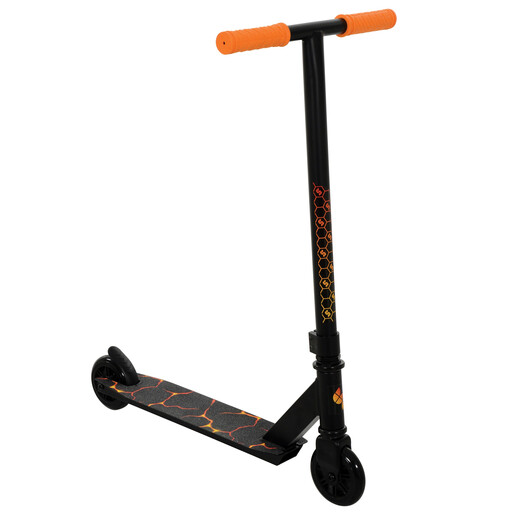
Why This Fits Their Persona: A straightforward option for an 8+ rider beginning basic tricks at a local UK skate park or on smooth streets.
Its single-piece handlebar and stem avoid the loose, multi-joint feel found on some general-purpose scooters. The solid 100mm PU wheels also avoid puncture maintenance.
It has ABEC-7 bearings, 100mm 85A PU cast wheels, a double clamp and a stated 100kg maximum user weight.
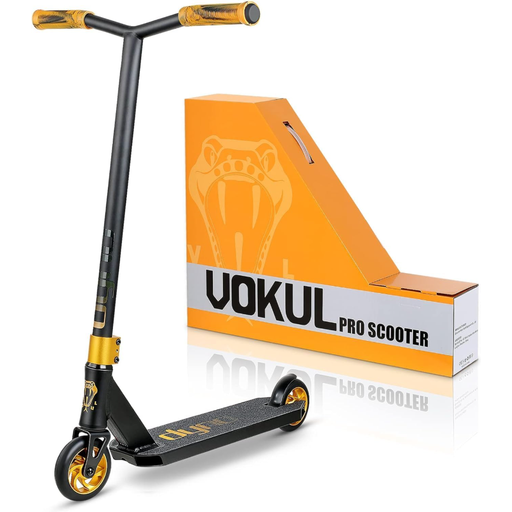
Why This Fits Their Persona: Suitable for older children, teens and adults wanting a feature-focused pro scooter for regular freestyle practice.
The specification lists a T-6061 aluminium deck, one-piece T4T6 fork and non-slip deck, rather than relying only on appearance-led claims.
It combines 110mm solid 88A polyurethane wheels, ABEC-9 bearings, soft 145mm grips and a stated 220lb weight limit.
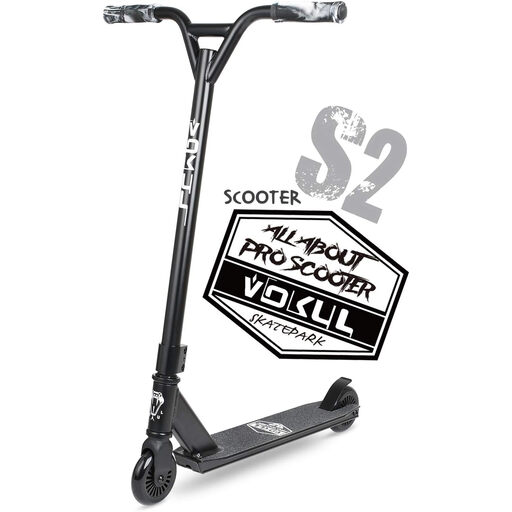
Why This Fits Their Persona: A practical match for younger riders aged 7–14 who want a lighter entry-level scooter for learning tricks and skate-park skills.
Its stated 8lb weight and fixed batwing handlebar provide a predictable setup, avoiding the unnecessary accessories and inflated tyres of a transport-focused scooter.
It uses a 6061 aluminium alloy frame, reinforced forged deck, 4130 chromoly steel handlebar, triple clamp and rear brake.
We have compiled a complete, real-time list of products that fully satisfy these strict selection criteria and UK safety regulations.
Most of the featured VOKUL models arrive mostly assembled, with the handlebar secured by tightening a three-bolt clamp. Before the first ride:
Avoid high-pressure water jets. They can damage bearings and wash dirt deeper into moving parts. For regular skate-park use, inspect the scooter more frequently than a model used occasionally on a quiet path.
It can be, provided the product is specifically rated for the child’s age, height and weight. An 8-year-old should begin on smooth, dry ground with adult supervision and protective equipment before attempting ramps or spins.
No. ABEC-9 bearings are a listed feature on several models, but they are not the only factor affecting smoothness. Wheel material, alignment, cleanliness and correct maintenance also influence how a scooter rolls.
There is no fixed lifespan. Occasional recreational use may place less stress on the components than frequent landings and grinding. Regularly tightening bolts, checking the fork and deck, keeping bearings dry and replacing worn wheels or grips can help maintain safe operation. Always stop using a scooter if structural damage or excessive looseness appears.