
24/7 Customer Support

Free returns

Same-day & Next-day Delivery

Quality Guaranteed

Unlock Your Welcome Offers: FREE Delivery | Up to 80% OFF | Free 30-day JoyPlus trial
Download the APP
A stunt scooter for kids needs to cope with repeated impacts, quick direction changes and learning falls—not just short trips around the park. Many scooters look suitable in online photographs but are designed for casual riding rather than freestyle use.
Before choosing a freestyle stunt scooter or trick scooter for kids, watch for three common buying traps:
For a scooter for performing tricks, the deck should be rigid and free from unnecessary folding joints. 6061 aluminium alloy is commonly used for lightweight decks, while steel components can provide additional rigidity at the handlebar or stem.
Look for a one-piece fork and a secure clamp. These parts experience considerable stress during barspins, tailwhips and landings. A triple or double clamp can help secure the handlebar, but it should still be checked regularly for movement.
A non-slip deck is also practical for beginners, as it helps maintain foot placement when learning basic tricks. However, no construction feature removes the need for suitable protective equipment or supervision.
A lightweight freestyle scooter can be easier for a younger rider to lift and control during early tricks. The products listed here range from approximately 7 lb to 9.6 lb, so comparing weight is worthwhile.
Do not rely on age guidance alone. Check:
A pro scooter for beginners may be suitable for a child learning foundational movements, while an intermediate stunt scooter may offer a more substantial setup for regular skate-park use. A scooter for teens should be selected by dimensions and load rating rather than appearance.
Solid polyurethane wheels are practical for stunt riding because they do not require inflation. Wheel sizes around 100–110 mm are common on entry-level and intermediate models. Smaller wheels may feel responsive for tricks, while 110 mm wheels can offer a smooth balance between stability and manoeuvrability.
Bearing ratings such as ABEC-7 and ABEC-9 describe manufacturing tolerances, but they should not be treated as a complete measure of ride quality. Wheel material, alignment, surface condition and maintenance also affect how smoothly a scooter rolls.
A rear foot brake should be easy to operate without dragging constantly on the wheel. After repeated use, the brake may become warm, so allow it to cool before touching it.
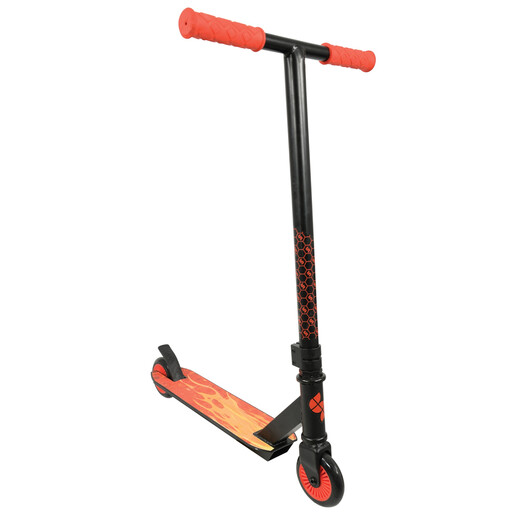
Why This Fits Their Persona: A practical starting point for children aged 8 and over who want to try skate-park riding without immediately moving to a more specialised setup. Its matte finish and glow-in-the-dark details add visual appeal without replacing the core riding features.
The single-piece handlebar and stem avoid a folding joint, while the pro-grade double clamp provides a secure connection for basic tricks.
100 mm 85A PU cast wheels, ABEC-7 bearings, 360° handlebar rotation and a rear footbrake; maximum user weight is 100 kg.
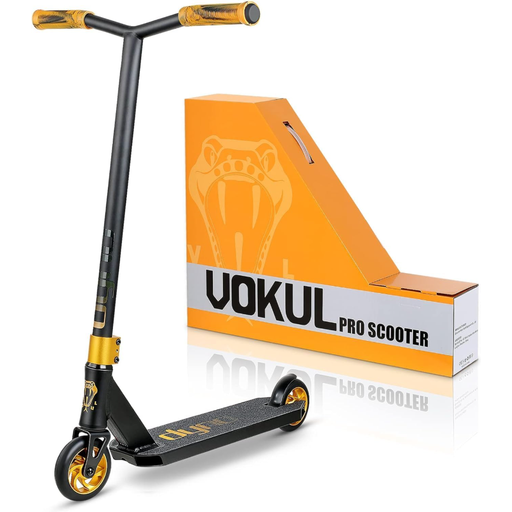
Why This Fits Their Persona: Suitable for an 8+ rider progressing from basic skills towards more regular freestyle sessions in a skate park or other approved smooth, dry area.
Its T-6061 aluminium deck, one-piece T4T6 fork and non-slip deck provide clearly stated construction details rather than relying only on appearance or marketing language.
110 mm solid polyurethane wheels, ABEC-9 bearings, adjustable T-bar and soft rubber grips; listed weight is approximately 4.26 kg with a 220 lb load limit.
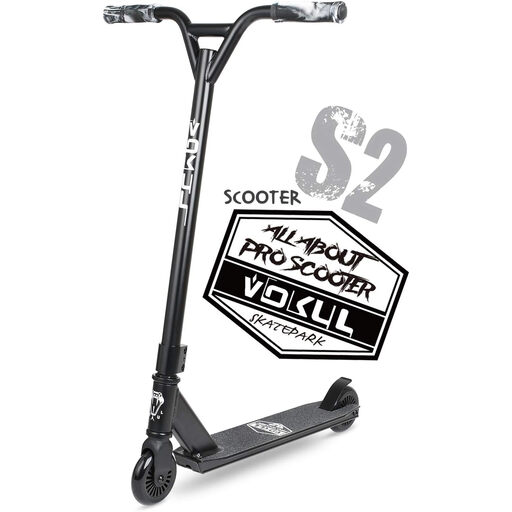
Why This Fits Their Persona: A sensible option for children aged 7–14 who need a stable entry-level freestyle scooter for learning tricks at a skate park or on a suitable private surface.
The fixed 4130 chromoly steel handlebar, triple clamp and reinforced forged deck prioritise a defined stunt configuration over folding convenience.
The scooter weighs approximately 8 lb, uses 100 mm polyurethane wheels and has a stated 220 lb maximum load with a two-year limited warranty.
A suitable stunt scooter still requires responsible use. Before the first ride:
Most of the featured freestyle models arrive mostly assembled, usually requiring the three-bolt clamp to be tightened. Follow the supplied instructions rather than relying on hand-tightening alone.
Check bolts before every session and clean the scooter with a damp cloth. Avoid high-pressure water, which can affect bearings and other components. Solid PU wheels do not need inflation, helping reduce routine running costs, but they still need replacement if worn, cracked or excessively flat-spotted.
We have compiled a complete, real-time list of products that fully satisfy these strict selection criteria and UK safety regulations.
Many stunt scooters in this selection are labelled for children aged 8 and over, while some entry-level models begin at age 6 or 7. Always follow the individual product guidance, check the rider’s size and supervise younger children. Age alone does not indicate whether a child is ready for ramps or advanced tricks.
Usually, complete models arrive mostly assembled. Common setup involves securing the handlebar with a three-bolt clamp, then checking wheel and brake movement. Some products may require more work, so read the included manual before riding.
Lifespan depends on rider weight, riding frequency, landing technique, surface quality and maintenance. Regularly tightening bolts and replacing worn wheels or grips can extend useful service. A scooter used for repeated drops and ramps will experience more wear than one used for basic flat-ground practice.