
24/7 Customer Support

Free returns

Same-day & Next-day Delivery

Quality Guaranteed

Unlock Your Welcome Offers: FREE Delivery | Up to 80% OFF | Free 30-day JoyPlus trial
Download the APP
Buying a stunt scooter involves more than choosing a colour or the highest bearing number on the specification sheet. A suitable model needs to match the rider’s age, height, weight, ability and intended surface, whether that is a local skate park, a smooth driveway or a dedicated BMX freestyle area.
Parents and guardians often face three common problems:
The following guide explains what to check before choosing a kids stunt scooter, beginner stunt scooter or more robust model for teenagers and adults.
Some large-wheel scooters are designed for commuting, parks or school journeys. They may include baskets, inflatable tyres, suspension or adjustable handlebars, but these features are not necessarily suitable for repeated barspins, tailwhips or jumps.
A freestyle scooter normally has a rigid structure and solid PU wheels. Avoid assuming that every product described as a “stunt scooter” is designed for skate-park use. Check the fork, clamp, deck and wheel construction carefully.
Bearings affect rolling smoothness, but the ABEC rating alone does not describe the complete ride. Wheel hardness, wheel size, axle fit, headset condition and the riding surface also matter. For example, the listed VOKUL K1 models use ABEC-9 bearings with 110 mm wheels, while several Stunted models use ABEC 7 bearings and 100 mm PU wheels.
A lower bearing number does not automatically make a scooter unsuitable. The complete specification and intended use are more useful comparison points.
An adjustable handlebar scooter can be convenient for growing children, but a fixed handlebar is often preferred for predictable handling during tricks. More importantly, the handlebar should not be set so high that the rider struggles to control the scooter.
For children aged eight and over, compare the stated handle height with the rider’s standing position. For teens and adults, also check the maximum user weight and deck dimensions rather than relying on the word “pro”.
Aluminium alloy decks can help keep a lightweight stunt scooter manageable during jumps. Steel components may add strength but can also increase overall weight. A rider learning tricks may find a lighter seven- to nine-pound scooter easier to lift and rotate.
Look for details such as T-6061 aluminium, a reinforced deck or a one-piece fork. These terms describe construction, not a guarantee that the scooter will withstand every impact. Regularly inspect the deck for cracks, dents or distortion.
Most trick scooters use solid PU wheels, commonly between 100 mm and 110 mm. Smaller wheels can feel responsive for younger beginners, while 110 mm wheels may offer a smoother roll over minor surface imperfections.
The wheel core also matters. Metal-core wheels are generally specified for more demanding freestyle use, while PU and PC constructions can provide a balance of weight and comfort. Solid wheels do not require inflation, but they still need checking for flat spots, cracks and loose axles.
A one-piece fork and a two- or three-bolt clamp help secure the steering assembly. The clamp must be tightened evenly and checked before each ride, particularly after assembly or repeated tricks.
A rear foot brake provides straightforward stopping control. It is not a substitute for safe riding practice, protective equipment or choosing a clear, dry surface. Some product listings include EN71 testing and CE UKCA compliance; buyers should check the individual product page for the relevant details rather than assuming every scooter carries the same certification.
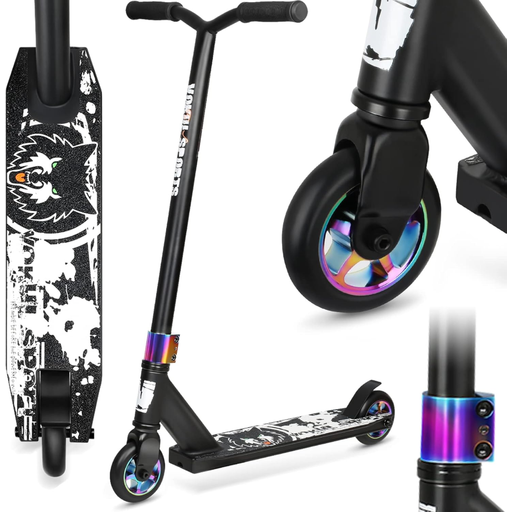
Why This Fits Their Persona: A 7 lb design is practical for younger beginners aged six and over who are learning basic scooter tricks at a local skate park or on a smooth private surface.
It is specified for tricks and stunts, with a rigid suspension and fixed handlebar rather than commuter-focused accessories.
Lightweight alloy steel and aluminium frame, solid 100 mm polyurethane wheels and a rear brake.
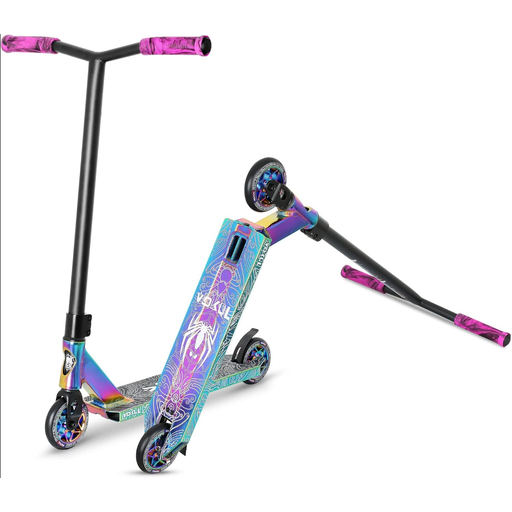
Why This Fits Their Persona: This option suits riders aged eight and over, including teens and adults who want a complete scooter for street riding and skate-park practice.
The listing gives specific construction details, including a T-6061 aluminium deck, one-piece T4T6 fork and 88A PU wheels.
ABEC-9 bearings, 110 mm wheels, soft 145 mm rubber grips and a stated 220 lb/100 kg weight limit.
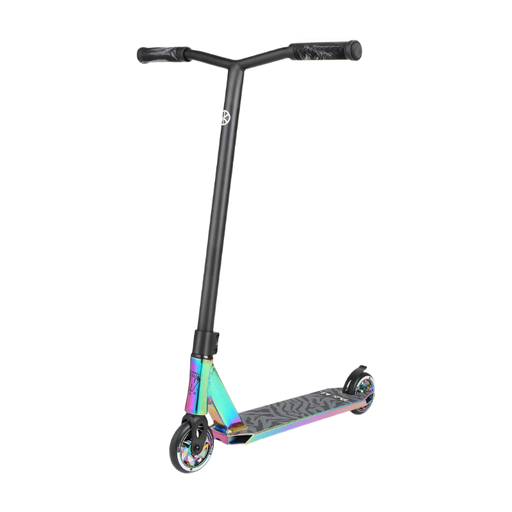
Why This Fits Their Persona: A suitable choice for intermediate riders aged eight to 18 who are progressing from basic skills towards barspins and tailwhips.
Its non-slip deck, rigid fork and solid alloy wheels are specified for freestyle or stunt riding rather than casual transport.
The product is listed as mostly assembled, with only the three-bolt clamp requiring tightening; it has a stated 220 lb weight limit.
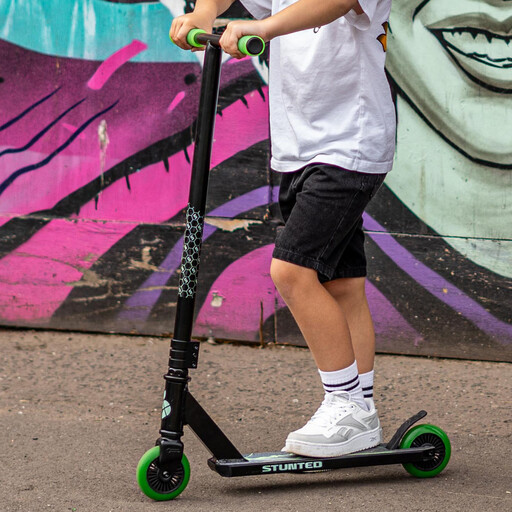
Why This Fits Their Persona: This model is aimed at children aged eight and over beginning to practise whips and 360-degree handlebar movement at suitable UK riding facilities.
The listing identifies a single-piece handlebar, triple clamp, rigid deck design and solid puncture-proof PU wheels.
It is listed as EN71 tested and CE UKCA compliant, with 100 mm 85A PU wheels, ABEC 7 bearings and a 100 kg maximum user weight.
Most of the listed models arrive partly assembled. Follow the supplied instructions and check that the clamp, handlebar, wheels and brake are secure before the first ride. Do not rely on hand-tightening alone where the instructions specify a tool.
For safer use:
A stunt scooter does not have a fixed lifespan. Frequency of use, rider weight, landing technique, storage and surface quality all affect wear. A scooter used several times a week at a skate park will need more frequent inspections than one used occasionally on a driveway.
Many models in this guide are listed for riders aged eight and over, while some entry-level options start at six or seven. Age guidance is only one factor: compare the rider’s height, ability, weight and confidence with the manufacturer’s specifications.
A dedicated trick scooter with solid PU wheels, a rigid fork, secure clamp and non-slip deck is generally more appropriate for skate-park riding than a large-wheel commuter scooter. Always follow the skate park’s own rules and use protective equipment.
Routine maintenance is relatively simple: inspect bolts and axles, check the brake and headset, clean the frame and replace worn wheels or grips. Avoid riding in wet conditions, as water and grit can accelerate wear around bearings and moving parts.
We have compiled a complete, real-time list of products that fully satisfy these strict selection criteria and UK safety regulations.