
24/7 Customer Support

Free returns

Same-day & Next-day Delivery

Quality Guaranteed

Unlock Your Welcome Offers: FREE Delivery | Up to 80% OFF | Free 30-day JoyPlus trial
Download the APP
Buying a stunt scooter for kids is not simply a matter of choosing the most colourful design. A scooter for school runs, pavements and casual riding has different priorities from a freestyle stunt scooter designed for ramps, jumps and tricks.
Parents and riders can easily overspend on features they do not need, or choose a model that feels unsuitable within a few months. The practical approach is to match the scooter’s construction, dimensions and intended use to the rider’s age, height, weight and experience.
A foldable kick scooter is convenient for storage, car journeys and commuting. However, folding mechanisms and adjustable components are not always the priority for repeated jumps or skate-park riding. A dedicated stunt scooter commonly uses a fixed or reinforced steering structure to provide a more consistent feel during tricks.
If the main use is pavement riding, commuting or leisure, portability may be more valuable than trick-focused construction. For ramps and bar spins, look for a model specifically described for freestyle or stunt riding.
A stated capacity of 220 lb can make a scooter suitable for a broad range of users, including some teenagers and adults. It does not automatically mean that every component is intended for advanced tricks. Check the deck, fork, handlebar and wheel construction, as well as the manufacturer’s suggested age and use.
A scooter may carry a larger rider for ordinary riding while still being unsuitable for drops, stairs or aggressive manoeuvres.
Large wheels can roll smoothly over ordinary pavement and help maintain momentum. They can also make a scooter more practical for commuting. By contrast, a compact 110 mm wheel is commonly found on trick scooters because it keeps the scooter relatively agile and manoeuvrable.
Neither option is universally suitable. A scooter with 205 mm wheels is generally more aligned with everyday riding, while smaller solid wheels are more closely associated with skate-park use.
Age guidance is a starting point, not a substitute for checking fit. Children aged 6–12 may need a lower or adjustable handlebar, while many stunt scooters are listed for riders aged 8 and over.
Check:
An adjustable-height scooter can suit growing children and shared household use. However, a fixed-height stunt scooter may provide a more rigid setup for trick practice.
Aluminium can help reduce overall weight, while steel may add structural mass. Several models combine aluminium and steel to balance portability with everyday durability. For freestyle riding, a T-6061 aluminium deck and one-piece T4T6 fork are listed on selected models in this range.
Look for a non-slip deck, secure grips and a steering assembly that does not wobble. Check the clamp and bolts after assembly, particularly when the scooter will be used frequently.
Polyurethane wheels are used across everyday and stunt scooters. The important differences include wheel diameter, solidity and bearing specification. A stunt scooter with 110 mm solid wheels may feel more responsive for tricks, while larger wheels can offer a smoother roll on pavements.
A scooter with rear brake or foot brake allows the rider to slow down by pressing the brake over the rear wheel. Riders should practise braking before travelling near roads, cycle paths or crowded areas. No scooter should be treated as a substitute for road awareness or protective equipment.
For UK shoppers, check the product information and safety instructions carefully. One listed stunt scooter states that it is EN71 tested and CE UKCA compliant. This information should be confirmed on the relevant product listing and packaging before purchase.
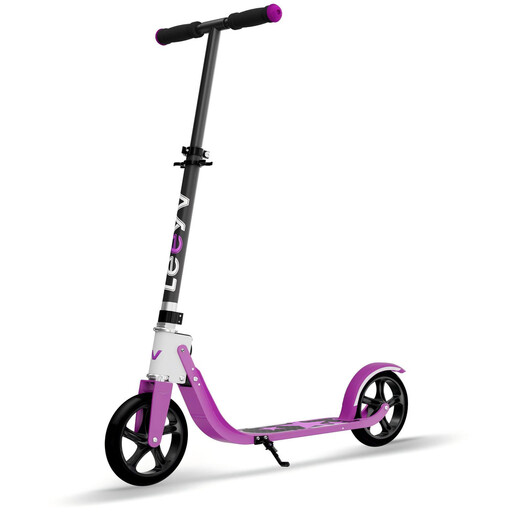
Why This Fits Their Persona: A practical choice for families seeking an adjustable scooter for pavement rides, leisure and commuting rather than dedicated skate-park tricks.
Its product information clearly presents it as a foldable, adjustable model with rigid suspension, rather than positioning portability as a trick-riding feature.
205 mm polyurethane wheels, adjustable handlebar, foldable frame and a stated 220 lb weight limit.
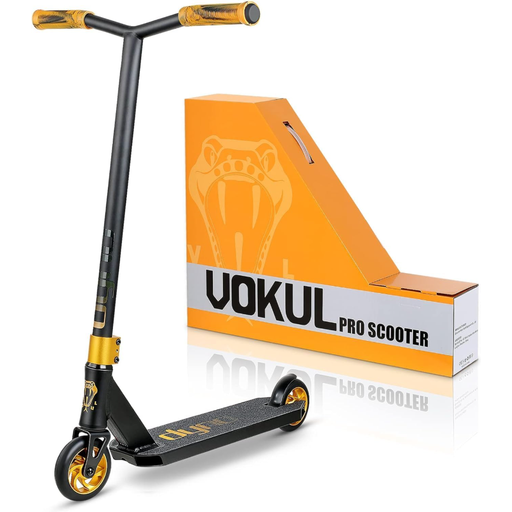
Why This Fits Their Persona: Suits riders aged 8 and over who want a purpose-built freestyle scooter for structured practice at a skate park or on suitable smooth surfaces.
The listing specifies a T-6061 aluminium deck, one-piece T4T6 fork, solid 110 mm wheels and a non-slip deck, giving buyers more useful detail than appearance alone.
88A polyurethane wheels, ABEC-9 bearings, soft rubber grips and mostly pre-assembled setup.
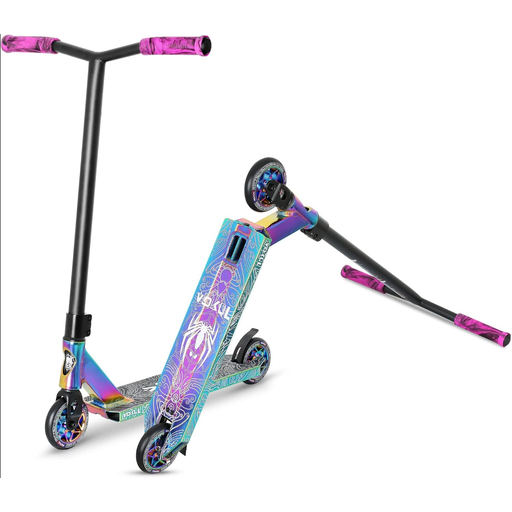
Why This Fits Their Persona: Appropriate for older children, teens and adults who prioritise freestyle handling and a compact stunt-scooter format over folding convenience.
Its fixed stunt-oriented construction avoids relying on a folding joint, while the product details state the 220 lb maximum and intended 8–18 age range.
T-6061 aluminium deck, 110 mm solid wheels, one-piece fork and adjustable handlebar listed at 21.5 inches.
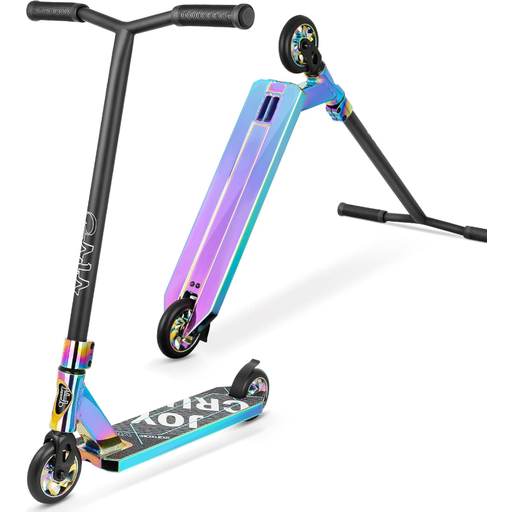
Why This Fits Their Persona: A straightforward option for younger riders developing basic skills, with a fixed handlebar and simple foot-braking arrangement.
The fixed handlebar avoids uncertainty around adjustment, while the listing gives a maximum age of 12, a 220 lb limit and rigid suspension.
Alloy steel and aluminium frame, solid polyurethane wheels, non-slip deck and minimal assembly.
We have compiled a complete, real-time list of products that fully satisfy these strict selection criteria and UK safety regulations.
Before the first ride:
A lightweight scooter is easier for a child to carry, but it still needs regular inspection. Wipe it with a damp cloth, keep bearings away from high-pressure water and store the scooter somewhere dry. Inspect it before every ride, particularly after jumps or repeated impacts.
Children should wear a properly fitted helmet, with knee, elbow and wrist protection appropriate to the riding activity. Use smooth, dry surfaces and keep away from traffic, stairs and steep inclines. Children under 12 should ride with suitable adult supervision.
Many trick scooters are listed for children aged 8 and over, while adjustable everyday scooters may be suitable for younger users, such as those aged 6–12. Always follow the individual product’s age guidance, check the rider’s size and use adult supervision for younger children.
It can be used for short leisure journeys, but a stunt scooter may have smaller wheels and less portability than a conventional kids kick scooter. For commuting, a foldable model with 205 mm wheels, adjustable height and a rear brake may be more practical.
Lifespan depends on rider weight, riding surface, storage and how often the scooter is used for tricks. Ordinary pavement riding usually places different demands on components than jumps and landings. Regularly tightening bolts, checking the brake and replacing worn wheels or grips can help maintain the scooter, but damaged components should not be ignored.