
24/7 Customer Support

Free returns

Same-day & Next-day Delivery

Quality Guaranteed

Unlock Your Welcome Offers: FREE Delivery | Up to 80% OFF | Free 30-day JoyPlus trial
Download the APP
For older adults, people recovering from injury, pregnant women and anyone with reduced mobility, a bathroom grab bar can make everyday movements feel more manageable. However, choosing the wrong suction shower grab bars may create a false sense of security rather than useful balance support.
The key is to look beyond phrases such as “heavy duty”, “strong suction” or “universal fit”. A removable shower grab bar can be convenient, but it is not suitable for every wall, tile or type of support. Use this guide to compare the important specifications before buying.
Suction cup grab rails need an airtight, smooth and non-porous surface. Glass, polished metal, acrylic and suitably smooth tiles may work, while textured tiles, grout lines, unfinished stone, wallpaper, painted walls and plasterboard generally do not.
A suction cup placed partly over a grout line may not form a consistent seal. Even if the handle initially feels firm, moisture, movement and temperature changes can affect its hold.
Most removable no-drill grab bars are intended for balance assistance, not for lifting your entire body weight or pulling yourself up from the bath. Always follow the product’s safety instructions and check the stated capacity.
If a user needs firm support for transfers, sitting down or standing up, a permanently fixed bathroom grab bar installed into a suitable solid wall may be more appropriate. A carer or qualified installer can help assess the bathroom layout.
A longer shower safety rail is not automatically more useful. It must fit the available wall area without crossing awkward tile edges or fixtures. A short bath handle may be easier to position near a bath entrance, while a pair of compact rails can provide support at separate points.
Also check whether the grip is practical when wet. A smooth, decorative finish may look attractive but offer less tactile control than a shaped rail with an anti-slip surface.
Look for clear installation instructions rather than relying on general descriptions. The TAILI suction models listed below use two suction cups with locking latches. The latches are pulled down to secure the cups, with installation described as taking approximately five seconds.
Before fitting a waterproof shower handle:
Some TAILI models specify tiles measuring 4 × 4 inches or larger, which is approximately 10 × 10cm. Always check the individual listing, as dimensions and installation requirements can vary.
An anti-slip bathroom grip should be comfortable to hold with wet hands. The TAILI designs feature an anti-slip strip on top and a curved wave pattern underneath for finger placement. Their suction cups use TPE, while the rail bodies are described as plastic or ABS, depending on the model.
A traditional fixed rail may use stainless steel. For example, the Croydex rail has a 32mm diameter stainless-steel bar, a corrosion-resistant finish and concealed fixings. This type of bathroom grab bar requires mounting to a solid wall and is not removable in the same way as a suction model.
The TAILI listings state a support capacity of 240lb per bar, but the supplied safety guidance says not to put all body weight on the rail. The Croydex listing states support up to 100kg when fitted to a solid wall.
Position the handle where the user can reach it without twisting. Consider the bath edge, shower entrance, toilet area and floor space. A rail should complement other bathroom mobility aids, such as a shower seat or raised toilet seat, rather than being expected to solve every movement challenge.
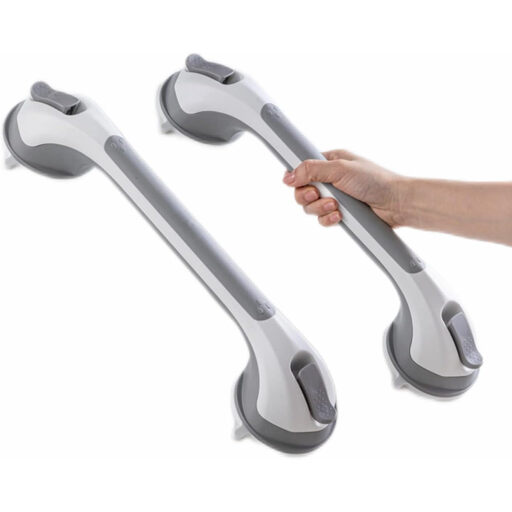
Why This Fits Their Persona: A two-pack gives households flexibility to place support near a shower entrance, bath or toilet without drilling into the wall.
It specifies suitable smooth surfaces and warns against porous, uneven and non-airtight walls, helping buyers check compatibility before installation.
ABS construction, two locking suction cups, anti-slip strip and stated 240lb capacity per bar.
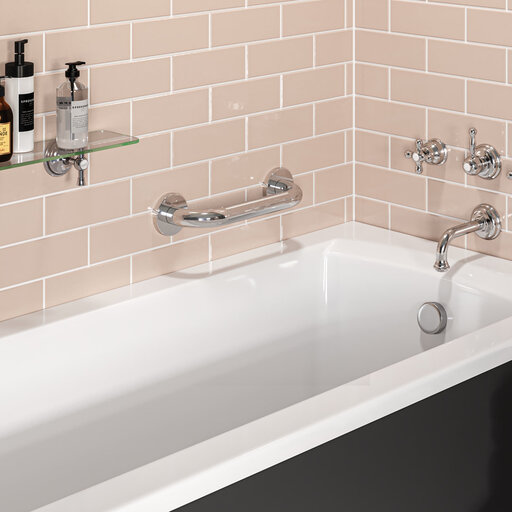
Why This Fits Their Persona: Suitable for homeowners who want a permanent-looking chrome rail and have a solid wall suitable for secure fixing.
It does not rely on suction. The listing clearly states that support depends on correct installation to a solid wall.
Stainless-steel construction, 300mm length, 32mm diameter and concealed fixings.
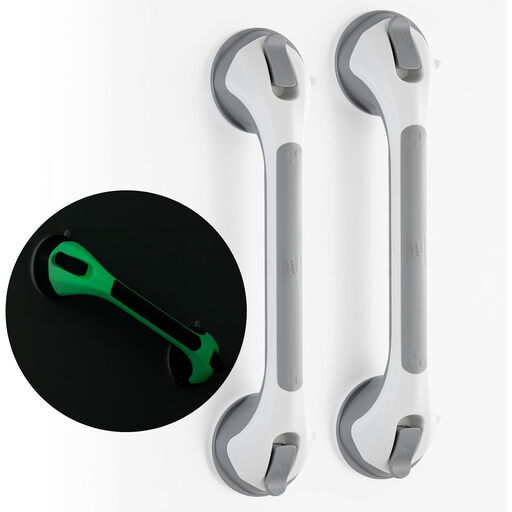
Why This Fits Their Persona: The longer 16.8-inch format and glow-in-the-dark material may suit bathrooms where visibility at night is a practical consideration.
The listing combines the glow feature with surface restrictions and a reminder that the rail is for balance assistance, not full-body loading.
16.8-inch length, luminous material, anti-slip strip, curved finger grip and waterproof construction.
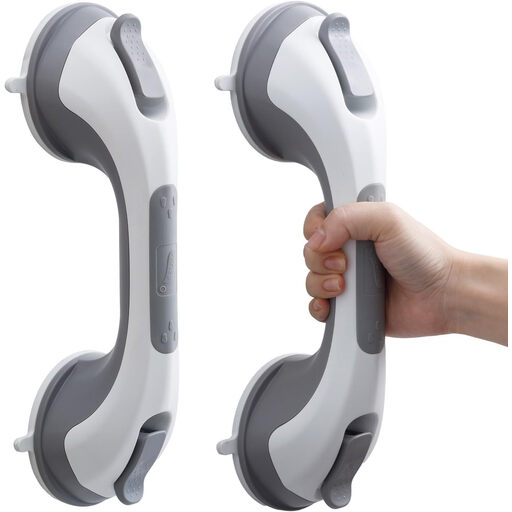
Why This Fits Their Persona: The shorter format can be easier to place in a small-footprint UK bathroom, shower enclosure or beside a bath where wall space is limited.
Its stated no-drill installation is paired with clear warnings about painted, porous, uneven and non-airtight surfaces.
12-inch size, removable suction-cup fitting, anti-slip strip and two rails supplied.
We have compiled a complete, real-time list of products that fully satisfy these strict selection criteria and UK safety regulations.
They may be suitable for smooth, non-porous and airtight tiles, but not for textured tiles, porous surfaces or areas where the suction cups cross grout lines. Clean, dry and inspect the surface before installation, then test the attachment gently.
There is no universal lifespan. Suction performance can change with wear, dirt, heat, direct sunlight and repeated removal. Wipe the rail with mild soap and a damp cloth, allow it to dry fully, and inspect the cups and locking latches regularly. Replace it if components show damage or no longer hold securely.
They can provide temporary balance support when installed on a compatible surface and used as directed. They should not be treated as a substitute for a permanently fixed shower support handle where the user needs to bear substantial weight. If unsure, ask an occupational therapist, carer or qualified installer to assess the bathroom.