Who is choosing the biscuits?
At a car boot sale, the right biscuit depends on what a visitor actually needs to avoid—not on whether a packet looks like a familiar custard cream.
Stallholders handling a strict sugar-free request
Check the sugars value per 100 g on the exact pack before calling a biscuit sugar-free. A Free From label or a similar sandwich-biscuit shape does not establish that it meets the sugar-free claim condition published by legislation.gov.uk.
Hosts catering for gluten- or milk-free visitors
Look for the specific exclusion the visitor needs, then keep the pack available so they can inspect its current ingredients and allergen information. Gluten-free or milk-free does not also mean sugar-free.
Regular car boot food sellers
Keep packaged biscuits identifiable and their labels available. If supplying refreshments is becoming a regular activity, ask the local authority how food-business requirements apply to your stall.
What should you check?
Start with the requirement that cannot be substituted: sugar-free, a specified ingredient exclusion, or simply a general biscuit refreshment. Then check the exact pack rather than relying on a range name.
| Priority |
What to check |
Your needs |
| Sugar-free claim |
Read the sugars value per 100 g on the current pack. Legislation.gov.uk publishes a sugar-free claim condition of no more than 0.5 g sugars per 100 g of food. |
If a visitor asks for sugar-free biscuits, I need the exact product to meet that condition, not merely to look like a custard cream. |
| Gluten and milk |
Check the stated Free From exclusions and the full ingredients and allergen information. Tesco and ASDA list Free From custard creams for gluten- and milk-free needs, but list 25.2 g and 25 g sugars per 100 g respectively. |
For someone avoiding gluten or milk, I want them to be able to inspect the packet; I will not describe those custard creams as sugar-free. |
| Biscuit format |
Check whether the product is a custard cream, another sandwich biscuit or a digestive. Keep the pack name visible so visitors know what is being offered. |
A different biscuit works for my refreshment table only if a custard cream’s particular format is not part of the request. |
| Pack information |
Keep the original packaging with its current nutrition, ingredient and allergen information. Check those details before making a claim on a stall sign. |
I want visitors to read the label for themselves rather than depend on a handwritten description. |
| Stall activity |
Consider how often and in what way you supply food. GOV.UK says selling or supplying food at events may amount to food-business activity; ask the local authority about your circumstances. |
If I plan to offer biscuits regularly, I need to establish which requirements apply before trading. |
Brand and range references
These examples show why the exact product label matters: a standard custard cream, a Free From version and a biscuit labelled for sugar-free use answer different requests.
Tesco
Tesco lists both standard and Free From custard creams.
- The Free From version uses rice flour; its product listing gives 25.2 g sugars per 100 g.
- The standard 400 g version lists 28.3 g sugars per 100 g and contains wheat flour and whey powder from milk. Neither listed version meets the published sugar-free claim condition.
Sainsbury's
Sainsbury's lists a standard custard cream and a separate Free From product.
- Its Free From product is described by Sainsbury's as gluten-free and milk-free.
- The standard custard creams list 26.5 g sugars per 100 g and contain wheat flour and whey powder from cows’ milk. Check the separate Free From pack for its own nutrition details.
ASDA Free From
ASDA’s Free From custard creams address stated gluten- and milk-free needs, not a sugar-free request.
- ASDA labels this product gluten-free, milk-free and suitable for vegans.
- Its listed sugars value is 25 g per 100 g, above the published condition for a sugar-free claim.
Morrisons Free From
Morrisons describes its Free From custard creams as gluten- and milk-free vanilla-flavour biscuits.
- The product listing specifies gluten and milk exclusions.
- Its listed ingredients include sugar and sugar syrups. Check the exact pack’s sugars value per 100 g before making any sugar-free claim.
Gullón
Gullón presents a Zero Sugar Free Biscuits range as a route to consider when the biscuit need not be a custard cream.
- The range offers a different starting point from conventional or gluten- and milk-free custard creams.
- Check the particular biscuit’s format, ingredients and sugars value per 100 g; a range name does not establish the details of every pack.
Biscuit alternatives on Joybuy
These are labelled zero-sugar biscuit alternatives for a stall where a custard cream is not essential. One is a sandwich cookie and the other a digestive; check each current pack’s sugars value and ingredients before offering it for a strict sugar-free request.
 No image available
Oreo Zero Sugar Sandwich Cookies 97g
A sandwich-cookie option when a custard cream is not required. The pack is 97g; check its current sugars value per 100 g and ingredients before describing it to visitors as sugar-free.
View on Joybuy
 No image available
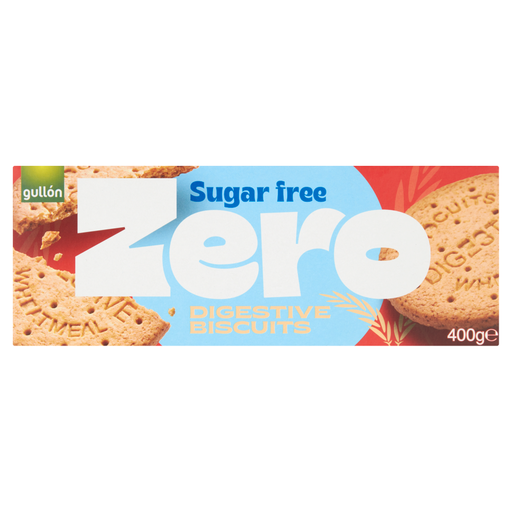
Gullón Zero Sugar Free Original Digestives 400g
A digestive-biscuit alternative rather than a custard cream. The pack is 400g; check its current sugars value per 100 g and ingredients against the visitor’s requirements.
View on Joybuy
Common questions
Are Free From custard creams sugar-free?
Not necessarily: Free From refers to specified exclusions. Tesco’s Free From custard creams list 25.2 g sugars per 100 g and ASDA’s list 25 g, both above the sugar-free claim condition of no more than 0.5 g per 100 g published by legislation.gov.uk. Check the exact pack for both its exclusions and nutrition values.
Can I call ordinary custard creams sugar-free at my stall?
Do not use that description for the standard Tesco or Sainsbury’s products cited here: their listings give 28.3 g and 26.5 g sugars per 100 g respectively. For any other biscuit, check the current pack against the published sugar-free claim condition before describing it that way.
Should I keep the original biscuit packets?
Yes. Keeping each pack available lets visitors inspect its current ingredients, allergens, nutrition values and product name, rather than relying on a stall sign or your memory.
Could selling packaged biscuits mean registering a food business?
It could. GOV.UK says that selling or supplying food at an event may amount to food-business activity, depending on what you do. Ask the local authority about your planned stall and how often you will trade before assuming registration is unnecessary.
Is a sugar-free biscuit automatically suitable for someone with diabetes?
No sugar-free label establishes individual medical suitability. Diabetes UK notes that polyols contain carbohydrate and calories. Provide the pack’s nutrition and ingredient information rather than making a suitability promise; anyone adjusting insulin should follow advice from their healthcare team.


