What should you check?
Sugar-free bar
Choose when: A guest specifically needs a product carrying the sugar-free claim, and the exact pack supports that choice.
Bear in mind: The claim does not tell you which sweeteners or allergens the bar contains.
No-added-sugar bar
Choose when: Avoiding added sugars is the aim, rather than requiring a sugar-free bar.
Bear in mind: Sugars can remain in the finished product. Chocolates Valor lists 8.7 g sugars per 100 g for its 0% added-sugar milk chocolate.
Conventional bar
Choose when: A guest wants a standard chocolate bar and has not asked for a sugar-free option.
Bear in mind: Do not use a conventional bar to fulfil a sugar-free request; check its own sugars figures and keep it separately labelled.
Start with the claim the guest needs, then check the nutrition panel and ingredients on the particular bar you will serve.
| Priority | What to check | Your needs |
|---|
| Label claim |
Legislation.gov.uk gives a limit of 0.5 g sugars per 100 g or 100 ml for a sugar-free claim. Its no-added-sugar definition concerns added sugars and other foods used for sweetening; compare the finished product’s sugars figure too. |
If I am serving a bar as sugar-free, I want that claim on the exact pack—not just wording about no added sugar. |
| Sweeteners |
Read the ingredients for polyols and other sweeteners. Check for an excessive-consumption warning and compare carbohydrate as well as sugars. |
I would like to know what sweetens the bar before putting out several for guests to choose from. |
| Allergens |
Read the exact pack’s ingredients and precautionary statements for relevant allergens. Keep its identity and label information available at the serving table. |
Guests need to check the bar they actually pick up, especially when different products are offered together. |
| Serving size |
Compare sugars per 100 g for a consistent basis, then read the per-portion figure and portion size. Do not treat different-sized bars as equal servings. |
For a coffee morning, I want to know what the figures mean for one bar, not only for 100 g. |
Relevant chocolate-bar ranges
A brand name alone does not establish whether a particular bar is sugar-free or no-added-sugar; the distinctions below concern the named ranges and products.
N!CK’S
N!CK’S describes its UK chocolate-bar range as no added sugar and lists different flavours and fillings.
- The range gives hosts different bar formats to examine for a no-added-sugar selection.
- Check each chosen bar’s sugars, sweeteners, ingredients and allergens; the range description is not a sugar-free claim for every product.
Valor
Chocolates Valor lists a 0% added-sugar milk chocolate bar with maltitol and steviol glycosides.
- Its product information lists 8.7 g sugars per 100 g, making the distinction between no added sugar and sugar-free relevant.
- The milk bar also displays an excessive-consumption laxative-effect warning; check the specific variant before serving.
Venchi
Venchi describes a no-added-sugar line that includes milk, dark and hazelnut bars.
- Venchi says the line contains no added sugars apart from those naturally present.
- That description does not establish a sugar-free claim or the sugars figure for an individual bar; read its pack.
Galaxy
The Galaxy Milk Chocolate Bar 42 g is a conventional chocolate option.
- Mars / Galaxy lists 23 g sugars per 42 g bar, giving a clear figure for this portion.
- Do not present this product as the sugar-free choice; check any other Galaxy variant separately.
Snickers
The Snickers Chocolate Bar 40 g is a conventional chocolate-and-peanut bar.
- Mars / Snickers lists 20 g sugars per 40 g bar.
- It is not a sugar-free substitute. Its ingredient and precautionary nut information also needs attention at a shared table.
KitKat
KitKat 4 Finger Milk is a conventional chocolate-wafer bar.
- KitKat UK lists 21.3 g total sugars for the 41.5 g bar.
- It is not a sugar-free choice, and the listed ingredients include wheat and milk.
A conventional Joybuy option
This chocolate-bar pack belongs with conventional coffee-morning choices for guests who do not require a sugar-free bar. Keep it separate from any selection presented as sugar-free.
 No image available
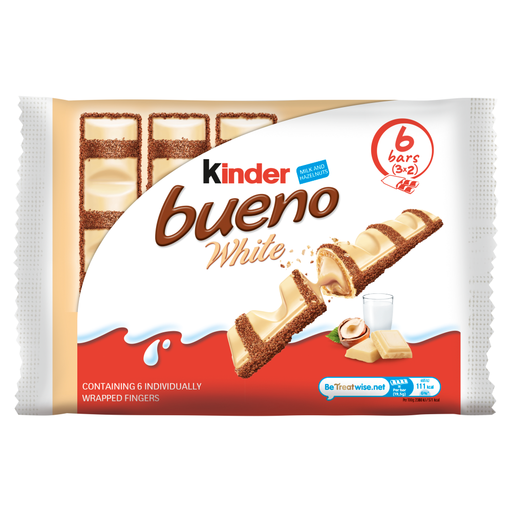
Kinder Bueno White 3 Pack 117g
A three-bar pack to consider as a conventional option, not to fulfil a sugar-free request. Check the current pack’s sugars and carbohydrate per bar, ingredients and allergen statements before serving.
View on Joybuy
Questions about serving chocolate bars
Is no added sugar the same as sugar-free?
No. Legislation.gov.uk gives a limit of 0.5 g sugars per 100 g or 100 ml for a sugar-free claim; its no-added-sugar definition concerns added sugars and foods used for sweetening. The finished bar can still contain sugars: Chocolates Valor lists 8.7 g per 100 g for its 0% added-sugar milk chocolate.
Does no added sugar mean a bar contains no carbohydrate?
No. Read the carbohydrate and sugars lines on the particular pack. Diabetes UK notes that polyols contain carbohydrate and calories, so a no-added-sugar label alone cannot answer a guest’s carbohydrate question.
Why does a bar carry a laxative-effect warning?
The warning concerns excessive consumption of certain polyol-containing products. Chocolates Valor displays it on its 0% added-sugar milk chocolate information; keep the warning available when guests are choosing how many bars to take.
How should I handle allergens at a shared coffee morning?
Keep each product’s packaging with its bars so guests can check the exact ingredients and precautionary statements. Snickers lists peanuts and a may-contain-other-nuts statement, while KitKat 4 Finger Milk lists wheat and milk; do not assume another bar has the same ingredients.
Can ordinary branded bars fill the sugar-free slot?
Not on brand familiarity or bar size alone. Mars / Galaxy lists 23 g sugars per 42 g Galaxy Milk bar, Mars / Snickers lists 20 g per 40 g bar, and KitKat UK lists 21.3 g per 41.5 g KitKat 4 Finger Milk bar. Serve those specific products as conventional choices, and check any alternative variant’s own label before describing it as sugar-free.


