Who is this choice for?
The useful distinction is whether you require a sugar-free claim or simply want a chocolate biscuit made without added sugar.
Tea-break shoppers avoiding added sugar
A no-added-sugar biscuit may fit your preference, but the claim does not tell you its total sugars, carbohydrate or portion size. Compare the nutrition panel before choosing between a small wrapped serving and a larger pack.
People keeping track of carbohydrate
Check total carbohydrate as well as sugars, then relate the per-100g figure to the amount you plan to eat. Diabetes UK explains that total carbohydrate matters when managing blood glucose; a no-added-sugar claim does not replace individual advice.
Buyers avoiding particular allergens
Read the ingredients, allergen declaration and any may-contain statement on the exact biscuit. The documented no-added-sugar products differ: their declarations include wheat, soya, milk or oats, with additional may-contain statements on some packs.
What should you check before buying?
Start with the claim you actually need, then compare the nutrition information for your intended tea-break portion and check the ingredients.
| Priority |
What to check |
Your needs |
| Sugar claim |
Read the exact claim and sugars per 100g. Legislation.gov.uk publishes a sugar-free criterion of no more than 0.5g sugars per 100g of food; “no added sugar” and “free from” do not establish that figure. |
If I specifically need sugar-free, I want the pack’s sugars figure to meet that criterion, rather than relying on its name or a retailer category. |
| Carbohydrate and portion |
Compare total carbohydrate per 100g and work out what the stated serving means for the amount you intend to eat. Diablo’s published panel lists 51g carbohydrate per 100g; Joybuy UK lists 57g for Gullón Zero Dark Chocolate Ginger Oaties and 65g for Cookies and Cream. |
For a tea break, I want to know how much of the pack I will eat. If I track carbohydrate, the sugars claim alone will not answer that question. |
| Sweeteners |
Check the ingredients for maltitol or other sweeteners and read any warnings on the pack. Diabetes UK identifies maltitol as a polyol, a carbohydrate-containing type of sweetener. |
I may prefer a sweetener-based biscuit, but I want to know what it contains before making it my regular choice. |
| Allergens |
Read the product-specific allergen and may-contain statements. Diablo declares wheat, milk and soya; the two documented Gullón Zero products have different declarations. |
When an ingredient must be avoided, I need the declaration for the exact biscuit and pack, not just a “free from” search result. |
Relevant biscuit brands
These examples illustrate different biscuit formats and claims; a brand name alone does not establish the nutrition or allergens of every product it makes.
Diablo
Diablo’s 136g no-added-sugar chocolate-covered cream cookies come as four individually wrapped packs of two, a format that makes the stated portion easy to identify.
- Diablo lists maltitol among the ingredients and publishes sugars and carbohydrate values for this product.
- Its panel states 4g sugars per 100g, despite “sugar free” wording elsewhere on the product page. Use the panel rather than that wording when checking a strict sugar-free requirement.
Gullón Zero
The documented range includes a cocoa biscuit with a cream filling and a dark-chocolate oat-and-ginger biscuit, both described on Joybuy UK as having no added sugar.
- Joybuy UK lists 2.4g sugars per 100g for Cookies and Cream and 1.0g for Dark Chocolate Ginger Oaties, allowing a comparison between the specific products.
- Both figures exceed the published sugar-free criterion. Their carbohydrate figures and allergen declarations also differ, so check the chosen variant.
McVitie's
Tesco Groceries and Sainsbury’s list conventional McVitie’s chocolate-biscuit formats, including Digestives, Penguin Original and Club Orange products.
- These listings give shoppers conventional chocolate-biscuit and multipack formats to consider when a reduced-sugar claim is not required.
- Check the exact pack’s nutrition and ingredients before comparing it with a no-added-sugar product; category placement does not provide those values.
Fox's
Tesco Groceries lists Fox’s Chocolate Viennese and Chocolatey Biscuits among its conventional chocolate-biscuit options.
- The listed products offer different conventional biscuit formats for a tea break.
- Confirm sugars, carbohydrate and allergens for the particular pack if those details affect your choice.
Chocolate-biscuit options on Joybuy
These Joybuy options include an Oreo Zero Sugar sandwich cookie and two Gullón Zero no-added-sugar biscuits. For a strict sugar-free requirement, check the Oreo pack’s nutrition panel; the published sugars values for both Gullón Zero products exceed the 0.5g-per-100g criterion.
 Image unavailable
Oreo Zero Sugar Sandwich Cookies 97g
If you are considering this sandwich cookie for a sugar-free tea break, compare the exact pack’s sugars per 100g with the published 0.5g criterion. Check its total carbohydrate, ingredients, allergens and sweetener information for your intended portion too; the product name alone cannot settle those questions.
View on Joybuy
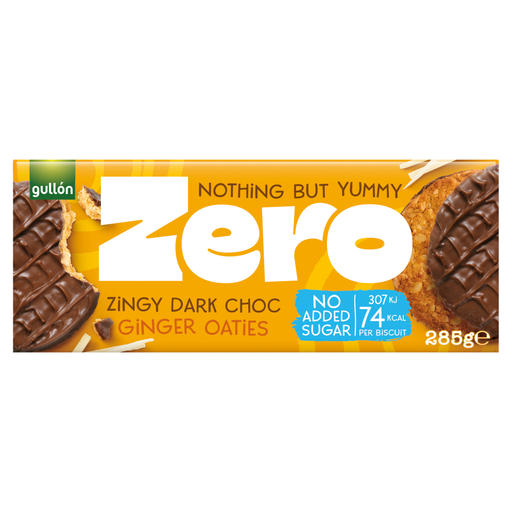 Image unavailable
Gullón Zero Dark Chocolate Ginger Oaties 285g
For a tea break where no added sugar is the preference, this dark-chocolate oat-and-ginger biscuit offers a different format from a cream-filled cookie. Joybuy UK lists 1.0g sugars and 57g carbohydrate per 100g, so it does not meet the published sugar-free criterion. It is sweetened with maltitol; its allergen information lists milk, oats, soya and wheat and says it may contain nuts.
View on Joybuy
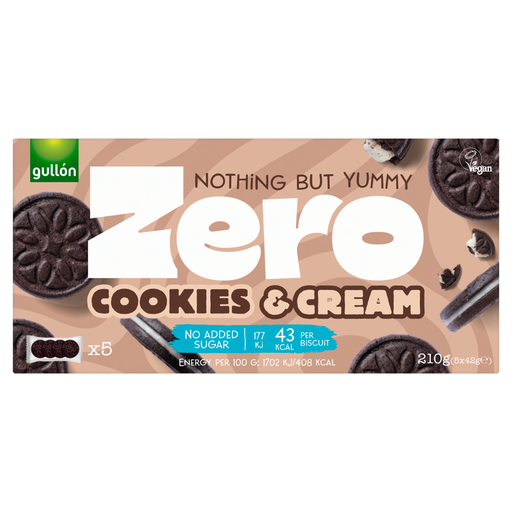 Image unavailable
Gullón Zero No Added Sugar Cookies and Cream 210g
This cocoa biscuit with a cream filling is a no-added-sugar option for a tea break, not a biscuit to choose on the assumption that it is sugar-free. Joybuy UK lists 2.4g sugars and 65g carbohydrate per 100g. It is sweetened with maltitol, contains soya and wheat, and may contain milk and mustard; check the current pack if an allergen affects your choice.
View on Joybuy
Questions about sugar claims and ingredients
What does “sugar-free” mean when I compare chocolate biscuits?
Legislation.gov.uk publishes a sugar-free claim criterion of no more than 0.5g sugars per 100g of food. Read the sugars-per-100g value on the exact biscuit: “no added sugar” does not give you the same answer.
Does “no added sugar” mean a biscuit contains no carbohydrate?
No. Joybuy UK lists 57g carbohydrate per 100g for Gullón Zero Dark Chocolate Ginger Oaties and 65g for Gullón Zero Cookies and Cream, despite their no-added-sugar descriptions. Compare total carbohydrate for the portion you intend to eat, particularly if you track it.
Is a no-added-sugar biscuit automatically suitable for someone with diabetes?
No: the claim alone cannot establish whether a biscuit fits an individual eating or insulin plan. Diabetes UK advises considering total carbohydrate and seeking individual guidance from a healthcare team where needed, including questions about polyols such as maltitol.
Which allergens appear in these no-added-sugar biscuits?
Diablo’s chocolate-covered cream cookies declare wheat, milk and soya. Joybuy UK lists soya and wheat for Gullón Zero Cookies and Cream, which may contain milk and mustard; Dark Chocolate Ginger Oaties lists milk, oats, soya and wheat and may contain nuts. Check the current pack for the specific product you are buying.
Should I reread the pack when buying a familiar biscuit?
Yes, especially if you depend on a sugars threshold or need to avoid an allergen. Use the nutrition panel and full ingredient and allergen statements on the pack you are buying rather than relying on its name or a retailer category.


