Late-night snackers reducing sugars
An explicit sugar-free claim is the starting point if sugars matter most. Compare the per-100g nutrition figures and the portion you intend to eat; sugar-free does not mean free of carbohydrate or energy.


If minimising sugars is your deciding factor, start with a chocolate biscuit explicitly labelled sugar-free rather than assuming that no added sugar, lower sugar or gluten-free means the same thing. For a late-night portion, also compare carbohydrate, energy and serving size, and check the sweeteners and allergens: a sugar-free claim does not answer those questions for you.
An explicit sugar-free claim is the starting point if sugars matter most. Compare the per-100g nutrition figures and the portion you intend to eat; sugar-free does not mean free of carbohydrate or energy.
Some sugar-free biscuits use sweeteners such as maltitol or isomalt. If these have caused digestive discomfort for you before, read the ingredients and any excessive-consumption warning on the pack.
A gluten-free chocolate biscuit can meet a separate ingredient requirement, but it is not automatically sugar-free. Check both the gluten-free wording and the sugars figure for the exact variety you choose.
Decide whether sugar-free is a requirement or whether a portioned, gluten-free or conventional biscuit would meet your needs; then compare the exact packs on the same nutrition basis.
Choose when: Minimising sugars is the main reason for changing your late-night biscuit.
Bear in mind: Sweeteners such as maltitol may bring digestive-tolerance considerations, while carbohydrate and energy still need checking.
Choose when: A defined serving or gluten-free format matters more to you than a strict sugar-free claim.
Bear in mind: A lower-sugar claim does not make a biscuit sugar-free; Sainsbury's lists 20.5 g sugars per 100 g for Nairn's Chocolate Biscuit Breaks.
Choose when: Your preferred chocolate-biscuit format matters more than reducing sugars.
Bear in mind: A familiar brand or multipack does not establish the sugars or allergens in an individual variety.
| Priority | What to check | Your needs and other shoppers |
|---|---|---|
| Sugar claim | Read the exact claim and sugars per 100 g. The sugar-free threshold stated in the legislation.gov.uk annex is no more than 0.5 g sugars per 100 g of food; no added sugar and lower sugar are different descriptions. | I want to minimise sugars, so I need the claim and nutrition figure for this particular biscuit, not just a name suggesting less sugar. |
| Nutrition label | Compare sugars, total carbohydrate, energy and saturates per 100 g, then check the figures for a biscuit or serving. Read traffic-light labels alongside the numerical nutrition table where provided. | I use traffic-light labels when shopping, but also want figures I can compare across packs. In the Food Standards Agency's 2024 Northern Ireland tracker, 49% of 611 adults interviewed from 16 September to 23 November reported actively using traffic-light labelling when food shopping; that finding is about food shopping generally, not chocolate biscuits. |
| Sweeteners | Look for maltitol, isomalt or other polyols in the ingredients, and read any warning about excessive consumption. Diabetes UK notes that polyols contain carbohydrate and calories. | If polyol-sweetened foods have disagreed with me, the type of sweetener matters as much as the sugar-free wording. |
| Portions | Check how many biscuits make a serving and whether the pack separates them into pouches. Nairn's Chocolate Biscuit Breaks, for example, are listed by Sainsbury's as four pouches of four. | A pre-portioned pack may help me choose how many biscuits to put out after supper, but it does not tell me how much sugar each biscuit contains. |
| Ingredients and allergens | Read the exact variety's ingredient and allergen statements. Check gluten-free wording separately from sugar claims, and review any relevant wheat, soya, milk or nut information on the current pack. | I need the biscuit to fit my ingredient requirements; a brand name or a free-from shelf label is not enough to settle a different requirement. |
A sugar-free biscuit can still contain carbohydrate and energy. The NHS notes that using lower- or no-calorie sweeteners does not necessarily change the nutritional profile of a food overall.
Compare energy, carbohydrate and sugars on the nutrition panel, using both per-100g and serving figures for the portion you are considering.
Polyol sweeteners may matter to digestive tolerance. A Tesco listing for Gullón Sugar Free Maria Cookies, for instance, warns that excessive consumption may produce laxative effects; that warning describes that product, not every biscuit.
Check the ingredients and any warning on the particular pack, especially if you have reacted to polyol-sweetened foods before.
Sainsbury's lists 20.5 g sugars per 100 g for Nairn's gluten-free Chocolate Biscuit Breaks despite their lower-sugar positioning. Gluten-free describes a different product characteristic.
If sugar-free is your requirement, check for that explicit claim and compare the sugars figure rather than relying on gluten-free or lower-sugar wording.
Conventional chocolate biscuits and products with different claims can sit within the same brand or retailer range. The name alone cannot establish an individual variety's sugars, sweeteners or allergens.
Read the current ingredient list, allergen statement and nutrition panel for the exact pack you plan to buy.
These examples show how claims and biscuit formats differ; each variety still needs its own label check.
Gullón identifies sugar-free choc chip cookies and a sugar-free dark-chocolate digestive in its Zero range.
Its gluten-free Chocolate Biscuit Breaks offer a portioned chocolate-biscuit format, rather than a sugar-free one.
Sainsbury's lists conventional options including Penguin, Club and Milk Chocolate Digestives.
Fox's Rocky appears among conventional biscuit-bar multipacks in Sainsbury's listings.
Its biscuit listings provide a way to compare conventional and free-from product categories.
These chocolate-biscuit options include zero-sugar or no-added-sugar wording and a gluten-free variety. They serve different priorities: check each pack's sugars figure rather than treating the wording as interchangeable.
 No image available
The sandwich-cookie format may suit someone who wants a zero-sugar-labelled alternative to a conventional chocolate biscuit. Check sugars per 100 g, the sweetener list, allergens and any consumption warning on the 97g pack before choosing a late-night portion.
 No image available
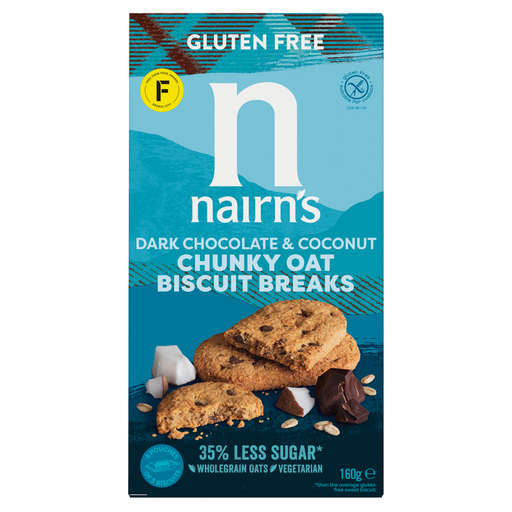
Consider this gluten-free oat-biscuit variety if that is your main requirement. Dark and coconut distinguish this 160g variant; check its own sugars per 100 g rather than applying figures from a different Nairn's Biscuit Breaks product.
 No image available
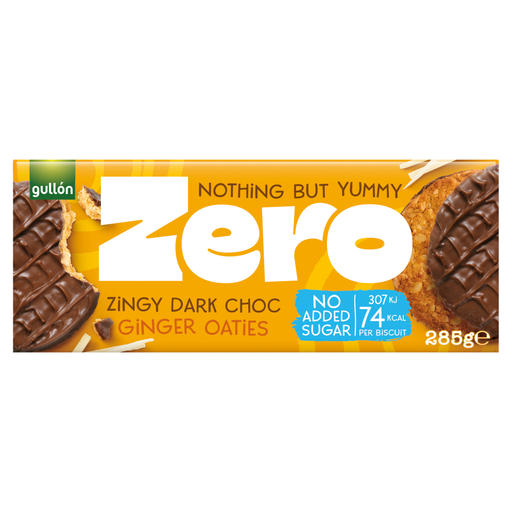
This 285g dark-chocolate-and-ginger oat-biscuit variety offers a different flavour and format from a sandwich cookie. If sugar-free is essential, confirm the precise claim and sugars per 100 g on this pack; the Zero range name is not a substitute for its label.
 No image available
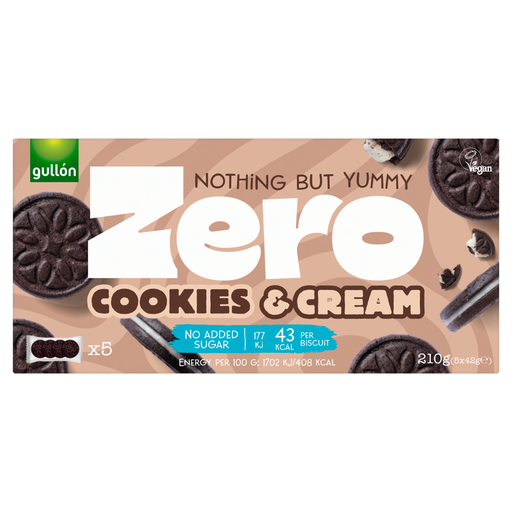
Choose this 210g cookies-and-cream variety for its filled-biscuit format if no-added-sugar wording meets your needs. That wording does not mean sugar-free: read the pack's sugars per 100 g, ingredients and serving information before deciding.
The sugar-free definition in the legislation.gov.uk annex uses a limit of no more than 0.5 g sugars per 100 g of food. Check the claim and the per-100g figure on the exact pack; no added sugar and lower sugar are not the same wording.
No. A sugar-free biscuit can still contain carbohydrate and energy from its other ingredients. Diabetes UK notes that polyol sweeteners also contain carbohydrate and calories, so compare the full nutrition panel as well as sugars.
Some biscuits use polyol sweeteners, and an excessive-consumption warning may be relevant to the particular product. Tesco's listing for Gullón Sugar Free Maria Cookies carries such a warning; read the current pack of whichever biscuit you choose rather than assuming every variety has identical ingredients or advice.
Not necessarily: gluten-free and sugar-free address different characteristics. Sainsbury's lists 20.5 g sugars per 100 g for Nairn's gluten-free Chocolate Biscuit Breaks, so check both claims and the nutrition table for your chosen variety.
No universal swap follows from a sugar-free label. Diabetes UK says people with diabetes do not need to eliminate sugar entirely, while polyols still contribute carbohydrate; anyone managing carbohydrate intake or adjusting insulin should discuss individual decisions with their healthcare team.