Do not treat Free From custard creams as sugar-free: Sainsbury's lists 24.9 g sugars per 100 g for its Free From biscuits, and ASDA lists 25 g per 100 g for its version. If the custard-cream format matters, check the sugar-free claim and nutrition declaration on the exact pack; if you can change biscuit type, a sugar-free-labelled sandwich biscuit is another route, with different ingredients and flavour.
Who is this choice for?
Shoppers looking for a sugar-free custard cream
If a custard cream is the biscuit you want, keep both parts of the requirement: the familiar sandwich-biscuit format and a sugar-free claim. A smaller serving or a Free From label does not establish that the biscuit is sugar-free.
Shoppers checking both allergens and sugars
Gluten-free or milk-free labelling answers a different question from sugar content. Sainsbury's and ASDA describe their Free From custard creams as gluten- and milk-free, but list 24.9 g and 25 g sugars per 100 g respectively.
Shoppers willing to change biscuit type
A sugar-free-labelled sandwich biscuit may be worth considering if a custard cream is not essential. Compare its flavour, ingredients, allergens and carbohydrate declaration with what you need, rather than assuming the change is like for like.
What should you check?
Decide whether the custard-cream format is essential, then check the exact pack for its sugar claim, nutrition figures and ingredients.
| Priority | What to check | Your needs |
|---|
| Sugar claim |
Look for a sugar-free claim on the exact product. Read sugars per 100 g in the nutrition declaration; a per-biscuit figure answers a separate portion question. |
I want a biscuit labelled sugar-free, not one that merely has a small-looking figure per biscuit. |
| Allergens |
Read the ingredients and allergen statement separately from the sugar figure. Sainsbury's and ASDA list around 25 g sugars per 100 g for their gluten- and milk-free custard creams. |
If I need to avoid gluten or milk as well as sugar, I need to check both requirements on the same pack. |
| Biscuit type |
Check whether it is a custard cream, another cream-filled sandwich biscuit or a digestive. Compare the flavour and filling before switching categories. |
A different sandwich biscuit could work after supper, but I do not want to mistake it for a custard cream. |
| Sweeteners |
Identify any sweeteners in the ingredients and read the carbohydrate declaration. Diabetes UK notes that polyols contain carbohydrate and calories. |
If I choose a sweetener-based biscuit, the sugar-free wording alone does not tell me its carbohydrate content. |
Common buying mistakes
-
Reading Free From as sugar-free
Free From identifies particular excluded ingredients. Sainsbury's Free From Custard Creams list 24.9 g sugars per 100 g, while ASDA Free From Custard Creams list 25 g per 100 g.
Check the sugar claim and sugars per 100 g independently of gluten-free, milk-free or vegan wording.
-
Using a per-biscuit figure to judge the whole product
Tesco lists 3.4 g sugars per biscuit for its standard custard creams and 28.3 g per 100 g. A Bestway Wholesale listing gives 3.6 g per biscuit and 30.7 g per 100 g for McVitie's Custard Creams.
Use the per-100-g figure when checking the product's sugar content, then use the per-biscuit figure to understand a serving.
-
Assuming another sugar-free biscuit is a custard cream
Gullón describes Zero Cookies & Cream as a sugar-free cocoa sandwich biscuit made with maltitol. Its flavour and ingredients differ from those of a custard cream; Diabetes UK notes that polyols contain carbohydrate and calories.
Choose a different biscuit type only if its format works for you, and check its ingredients, allergens and carbohydrate declaration.
Brand and product-line references
These examples show why the sugar figure needs checking on the particular biscuit, rather than judging it by a brand or product range.
Sainsbury's
Its 125 g Free From Custard Creams address gluten- and milk-free requirements.
- Sainsbury's describes the biscuits as milk- and gluten-free.
- Its nutrition panel lists 24.9 g sugars per 100 g and 3.5 g per biscuit; this is not a sugar-free substitute.
ASDA
Its 125 g Free From custard creams address gluten- and milk-free requirements.
- ASDA identifies this product as free from gluten and milk.
- The nutrition panel lists 25 g sugars per 100 g and 3.5 g per biscuit.
Tesco
Tesco's standard 400 g custard creams are conventional sandwich biscuits, not a sugar-free choice.
- The Tesco listing gives both per-biscuit and per-100-g sugar figures.
- It lists 28.3 g sugars per 100 g and 3.4 g per biscuit.
McVitie's
The 300 g Custard Creams listed by Bestway Wholesale are a conventional cream-filled biscuit.
- The listing provides sugars figures per 100 g and per biscuit.
- It lists 30.7 g sugars per 100 g and 3.6 g per biscuit, so this product does not meet a sugar-free requirement.
Gullón
Zero Cookies & Cream is an alternative for shoppers open to a cocoa sandwich biscuit instead of a custard cream.
- Gullón describes this product as sugar-free and lists maltitol as a sweetener.
- It is not a custard cream; its ingredients include wheat and soya.
Joybuy biscuit options
These options are for shoppers willing to choose a different sugar-free-labelled biscuit for late-night supper. Neither is a custard cream: one is a sandwich cookie and the other is a digestive.
 No image available
Oreo Zero Sugar Sandwich Cookies, 97g
A sandwich-cookie option if the filled-biscuit format matters more than choosing a custard cream. Check the pack's sugars per 100 g, sweeteners and allergen statement for your requirements.
View on Joybuy
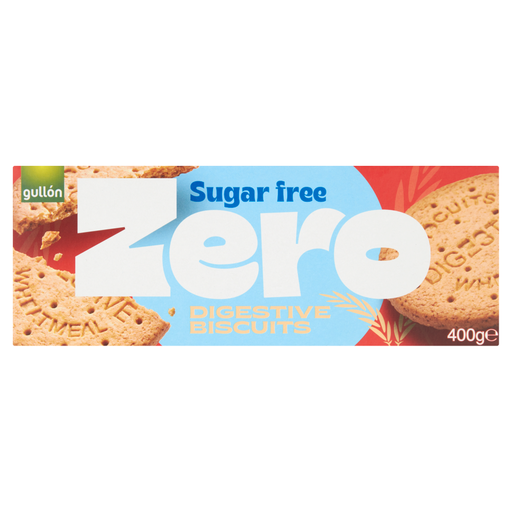 No image available
Gullon Zero Sugar Free Original Digestives, 400g
A digestive option if you do not need a cream-filled biscuit. Check the pack's sugars per 100 g, sweeteners and allergen statement before choosing it.
View on Joybuy
Questions about sugar-free biscuits
Are Free From custard creams sugar-free?
Not necessarily. Free From refers to the specified excluded ingredients: Sainsbury's Free From Custard Creams list 24.9 g sugars per 100 g, and ASDA's list 25 g per 100 g. Check sugar content separately.
Which nutrition figure should I check?
Start with sugars per 100 g on the exact pack when assessing its sugar-free claim. The per-biscuit figure serves a different purpose: it shows the sugars in one biscuit.
Does sugar-free mean carbohydrate-free?
No. Diabetes UK notes that polyols contain carbohydrate and calories. If a biscuit uses sweeteners such as maltitol, check its ingredients and carbohydrate declaration rather than relying on the sugar-free wording alone.
What should I check before buying biscuits for late-night supper?
Check the current pack's sugars per 100 g, per-biscuit serving figure, ingredients and allergen statement. Confirm that it is the biscuit type you want, particularly if you are switching from custard creams to sandwich cookies or digestives.


