Travellers seeking a sugar-free biscuit
If a familiar custard cream is your first choice, check its sugars per 100 g before packing it. A biscuit labelled ‘no added sugar’ or ‘free from’ answers a different question.


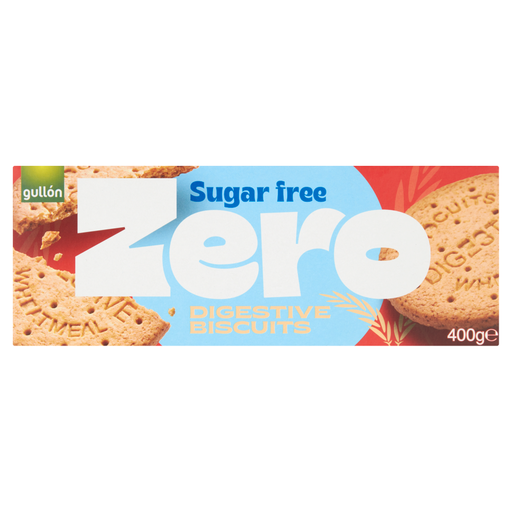
Do not assume a custard cream is sugar-free: the Tesco, Sainsbury’s, Asda, M&S and Schär products discussed here all list more than 0.5 g sugars per 100 g. Business Companion’s February 2025 guidance gives 0.5 g per 100 g as the maximum for a sugar-free claim on solid food. If that condition matters more than the custard-cream format, Asda lists Gullón Zero Digestive Original at less than 0.5 g sugars per 100 g; it is a different biscuit, and its sweetener warning is worth reading before packing several servings.
If a familiar custard cream is your first choice, check its sugars per 100 g before packing it. A biscuit labelled ‘no added sugar’ or ‘free from’ answers a different question.
A sugar-free claim does not give the total carbohydrate or the amount in the portion you plan to eat. Read both figures on the product you choose.
Check the ingredients and allergen statements on the actual pack. A gluten- or milk-free custard cream and a sugar-free wheat digestive address different requirements.
Decide whether the sugar-free condition or the custard-cream format matters more, then check the exact pack for ingredients, portion information and storage instructions.
| Priority | What to check | Your needs |
|---|---|---|
| Sugar-free claim | Compare sugars per 100 g with the 0.5 g per 100 g sugar-free claim condition in Business Companion’s February 2025 guidance. Check ‘no added sugar’ and ‘free from’ claims separately. | I need the biscuit itself to qualify as sugar-free, even if that means choosing a digestive instead of a custard cream. Asda lists Gullón Zero Digestive Original at less than 0.5 g sugars per 100 g; Joybuy’s Gullón Zero Cookies and Cream listing states 2.4 g per 100 g despite its no-added-sugars description. |
| Carbohydrate and sweeteners | Read total carbohydrate, the intended serving and any sweetener warning. Asda lists 68 g carbohydrate per 100 g for Gullón Zero Digestive Original and names isomalt and maltitol. | If I plan to eat several biscuits on the train, I want to know what is in that portion. Asda’s Gullón digestive listing warns that excessive consumption may produce a laxative effect. |
| Allergens and packing | Check the current pack’s allergen declaration and storage instructions. Asda’s Gullón digestive listing identifies wheat and says to keep the biscuits cool and dry and close the pack after use. | I need a biscuit that fits the allergens I avoid and can be packed as its label directs. Tesco Free From Custard Creams are labelled gluten- and milk-free, but Tesco lists 19.9 g sugars per 100 g for them. |
| Custard-cream format | Compare the exact product’s sugars per 100 g and per biscuit. Tesco Custard Cream Biscuits 400g list 28.3 g per 100 g and 3.4 g per biscuit. | I may prefer a vanilla-filled custard cream and choose my portion accordingly, without treating it as sugar-free. |
Tesco Free From Custard Creams are labelled gluten- and milk-free, yet Tesco lists 19.9 g sugars per 100 g for that product.
Check the stated allergen exclusions and the sugars-per-100 g line separately.
Joybuy describes Gullón Zero Cookies and Cream as having no added sugars, while its listing states 2.4 g sugars per 100 g.
When you need a sugar-free biscuit, compare the exact product’s declaration with the 0.5 g per 100 g condition set out in Business Companion’s guidance.
Asda’s Gullón Zero Digestive Original listing names isomalt and maltitol and warns that excessive consumption may produce a laxative effect.
Read the ingredients and warning when deciding how much of this biscuit to take on the journey.
These examples show why the biscuit type and the nutrition declaration matter more than the brand name alone.
A digestive alternative if you can forgo the custard-cream filling.
Own-label custard creams in ordinary and Free From versions.
Ordinary custard creams and a separate milk- and gluten-free version.
An own-label custard cream alongside a separately branded Gullón digestive listing.
Extra Cream Custard Creams for those choosing the filled-biscuit format.
Gluten-free custard creams supplied in portion packs.
These are sandwich-biscuit and digestive alternatives to a custard cream for a train journey. Check the current pack’s sugars per 100 g if a sugar-free claim is essential to your choice.
 No image available
A filled sandwich biscuit rather than a custard cream. Before packing it, check this pack’s sugars per 100 g, ingredients and intended portion against your requirements.
 No image available
An unfilled digestive for someone willing to change biscuit format. Check this exact pack’s sugars per 100 g, ingredients and consumption warning rather than applying figures from a different retailer’s listing.
No. The claim identifies what the particular product excludes: Tesco Free From Custard Creams are labelled gluten- and milk-free, but Tesco lists 19.9 g sugars per 100 g for them. Check both the exclusion and the nutrition declaration.
Business Companion’s February 2025 guidance states that a sugar-free claim on solid food requires no more than 0.5 g sugars per 100 g. A ‘no added sugar’ description alone does not establish that a biscuit meets this condition; read the declaration for the exact product.
No. Asda lists 68 g total carbohydrate per 100 g for Gullón Zero Digestive Original, alongside less than 0.5 g sugars per 100 g. Check total carbohydrate and your planned portion separately from the sugars claim.
Follow the instructions on the pack you buy. Asda’s Gullón Zero Digestive Original listing says to keep it cool and dry and close the pack after each use; check the physical pack’s best-before information as well.
Read the actual pack’s ingredients and allergen statements before choosing it. GOV.UK’s allergen-labelling guidance says regulated allergens in prepacked food must be clearly labelled in the ingredients list; Asda’s Gullón digestive listing identifies wheat and says it may contain milk and soya.