Organisers with a strict sugar-free brief
Check the sugar-free claim and sugars declaration rather than relying on a gluten-free, milk-free or vegan label. A cream-biscuit alternative may be needed if the custard-cream format is flexible.


For a strict sugar-free meeting brief, look for an explicit sugar-free claim and check the current sugars declaration. Tesco lists Diablo sugar-free vanilla-and-cocoa cream cookies, but they are not traditional custard creams. Tesco and Asda free-from custard creams declare 19.9 g and 25 g sugars per 100 g respectively, so they suit different dietary requirements rather than a sugar-free brief.
Check the sugar-free claim and sugars declaration rather than relying on a gluten-free, milk-free or vegan label. A cream-biscuit alternative may be needed if the custard-cream format is flexible.
Check sugar and allergen requirements separately, then keep the chosen biscuits’ ingredient and allergen details available when serving them.
Conventional custard creams remain an option when sugar-free and relevant free-from requirements do not apply. Check each pack before offering them as a shared refreshment.
Choose when: the sugar-free brief matters more than serving a traditional custard cream.
Trade-off: Tesco’s Diablo example has vanilla biscuits and cocoa cream, and its listing declares wheat, milk and soya.
Choose when: attendees need a custard cream labelled gluten-free, milk-free and vegan.
Trade-off: Tesco and Asda free-from custard creams declare sugars and do not meet a strict sugar-free brief.
Choose when: the meeting calls for familiar custard creams without a sugar-free or relevant free-from requirement.
Trade-off: the Sainsbury’s and Asda examples declare sugars and contain wheat and milk.
| Priority | What to check | Your needs |
|---|---|---|
| Sugar-free claim | Check the exact claim and sugars per 100 g. Legislation.gov.uk lists no more than 0.5 g sugars per 100 g or 100 ml as the sugar-free claim criterion; a “free from” label refers to a different property. | If the meeting brief says sugar-free, I need to check sugars rather than assume a free-from custard cream qualifies. |
| Allergens | Read the current ingredients, allergen declaration and any free-from claims for each product. Tesco’s Diablo cookie listing declares wheat, milk and soya. | Before putting biscuits out for everyone, I need to match the packs to attendees’ known requirements and make their allergen details accessible. |
| Biscuit format | Check whether the product is a custard cream, a different cream-filled biscuit or an unfilled biscuit, as well as its stated flavour. | Would a cocoa-cream cookie or a digestive work for this meeting, or are people expecting custard creams? |
Tesco Free From Custard Creams declare 19.9 g sugars per 100 g; Asda Free From Custard Creams declare 25 g per 100 g. Their gluten-free and milk-free positioning does not make them sugar-free.
Check the sugars declaration against the meeting brief before considering other dietary claims.
Tesco describes the Diablo option as a vanilla sandwich biscuit with cocoa cream, so it changes the flavour and format of the refreshments.
Name the biscuit accurately on the meeting refreshment list if the distinction matters to attendees.
Tesco’s Diablo listing declares wheat, milk and soya. Sugar-free does not mean suitable for people avoiding those ingredients.
Keep the original labelled packs or a clear ingredient and allergen list available beside the refreshments.
Tesco lists two different routes: Diablo sugar-free vanilla-and-cocoa cream cookies through its Marketplace, and Tesco Free From Custard Creams.
Asda provides both free-from and conventional custard-cream examples for comparing meeting requirements.
Sainsbury’s standard Custard Creams are a conventional biscuit option when sugar-free is not required.
M&S describes its Extra Cream Custard Creams as containing custard powder and extra vanilla cream.
These Joybuy options are labelled for a sugar-free biscuit choice at a meeting: one is a sandwich cookie and the other is a digestive, rather than a custard cream. Check the current pack’s sugars declaration and allergens against the meeting requirements.
 No image available
A sandwich-cookie option if the meeting can accommodate a different flavour and format from custard creams. Check the current sugars declaration and allergen list before serving.
 No image available
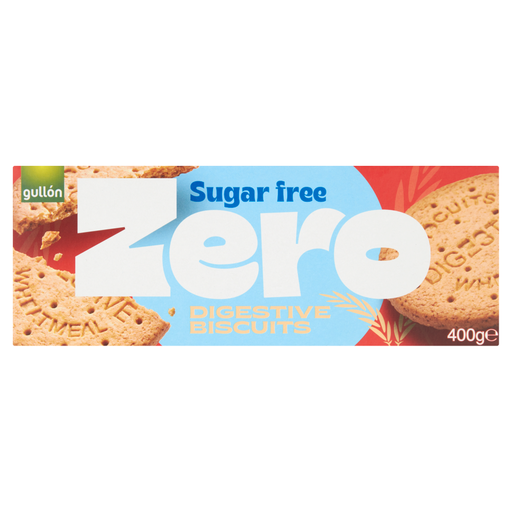
A 400g digestive-biscuit option if neither custard-cream flavour nor a cream filling is required. Check the current sugars declaration and allergen information against attendees’ needs.
No. Tesco Free From Custard Creams declare 19.9 g sugars per 100 g, and Asda Free From Custard Creams declare 25 g per 100 g. Legislation.gov.uk lists no more than 0.5 g sugars per 100 g or 100 ml as the criterion for a sugar-free claim.
It can if meeting the sugar-free brief matters more than serving the traditional biscuit. Tesco describes its Diablo sugar-free option as a vanilla sandwich biscuit with cocoa cream, so tell attendees what is being served rather than calling it a custard cream.
No single sugar-free claim establishes allergen suitability. Tesco’s Diablo cookie listing declares wheat, milk and soya; check attendees’ requirements and the current pack before serving it.
Keep the original labelled packs or a clear ingredient and allergen list where people can consult them. The Food Standards Agency’s guidance addresses allergen information for food businesses serving both prepacked and non-prepacked food; for any meeting, the practical point is not to rely on memory when answering ingredient questions.