Shoppers seeking a sugar-free tea biscuit
Look for an explicit sugar-free claim and compare the sugars value per 100 g. A biscuit labelled free from gluten or milk does not meet this need on that basis alone.


If sugar-free is essential, choose a biscuit with an explicit sugar-free claim rather than assuming a free-from custard cream qualifies. Tesco and Sainsbury’s list gluten-free, milk-free custard creams for a different need, while their conventional custard creams contain sugars. Check the current pack’s claim and nutrition panel before deciding.
Look for an explicit sugar-free claim and compare the sugars value per 100 g. A biscuit labelled free from gluten or milk does not meet this need on that basis alone.
If the custard-cream format matters, Tesco and Sainsbury’s list free-from versions described as gluten-free and milk-free. Check the current ingredients and allergen information for the particular pack.
Conventional cream-filled biscuits suit a tea break when a sugar-free claim is not required. The standard Tesco and Sainsbury’s products list sugars per biscuit, so compare their serving information if that affects your choice.
Decide whether the essential requirement is a sugar-free claim, avoidance of particular ingredients or the custard-cream format; those labels answer different questions.
| Priority | What to check | Your needs |
|---|---|---|
| Sugar-free claim | Look for the claim on the current pack and read sugars per 100 g. The nutrition-claims annex published by legislation.gov.uk gives a criterion of no more than 0.5 g sugars per 100 g for a sugar-free claim on solid food. | If sugar-free is essential to my choice, I would consider a biscuit in another style rather than assume a custard cream qualifies. |
| Gluten or milk | Read the stated dietary suitability, ingredients and allergen information for the exact pack. Tesco and Sainsbury’s describe their free-from custard creams as gluten-free and milk-free. | I want a custard-cream-style biscuit while avoiding gluten or milk; I would not treat that suitability as a sugar-free claim. |
| Carbohydrate information | Read the carbohydrate line as well as sugars and check which sweeteners are listed. Diabetes UK notes that polyols contain carbohydrate and calories. | When carbohydrate information matters to my choice, a sugar-free label alone does not tell me what I need to know. |
| Tea-biscuit format | Compare a cream-filled sandwich biscuit with other biscuit styles, then check the serving information. Tesco lists 3.4 g sugars per biscuit for its standard custard creams; Sainsbury’s lists 3.3 g for its standard version. | For tea, I may prefer the familiar cream-filled format if I do not require a sugar-free biscuit. |
Gluten-free, milk-free and vegan statements describe different aspects of a biscuit. They do not establish its sugars content.
If sugar-free is your requirement, check for that claim and read sugars per 100 g on the current pack.
The standard Tesco and Sainsbury’s custard creams list 3.4 g and 3.3 g sugars per biscuit respectively. Neither figure describes a sugar-free biscuit.
Choose a conventional custard cream for its format when that suits your needs; choose a biscuit with a sugar-free claim when the claim is essential.
Diabetes UK notes that polyols contain carbohydrate and calories. The sugars line alone therefore does not describe all the carbohydrate in a biscuit.
Read both the carbohydrate and sugars lines, along with the ingredient list, when comparing products.
Ingredients and dietary information can change, so a familiar product name is not enough for an ingredient or sugar decision.
Read the pack you are buying, particularly its ingredients, allergen information and nutrition panel.
Tesco lists both standard custard creams and a separate Free From Custard Creams product.
Sainsbury’s lists conventional and Free From custard creams for different ingredient requirements.
McVitie’s Tasties Custard Creams are a conventional cream-filled biscuit option.
Crawford’s custard creams are sandwich biscuits with a vanilla-flavour cream filling, according to Tesco’s listing.
M&S describes its Extra Cream Custard Creams as containing extra vanilla cream and custard powder.
Gullón’s Zero range offers biscuit styles other than custard creams for shoppers considering a sugar-free alternative.
These Joybuy selections are sugar-free-labelled biscuits for tea in styles other than custard creams: one sandwich cookie and one digestive.
 No image available
The Zero Sugar-labelled sandwich-cookie format is an alternative when you want a filled biscuit with tea, but it is not a custard cream. Check the current pack’s nutrition and ingredients for your requirements.
 No image available
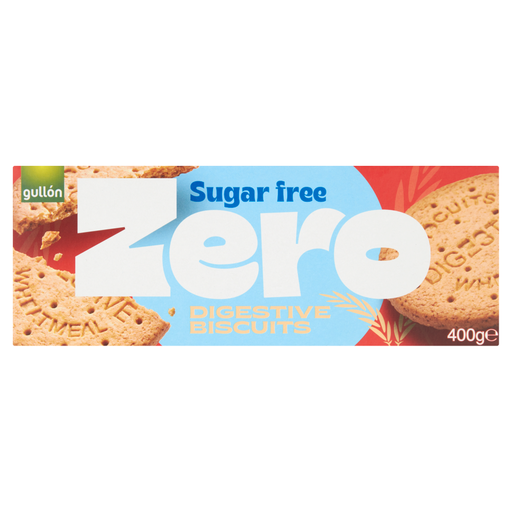
This Sugar Free-labelled digestive offers a tea-biscuit format without the cream filling of a custard cream. The product information warns that excessive consumption may have a laxative effect; read the current pack for its ingredients and nutrition.
The nutrition-claims annex published by legislation.gov.uk gives a criterion of no more than 0.5 g sugars per 100 g for a sugar-free claim on solid food. Check the claim and the sugars-per-100 g value on the current pack rather than relying on a product category.
Not automatically. Tesco and Sainsbury’s describe their free-from custard creams as gluten-free and milk-free, but those statements do not tell you that the biscuits meet a sugar-free claim criterion. Read the current nutrition panel if sugars are your deciding factor.
No. Diabetes UK notes that polyols contain carbohydrate and calories. Check the carbohydrate and sugars lines separately rather than using ‘sugar-free’ as a description of the biscuit’s total carbohydrate.
Ingredients and dietary information can change. Read the current pack’s ingredient list, allergen information and nutrition panel, especially when avoiding sugar, gluten or milk affects your choice.
A Joybuy listing identifies Schär Gluten Free Custard Creams as gluten-free; that description alone does not make them sugar-free. If you need both the custard-cream format and a sugar-free claim, check the exact product’s current pack and sugars per 100 g before choosing it.