Families looking for a sugar-free half-term snack
A free-from claim addresses a different requirement. If sugar-free status is essential, check the exact claim and sugars per 100 g rather than relying on the biscuit's name or format.


Do not treat a free-from custard cream as sugar-free: Tesco and Sainsbury's list 2.8 g and 3.5 g sugars per biscuit respectively for their Free From versions. If sugar-free status is essential for a half-term snack, check the exact claim and sugars per 100 g on the current pack; the Joybuy biscuits below offer different formats, not custard creams.
A free-from claim addresses a different requirement. If sugar-free status is essential, check the exact claim and sugars per 100 g rather than relying on the biscuit's name or format.
A free-from custard cream may address those exclusions, but its sugar content needs a separate check. Tesco and Sainsbury's both list sugars per biscuit for their Free From products.
Check the nation, school setting and applicable food requirements before choosing a snack. The Department for Education's school-food guidance covers state-funded schools in England; it is distinct from England's retailer-promotion guidance on certain foods high in fat, salt or sugar.
Decide whether the non-negotiable requirement is a sugar-free claim, a dietary exclusion or simply a custard-cream biscuit, then compare labels on the same basis.
| Priority | What to check | Your needs |
|---|---|---|
| Sugar-free claim | Look for an explicit claim and read sugars per 100 g. The sugar-free claim condition in the annex to Regulation (EC) No 1924/2006, published on legislation.gov.uk, is no more than 0.5 g sugars per 100 g for food. | If sugar-free is essential, I need the pack's claim and per-100-g figure, not just a small per-biscuit serving value. |
| Dietary exclusions | Check the relevant gluten-free, milk-free or vegan declaration separately from sugars. Tesco lists 2.8 g sugars per biscuit for its Free From custard creams; Sainsbury's lists 3.5 g for its Free From version. | Our household may need to avoid gluten or milk, but that does not answer a separate sugar-free requirement. |
| Snack portion | Compare the stated serving with the number of biscuits being packed. Sainsbury's lists 3.3 g sugars per biscuit for its standard custard creams, while Asda lists 3.4 g per biscuit for its standard version. | For a conventional custard-cream treat, I want to know what the label's per-biscuit figure represents before packing several. |
| Whole label | Read the ingredients and nutrition information as well as the sugar claim. The Office for Health Improvement and Disparities notes that non-sugar sweeteners can provide sweet taste for fewer or no calories than sugar; that fact alone does not describe a biscuit's full nutritional profile. | A sugar-free claim matters to me, but I also want to check the other ingredients and nutrition values. |
Free-from declarations can address dietary exclusions without addressing sugar. Sainsbury's lists 3.5 g sugars per biscuit for its Free From custard creams, and Tesco lists 2.8 g for its version.
Match the claim to your requirement: check the relevant dietary declaration for an exclusion, and check the sugar-free claim and sugars per 100 g for a strict sugar-free choice.
Standard custard creams still need a label check. Sainsbury's lists 3.3 g sugars per biscuit and Asda lists 3.4 g per biscuit; M&S lists 40.2 g per 100 g for Extra Cream Custard Creams.
Compare the current pack's per-biscuit and per-100-g figures, keeping the different measurement bases distinct.
The Department of Health and Social Care's HFSS guidance concerns promotion and placement of certain foods by retailers in England. The Department for Education's school-food guidance addresses food provided in state-funded schools in England.
For a school-provided snack, establish the nation and school setting, then check the food requirements and local policy that apply there.
These product-label examples show why a familiar brand or a free-from range cannot replace a check of the particular pack.
Tesco lists a Free From Custard Creams 125G variant alongside conventional custard creams.
Sainsbury's lists standard Custard Creams 200g and Free From Custard Creams 125g.
Asda lists Custard Creams 400g as a conventional biscuit option.
M&S lists Extra Cream Custard Creams as a conventional custard-cream option.
Crawford's Custard Creams Sandwich Biscuits 300g are listed as a conventional sandwich biscuit by Iceland Foods.
B&M describes McVitie's Tasties Custard Creams 300g as biscuits with a custard-flavour filling.
These are biscuits to consider when a sugar-free snack matters more than finding a custard cream: one is a sandwich cookie and the other a digestive. Check the current pack's claim and sugars per 100 g before choosing.
 No image available
This sandwich-cookie format may suit a half-term snack when a custard cream is not essential. The product name says Zero Sugar; check the current pack's sugars per 100 g and ingredients against your requirements. It is not a custard cream.
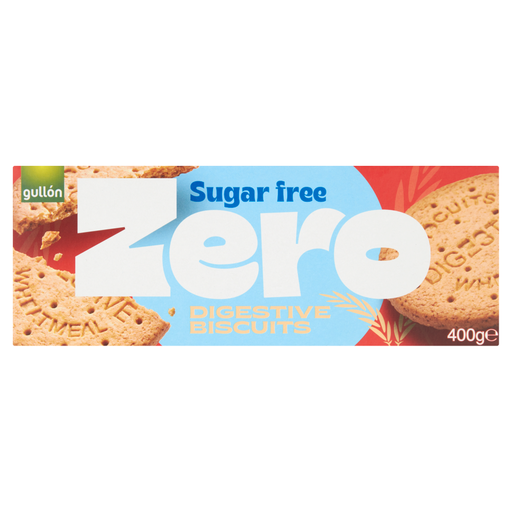 No image available
This is a digestive biscuit for a snack choice that does not require a custard-cream format. Its name says Zero Sugar Free; check the current pack's sugars per 100 g and ingredients before deciding. It is not a custard cream.
No. Gluten-free and milk-free declarations address different requirements from a sugar-free claim. The claim condition in the annex to Regulation (EC) No 1924/2006, published on legislation.gov.uk, is no more than 0.5 g sugars per 100 g for food; check the exact claim and current nutrition panel.
Do not choose either on the strength of its Free From name. Tesco lists 2.8 g sugars per biscuit and Sainsbury's lists 3.5 g per biscuit for their respective Free From custard creams; check a product's explicit sugar-free claim and sugars per 100 g instead.
No. Check the ingredients and full nutrition information for the particular biscuit as well as its sugar claim. The Office for Health Improvement and Disparities notes that non-sugar sweeteners can provide sweet taste for fewer or no calories than sugar, but that does not describe every other attribute of a product.