Families comparing sugar figures
If a ginger-flavoured holiday treat appeals but declared sugars matter, compare figures per 100g rather than relying on the front-of-pack wording alone. Check the rest of the nutrition panel too.


Choose a sugar-free or no-added-sugar ginger biscuit if reducing declared sugars is the main aim, but compare the figure per 100g and check sweeteners and allergens before serving it. A biscuit labelled “less sugar” or “free from” answers a different need; none of these claims settles how the biscuit fits into a school-holiday snack routine.
If a ginger-flavoured holiday treat appeals but declared sugars matter, compare figures per 100g rather than relying on the front-of-pack wording alone. Check the rest of the nutrition panel too.
Wheat-free or gluten-free requirements call for a product-specific ingredient and allergen check. A “free from” label does not, by itself, describe the biscuit’s sugar content.
Food provided in a state-funded school in England raises a separate question from snacks eaten at home during the holidays. Check the school-food requirements and the provider’s arrangements for the setting involved.
Start with the claim that matters to you, then compare the nutrition panel and ingredients for the specific biscuit.
| Priority | What to check | Your needs |
|---|---|---|
| Declared sugars | Compare sugars per 100g and the exact wording: “sugar free”, “no added sugar” and “less sugar” make different claims. Farmhouse Biscuits declares 0.2g sugars per 100g for its Sugar Free Ginger Biscuits; the Traditional Sweets listing gives 0.5g per 100g for Simpkins No Added Sugar Ginger Biscuits. | I want a ginger biscuit with a clearly stated sugars figure, not just a claim that sounds suitable. |
| Sweeteners and allergens | Read the ingredient list, allergen statement and any pack warning. The Traditional Sweets listing declares 22.7g polyols per 100g for Simpkins; Farmhouse Biscuits warns that excessive consumption of its sugar-free biscuits may produce laxative effects. | If a child needs to avoid an ingredient, I need to check the exact packet before serving it. |
| Whole nutrition panel | Look beyond sugars to the other per-100g values and the amount being served. For comparison, Tesco lists 25.5g sugars per 100g for its standard Ginger Nut Biscuits; Farmhouse Biscuits lists 26.1g fat per 100g for its sugar-free ginger biscuits. | Reducing sugars matters to me, but I do not want one figure to stand in for the whole snack choice. |
| Type of biscuit | Check what a comparison or “free from” claim refers to. Waitrose lists Nairn’s Gluten Free Oat & Ginger Biscuit Breaks as having 40% less sugar than the average gluten-free sweet biscuit; that is not a sugar-free claim. Tesco describes its Free From Ginger Nuts as gluten free. | I may care more about a gluten-free format or ginger-nut flavour than a sugar-free claim. Those choices need different label checks. |
| Where it is served | Distinguish home snacks from food provided by a school. The Requirements for School Food Regulations 2014 restrict cakes and biscuits provided otherwise than as part of a school lunch; Department for Education guidance identifies its school-food scope as state-funded schools in England. | For snacks at home during the holidays, I can focus on the product and portion. If I am supplying food through a school, I need to check the rules for that setting. |
The claim concerns sugars, not every nutrition value. Farmhouse Biscuits declares 26.1g fat per 100g for its Sugar Free Ginger Biscuits and warns about laxative effects from excessive consumption.
Compare the full nutrition panel and decide how much to serve rather than using the sugar claim to set the portion.
These labels answer different questions. Waitrose’s 40%-less-sugar description for Nairn’s Gluten Free Oat & Ginger Biscuit Breaks compares them with an average gluten-free sweet biscuit; Tesco’s Free From Ginger Nuts are described as gluten free.
Read the precise claim and the sugars figure on each product’s current pack.
A small sugars figure does not remove the need to check the recipe. The Simpkins listing declares polyols, while Farmhouse Biscuits carries a warning that excessive consumption may produce laxative effects.
Check sweeteners, allergens and any warning on the packet, particularly when choosing food for a child with an ingredient restriction.
The biscuit restriction in The Requirements for School Food Regulations 2014 concerns food provided otherwise than as part of a school lunch; it is not a rule about a family’s snacks at home during school holidays.
For food supplied through a state-funded school in England, check the requirements for that provision and any relevant school arrangements.
Its Sugar Free Ginger Biscuits are an option to compare when declared sugars are the deciding figure.
Its No Added Sugar Ginger Biscuits offer a differently worded claim from “sugar free”.
Its ginger-biscuit ranges provide wheat-free or gluten-free formats to assess separately from a sugar-free requirement.
Its standard and Free From ginger nuts serve different label-checking needs.
This ginger-oat biscuit includes dark chocolate. If sugars are the deciding factor for a school-holiday snack, compare its current pack label with the alternatives described above.
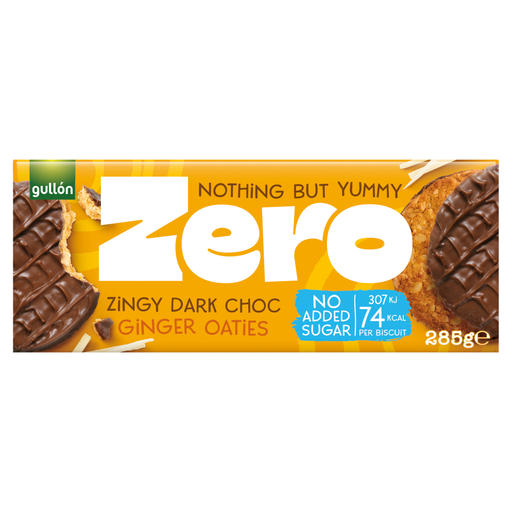 Image unavailable
For a ginger-flavoured holiday snack, check the current sugars-per-100g figure, sweeteners and allergen statement before choosing this dark-chocolate oat biscuit. The pack size is 285g.
No. Compare the exact claim with the sugars figure on the packet. For example, the Traditional Sweets listing for Simpkins No Added Sugar Ginger Biscuits declares 0.5g sugars per 100g, while Farmhouse Biscuits declares 0.2g per 100g for its separately labelled Sugar Free Ginger Biscuits.
No single sugar claim establishes that. Farmhouse Biscuits declares 26.1g fat per 100g for its Sugar Free Ginger Biscuits. NHS Healthier Families advises checking packaging and nutrition labels when buying snacks; use the whole panel and the amount served to inform your choice.
Farmhouse Biscuits warns that excessive consumption of its Sugar Free Ginger Biscuits may produce laxative effects. Read the warning on the current pack rather than treating a low sugars figure as a reason to serve an unrestricted amount.
No. Tesco describes its Free From Ginger Nuts as gluten free; that description does not give you their sugars figure. Check that product’s own nutrition panel if reducing sugars is the aim.
No. The biscuit restriction in The Requirements for School Food Regulations 2014 addresses food provided otherwise than as part of a school lunch, not snacks eaten at home. Department for Education guidance identifies the school-food requirements as applying to state-funded schools in England; check the relevant arrangements if food is being supplied through a school.