Snackers looking for sugar-free jelly
If a sugar-free label matters more than a chewy texture, prepared jelly is worth considering. Sainsbury's lists 0.5 g sugars per 145 g prepared serving for the checked Hartley's Strawberry Sugar Free crystals.


If sugar-free is the requirement for your afternoon break, choose a jelly labelled sugar-free: prepare crystals ahead, or choose a ready-to-eat pot when you can find one. Reduced-sugar chewy gums meet a different texture preference, but the checked M&S product lists 31.0 g sugars per 100 g, according to Marks & Spencer.
If a sugar-free label matters more than a chewy texture, prepared jelly is worth considering. Sainsbury's lists 0.5 g sugars per 145 g prepared serving for the checked Hartley's Strawberry Sugar Free crystals.
A jelly pot avoids making and setting crystals before the break. Sainsbury's describes the checked Hartley's 10 Cal Blueberry and Blackcurrant pot as sugar-free and vegan; check availability before relying on that particular product.
The checked Hartley's sugar-free crystals contain pork gelatine and aspartame, while the M&S reduced-sugar gums contain beef gelatine and sorbitol. Check the actual pack for gelatine, sweeteners and any phenylalanine warning relevant to your needs.
Choose when: You can make jelly before the afternoon break and want a product labelled sugar-free.
Bear in mind: The checked Hartley's crystals need boiling water, cooling and refrigeration, and contain pork gelatine.
Choose when: You want spoonable jelly without making it beforehand.
Bear in mind: Check current availability; the particular Hartley's 10 Cal pot reviewed here was listed as out of stock at Sainsbury's.
Choose when: Chewy texture matters more to you than a sugar-free label.
Bear in mind: Marks & Spencer lists 31.0 g sugars per 100 g for its Reduced Sugar Red and Black Gums.
| Priority | What to check | Your needs |
|---|---|---|
| Sugar wording | Look for a sugar-free claim if that is your requirement. Compare sugars per 100 g or 100 ml, and check whether serving figures describe prepared jelly or the product in its pack. | I want sugar-free jelly, rather than assuming that ‘reduced sugar’ means the same thing. |
| Preparation | Check whether the jelly is ready to eat. The checked Hartley's crystals require boiling water, cold water and time to cool and set in the fridge. | If my break is today, I need a ready-to-eat option; crystals make more sense when I can prepare them ahead. |
| Ingredients | Read the pack for gelatine source, vegan labelling, aspartame or E951, phenylalanine warnings and polyols such as sorbitol. The NHS notes that polyols can have a laxative effect in large amounts. | A fruit flavour does not tell me whether a jelly is vegan or which sweetener it contains. |
| Texture | Decide whether you want spoonable jelly or a chewy sweet. For the checked M&S gums, compare their 31.0 g sugars per 100 g with your reason for seeking a sugar-free product. | I may prefer a chewy gum, but I do not want its reduced-sugar wording to stand in for a sugar-free label. |
A reduced-sugar claim describes a comparison, not an absence of sugars. Marks & Spencer lists 31.0 g sugars per 100 g for its Reduced Sugar Red and Black Gums.
If sugar-free is your requirement, look for that wording on the product and read the sugars figure on its nutrition panel.
The checked Hartley's crystals must be mixed with water and given time to cool and set in the fridge; they are not ready to eat from the pack.
Make the jelly in advance, or look for a ready-to-eat pot and check its current availability.
The checked Hartley's crystals contain pork gelatine and aspartame; the checked M&S reduced-sugar gums contain beef gelatine and sorbitol. These distinctions matter when checking dietary ingredients or sweeteners.
Read the pack you intend to buy, including its gelatine source, vegan statement and any phenylalanine warning.
Hartley's provides the checked sugar-free jelly-crystal and ready-to-eat pot examples in this comparison.
The checked Reduced Sugar Red and Black Gums provide a chewy alternative for comparison, not a sugar-free jelly option.
Haribo Jelly Beans are a conventional sweets reference rather than a sugar-free selection here.
Tesco Fruit Pastilles offer a conventional fruit-sweet comparison.
This Joybuy option is a sugar-free strawberry jelly for a break you can prepare for in advance, rather than a ready-to-eat pot or a chewy sweet.
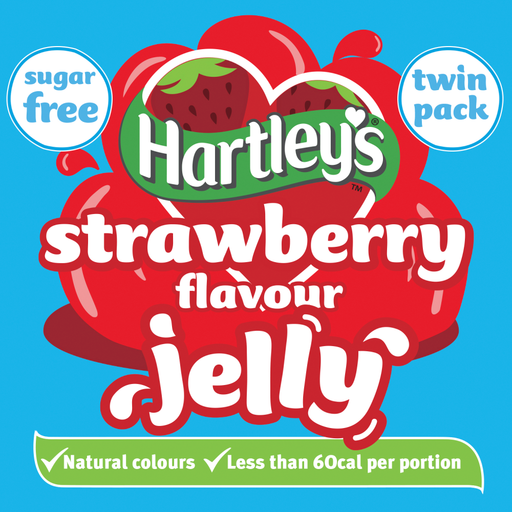 Image unavailable
Consider this 23g sugar-free jelly when you can prepare it before your afternoon break. It requires boiling water and time to set, rather than being ready to eat from the pack. Check the ingredients and phenylalanine warning on the product before choosing it for particular dietary needs.
No. The checked M&S Reduced Sugar Red and Black Gums list 31.0 g sugars per 100 g, according to Marks & Spencer. If you want a product labelled sugar-free, check that wording and the nutrition panel rather than relying on ‘reduced sugar’.
Yes, if you allow time for it to set. The checked Hartley's crystals are prepared with boiling and cold water, then cooled and refrigerated, so make them ahead rather than opening the pack at break time.
Sainsbury's describes the checked Hartley's 10 Cal Blueberry and Blackcurrant ready-to-eat pot as vegan. The checked Hartley's sugar-free crystals contain pork gelatine, so check the exact product and flavour you plan to buy.
Check the actual pack for gelatine, aspartame or E951, and any phenylalanine warning, particularly if phenylalanine is relevant to your dietary requirements. The checked Hartley's sugar-free crystals contain aspartame and carry that warning.
Not necessarily: the checked M&S reduced-sugar gums contain sorbitol, while the checked Hartley's sugar-free crystals contain aspartame. The NHS notes that polyols such as sorbitol can have a laxative effect if consumed in large amounts, so read the ingredients for the particular sweet you choose.