For a strict sugar-free choice, check the claim on the actual product: legislation.gov.uk sets the threshold at no more than 0.5g sugars per 100g or 100ml. Hartley’s Strawberry Jelly Sugar Free meets that figure as prepared, but it is a dessert that needs preparation, not a bag of chewy sweets. M&S Reduced Sugar Wine Gums offer a chewy format but list 31.0g sugars per 100g, so the format, ingredients and age warnings matter as much as the front-of-pack wording.
Who is choosing?
Households needing a sugar-free treat
If sugar-free is a firm requirement, check the product’s claim and sugars figure rather than assuming that a reduced-sugar sweet qualifies. Also decide whether a prepared jelly dessert will work in place of a chewy sweet.
Families looking for a chewy sweet with less sugar
A reduced-sugar claim may suit this preference without meeting a sugar-free requirement. M&S lists 31.0g sugars per 100g for its Reduced Sugar Wine Gums, so the nutrition panel remains important.
Families checking ingredients and age warnings
Sweeteners, gelatine, allergen information and age warnings can change whether a particular product suits the people sharing it. Check the pack received, not just the sugar claim.
What should you check?
Start with the sugar claim, then check whether the product’s format and label suit the planned half-term snack.
| Priority | What to check | Your needs |
|---|
| Sugar claim |
Compare sugars per 100g or 100ml on the same basis. Legislation.gov.uk sets the sugar-free claim threshold at no more than 0.5g; a reduced-sugar claim is different. |
If I need a sugar-free product, a chewy sweet labelled reduced sugar will not do unless its own label also supports a sugar-free claim. |
| Snack format |
Check whether it is ready-to-eat chewy confectionery or a jelly dessert that needs preparation and setting. Check the pack size and serving instructions. |
For a snack away from home, I need to know whether it can be served straight from the pack. |
| Ingredients and warnings |
Read the sweeteners, phenylalanine warning where relevant, gelatine source, allergen information and any age warning on the pack received. |
Before sharing it with children, I want to check that the specific ingredients and warnings fit everyone who will have some. |
| Portion |
Check sugars per serving as well as per 100g. ASDA lists 34g sugars per 100g for Haribo Fruitilicious; a share bag still needs a serving decision. |
When choosing standard jelly sweets, I want to plan how much to serve alongside the other foods and drinks that day. |
Common buying mistakes
-
Reading “reduced sugar” as “sugar-free”
The claims answer different questions. M&S lists 31.0g sugars per 100g for its Reduced Sugar Wine Gums, whereas legislation.gov.uk sets the sugar-free claim threshold at no more than 0.5g per 100g or 100ml.
Match the wording to your requirement, then compare the sugars figures on a consistent per-100g basis.
-
Buying jelly dessert instead of chewy sweets
Hartley’s Strawberry Jelly Sugar Free needs preparation and setting. Its sugar-free claim does not make it a ready-to-eat gummy sweet.
Decide whether the occasion calls for a prepared dessert or sweets that can be served from the pack.
-
Overlooking ingredients and age warnings
The named products have different sweeteners and gelatine sources; M&S also labels its Reduced Sugar Wine Gums unsuitable for children under 36 months because of a potential choking hazard.
Read the physical pack for sweeteners, phenylalanine information, gelatine, allergens and age suitability before serving.
-
Judging a fruit-flavoured sweet by its name
Fruit flavour does not establish its sugars content. ASDA lists 34g sugars per 100g for Haribo Fruitilicious.
Use the nutrition panel and serving information when deciding how much to offer.
Brand and product references
These details describe the named products, not every sweet or jelly sold under each brand.
Hartley’s
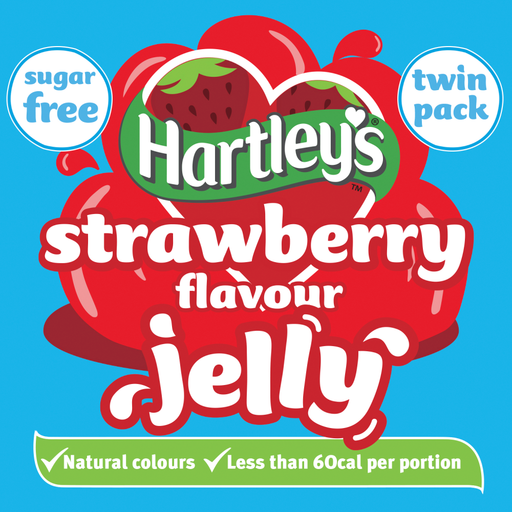
Strawberry Jelly Sugar Free 23g is a prepared jelly dessert rather than a chewy jelly sweet.
- Joybuy lists 0.5g sugars per 100g as prepared, alongside aspartame and acesulfame K.
- It requires preparation and contains pork gelatine; the listing also identifies it as a source of phenylalanine.
M&S
Reduced Sugar Wine Gums 175g are a chewy option, but reduced sugar does not mean sugar-free.
- M&S describes the product as 30% less sugar and lists 31.0g sugars per 100g.
- It contains sorbitol and beef gelatine and is labelled unsuitable for children under 36 months because of a potential choking hazard.
Haribo
Fruitilicious is a chewy fruit gum, not a sugar-free example.
- ASDA lists 34g sugars per 100g for its Fruitilicious 150g sharing bag.
- The ASDA listing identifies gelatine and precautionary allergen information for milk, peanuts and soya. Check the pack received.
Joybuy product options
This option is for a half-term occasion where a sugar-free prepared jelly dessert works instead of ready-to-eat chewy sweets.
 No image available
Hartley's Strawberry Jelly Sugar Free 23g
This is a prepared jelly dessert for occasions when a chewy sweet is not essential. Joybuy lists 0.5g sugars per 100g as prepared; it requires preparation and setting and contains pork gelatine, aspartame and acesulfame K. The listing identifies it as a source of phenylalanine.
View on Joybuy
Frequently asked questions
What does “sugar-free” mean on a jelly product?
Legislation.gov.uk sets the threshold for a sugar-free claim at no more than 0.5g sugars per 100g or 100ml. Check the claim and nutrition panel on the specific product; “reduced sugar” is a different claim.
Are reduced-sugar wine gums sugar-free?
Not on the basis of a reduced-sugar claim alone. M&S lists 31.0g sugars per 100g for its Reduced Sugar Wine Gums, so they do not meet the sugar-free threshold stated by legislation.gov.uk.
What else should I check on a sugar-free or reduced-sugar label?
Check sweeteners, phenylalanine information where aspartame is present, gelatine, allergens and age warnings. The NHS notes that lower- or no-calorie sweeteners do not necessarily make a food healthy; the pack received provides the details for the particular product.
Do school-food rules decide what I can buy for half term at home?
The Department for Education’s school-food guidance addresses food and drink provided in state-funded schools in England, not a parent’s home snack purchase. For a half-term activity run by a school or another provider, check that provider’s policy and the rules applicable to its setting and nation.


