Students with a kettle and fridge
If you can prepare and chill jelly in your new accommodation, crystals may be practical. They are a different choice from sweets you can eat as soon as you open the bag.


If sugar-free is your priority and you have access to boiling water and a fridge, jelly crystals are worth considering; they need preparation and time to set. If you want sweets you can eat while unpacking, compare ready-to-eat packs by their sugar content rather than assuming that reduced-sugar or vegan means sugar-free. Check gelatine and sweeteners on the exact pack if you have dietary restrictions.
If you can prepare and chill jelly in your new accommodation, crystals may be practical. They are a different choice from sweets you can eat as soon as you open the bag.
If sugar-free is a firm requirement, check the wording and nutrition panel on the product you are buying. A reduced-sugar or no-added-sugar description does not answer the same question.
Gelatine and sweeteners deserve a separate look. For example, the Hartley’s sugar-free strawberry jelly twin pack listed by ASDA contains pork gelatine and aspartame, while Tesco lists Rowntree’s Jelly Tots as suitable for vegans.
Decide whether sugar-free wording, an immediately edible sweet or particular ingredients matter most, then check the exact pack against that choice.
Consider these when: you can prepare jelly with boiling water and leave it in a fridge to set.
Trade-off: the cited Hartley’s strawberry twin pack contains pork gelatine and aspartame, and it is not ready to eat.
Consider these when: you want a ready-to-eat sweet and reducing sugar, rather than finding a sugar-free product, is your aim.
Trade-off: reduced-sugar wording does not establish that a product is sugar-free.
Consider these when: vegan suitability and a ready-to-eat format take priority over a sugar-free claim.
Trade-off: vegan suitability says nothing by itself about sugar content; check the nutrition panel separately.
| Priority | What to check | Your needs |
|---|---|---|
| Sugar wording | Look for an explicit sugar-free claim on the exact product. Read sugars per 100 g and per serving; do not substitute reduced-sugar or no-added-sugar wording. | If I need sugar-free sweets, a reduced-sugar label alone will not settle the choice. |
| Preparation | Check whether the product is ready to eat or needs boiling water, a suitable container and refrigeration. Follow the directions for its specific pack. | Will I have a kettle and fridge space when I move in, or do I need something I can open straight away? |
| Ingredients | Read the current gelatine source, dietary-status information and sweeteners. The NHS states that aspartame is not suitable for people with phenylketonuria (PKU). | I need to know whether the ingredients meet my dietary requirements, independently of the sugar wording. |
| Pack and serving | Compare the stated sugars per 100 g with the serving information, and check whether prepared jelly can be stored once made. | If I am sharing sweets or making several portions, I want to know how much the pack makes and how I will use it. |
The descriptions answer different questions. M&S markets a Reduced Sugar Percy Pig product, but that wording alone does not make it a sugar-free choice.
Check for sugar-free wording on the product itself and read its current nutrition panel.
Tesco’s instructions for the Hartley’s Sugar Free Strawberry Jelly Crystals twin pack call for boiling water, cold water and refrigeration to set the jelly.
Confirm you can use the necessary equipment and fridge space; otherwise, check the sugar content of a ready-to-eat option.
ASDA lists pork gelatine and aspartame in the cited Hartley’s strawberry jelly twin pack. The NHS states that aspartame is not suitable for people with PKU because it contains phenylalanine.
Read the ingredients and dietary-status information on the exact pack, including any phenylalanine warning.
Tesco lists its vegan Rowntree’s Jelly Tots sharing bag at 61.0 g sugars per 100 g; M&S lists its vegan Percy Pig product at 59.5 g per 100 g. Vegan suitability and sugar content are separate checks.
If both matter to you, check the dietary label and the nutrition panel rather than relying on either one alone.
These examples illustrate differences between prepared jelly, chewy sweets and dietary labels; check the particular product rather than assuming every sweet from a brand is alike.
The cited sugar-free strawberry jelly crystals suit someone who can prepare and chill jelly instead of needing a sweet straight from the pack.
The cited Jelly Tots sharing bag is a ready-to-eat vegan sweet, not a sugar-free example.
The cited Goldbears bag is an example of a conventional jelly sweet rather than a sugar-free product.
Its cited reduced-sugar and vegan Percy Pig products illustrate why those descriptions should be checked separately from sugar-free wording.
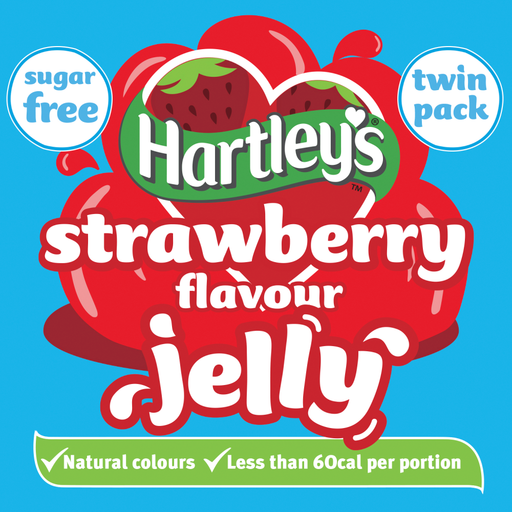
This sugar-free-labelled jelly is an option to consider if you can prepare it and leave it to set, rather than needing a ready-to-eat bag of sweets.
 No image available
This 23 g jelly needs boiling-water preparation and time to set, so it is not a sweet to eat while unpacking. Check this pack’s water quantities and setting directions, along with its gelatine, sweeteners and phenylalanine warning, before deciding whether it suits you.
No. Reduced-sugar wording is not, by itself, a sugar-free claim. If sugar-free is your requirement, check the wording and sugars figure on the exact product rather than choosing it from a reduced-sugar description.
Yes, if you can safely use boiling water and have a container and fridge space for the jelly to set. Tesco’s directions for its Hartley’s Sugar Free Strawberry Jelly Crystals twin pack specify 285 ml boiling water followed by 285 ml cold water and refrigeration; follow the directions on the pack you buy.
No. ASDA lists pork gelatine in the cited Hartley’s sugar-free strawberry jelly twin pack. Check the ingredients and any dietary-status statement on the exact product.
Check for aspartame and a phenylalanine warning. The NHS states that aspartame is not suitable for people with phenylketonuria (PKU) because it contains phenylalanine.
No. Read the nutrition panel separately. Tesco lists 61.0 g sugars per 100 g for its cited vegan Rowntree’s Jelly Tots bag, while M&S lists 59.5 g per 100 g for its cited vegan Percy Pig product.