People wanting something ready to eat
A portioned jelly pot avoids making jelly during the break. Check the nutrition panel separately from a “no added sugar” claim if sugar content is the deciding factor.


Choose a ready-to-eat jelly pot if your morning break leaves no time for preparation, but check its sugar claim: Tesco Groceries lists Hartley’s Raspberry Jelly as “no added sugar”, with less than 0.5 g sugars per 100 g. Hartley’s sugar-free crystals suit a break planned in advance, although they need time to set and contain pork gelatine; conventional gummies are a different choice, and HARIBO UK lists 47 g sugars per 100 g for Starmix.
For a short morning tea break, preparation time can matter as much as the wording on the pack.
A portioned jelly pot avoids making jelly during the break. Check the nutrition panel separately from a “no added sugar” claim if sugar content is the deciding factor.
Sugar-free crystals are an option when there is time to mix them with water and refrigerate the jelly before the break.
Look at the exact pack for gelatine, sweeteners and relevant warnings. A sugar-related claim does not establish whether a jelly is vegetarian or vegan.
Decide whether the jelly must be ready to eat, then compare the sugar wording, nutrition panel and ingredients of the formats that fit your break.
| Priority | What to check | Your needs |
|---|---|---|
| Sugar claim | Read the pack claim and “of which sugars” per 100 g or 100 ml. Legislation.gov.uk lists no more than 0.5 g sugars per 100 g or 100 ml as the condition for a sugar-free claim; “no added sugar” is different wording. | I want to know whether I am choosing a product labelled sugar-free or one labelled no added sugar, rather than treating the phrases as interchangeable. |
| Preparation | Check whether the jelly is ready to eat or needs water, cooling and refrigeration. Hartley’s sugar-free crystals require preparation before they set. | For a break lasting only a few minutes, I need something ready to eat; if I can prepare it earlier, crystals are another option. |
| Ingredients | Check the exact pack for gelatine source, dietary-suitability statements, sweeteners and a phenylalanine warning where relevant. | A vegan or pork-free choice matters to me, so I cannot decide from the sugar claim alone. |
| Full nutrition panel | Compare carbohydrates and serving information as well as sugars. Diabetes UK notes that polyols can contain carbohydrates and calories. | If I need to account for carbohydrates, a sugar-free claim does not replace reading the full nutrition panel. |
The phrases describe different claims. Tesco Groceries lists the Hartley’s raspberry pot as no added sugar and reports less than 0.5 g sugars per 100 g, but the pack wording still matters when an explicit sugar-free claim is your requirement.
Read the current claim and the “of which sugars” value together before choosing.
Hartley’s sugar-free crystals need water and time to cool and set in a fridge; they are not ready to eat straight from the pack.
Choose a ready-to-eat format for an unplanned break, or make and refrigerate crystal portions beforehand.
Tesco Groceries lists pork gelatine and a phenylalanine warning for Hartley’s strawberry crystals, while it lists the raspberry ready-to-eat pot as vegan.
Check the ingredients and suitability information on the exact flavour and format you intend to buy.
Diabetes UK notes that polyols contain carbohydrates and calories. A sugar-free claim alone does not describe the whole nutrition panel.
Read the carbohydrates and serving information on the pack, alongside any sweetener warnings.
These examples show why the product format and exact pack matter more than a brand name alone.
Tesco Groceries lists both a ready-to-eat raspberry jelly pot and strawberry jelly crystals, with different claims, preparation needs and ingredients.
Starmix is a conventional chewy gummy comparison, not a sugar-free substitute.
Tesco Groceries lists Fruity Gems Sugar Free Jellies as a 45 g sweets pack, a different format from a jelly dessert.
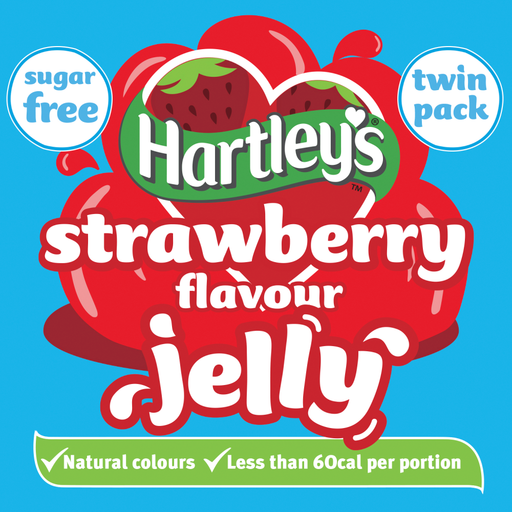
These Hartley’s strawberry jelly crystals are an option for a morning break when you can prepare the jelly beforehand.
 No image available
For a planned tea break, prepare these strawberry jelly crystals with boiling water and allow time for them to set. The product information lists 0.5 g sugars per 100 g as prepared and 9 kcal per 145 g serving. It also lists pork gelatine and aspartame and carries a phenylalanine warning; check the current pack for suitability and preparation instructions.
Legislation.gov.uk lists a maximum of 0.5 g sugars per 100 g or 100 ml as the condition for a sugar-free claim. Check the claim on the current pack alongside its “of which sugars” nutrition value.
No. “No added sugar” is different wording from a sugar-free claim, so read the nutrition panel rather than assuming the two labels mean the same thing. Tesco Groceries lists the Hartley’s raspberry pot as no added sugar and reports less than 0.5 g sugars per 100 g.
A ready-to-eat pot works when there is no time to prepare jelly. Hartley’s sugar-free crystals need water, cooling and refrigeration, so make them before the break if you prefer that format.
A sugar claim does not tell you whether a product meets your ingredient requirements. Tesco Groceries lists pork gelatine and a phenylalanine warning for Hartley’s strawberry crystals; check the exact pack when those details matter to you. Diabetes UK also notes that polyols can contain carbohydrates and calories, so compare the full nutrition panel for sweets made with them.