Full English breakfast eaters reducing added sugar
You may want to add or alternate a cereal component on some mornings without choosing a recipe with added sugar, while still accounting for sugars from dried fruit and the rest of the breakfast.


For a genuinely sugar-free requirement, do not treat “no added sugar” as equivalent: under Regulation (EC) No 1924/2006, sugar-free food must contain no more than 0.5g sugars per 100g, while the reviewed no-added-sugar mueslis declare 8.3g to 18g per 100g. If you are avoiding added sugar rather than all sugars, compare the nutrition panel, portion size, allergens and how muesli fits alongside the rest of your Full English breakfast.
You may want to add or alternate a cereal component on some mornings without choosing a recipe with added sugar, while still accounting for sugars from dried fruit and the rest of the breakfast.
You need the legal meaning of sugar-free rather than a no-added-sugar claim. The reviewed mueslis are not suitable for this strict requirement because their declared sugars are above 0.5g per 100g.
You are comparing pack size, unit price and household suitability rather than assuming that a no-added-sugar recipe automatically suits every breakfast priority.
Start with the claim you need, then check the nutrition panel and ingredients before deciding how a muesli portion will sit alongside a cooked breakfast.
| Priority | What to check | Your needs |
|---|---|---|
| Sugar-free claim | Read sugars per 100g and the claim wording. A sugar-free food must contain no more than 0.5g sugars per 100g under Regulation (EC) No 1924/2006. | I need a product that meets a strict sugar-free requirement, rather than one that simply has no added sugar. |
| Total sugars and portion | Compare sugars per 100g on a common basis, then use the declared serving as a starting point. Dried fruit can contribute naturally occurring sugars. | I want to avoid added sugar but still choose a portion that makes sense with toast, beans, hash browns or other carbohydrate foods on the plate. |
| Ingredients and allergens | Check ingredients, highlighted allergens and any “may contain” statement. A gluten-free requirement needs a specific gluten-free claim; oats alone do not establish suitability. | My breakfast cereal must work with an allergy, coeliac disease or an ingredient exclusion. |
| Recipe and pack value | Compare fibre, sugars, pack size and unit price rather than shelf price alone. Recheck the physical pack because recipes and nutrition information can change. | I am deciding whether a larger pack, a nut-heavy recipe or a preferred brand is worth the trade-off for my household. |
This can lead to buying a muesli with sugars from dried fruit when a strict sugar-free requirement applies.
Read the sugars figure per 100g, not only the front-of-pack claim. For a strict requirement, choose a product explicitly labelled sugar-free and check that it meets the 0.5g-per-100g threshold.
A lower-sugar recipe may still contain nuts, milk or gluten-containing cereals that do not suit your needs.
Check the full ingredients list, highlighted allergens and any precautionary statement each time you buy, especially after packaging changes.
Muesli adds another carbohydrate component to a meal that may already include bread, beans, hash browns, meat and eggs.
Use the declared portion as a starting point and decide whether muesli is replacing, rather than simply adding to, another carbohydrate item. NHS Grampian guidance describes a planned breakfast as including a fibre-rich carbohydrate source, protein and fruit or vegetables.
A smaller pack can appear cheaper at checkout while costing more per kilogram, and a lower unit price does not necessarily mean fewer sugars.
Compare price per kilogram alongside sugars per 100g, fibre, allergens and pack size, then recheck current prices and offers before buying.
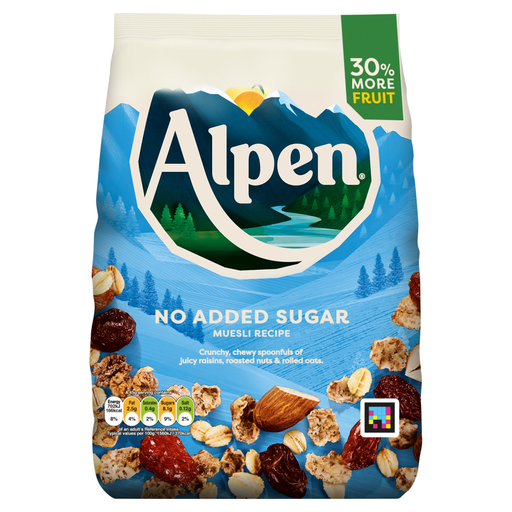
Alpen No Added Sugar combines wholegrain wheat, rolled oats, raisins and roasted hazelnuts and almonds.
Dorset Cereals offers no-added-sugar mueslis including Gloriously Nutty and Delicious Fruit & Nut, both containing naturally occurring sugars.
Jordans Natural Muesli is a 1kg cereal, fruit and nut mix sold with no added sugar and no added salt claims.
Tesco Swiss Style No Added Sugar Muesli is a 1kg own-label option for shoppers comparing unit price and pack size.
Joybuy product options for the no-added-sugar muesli route in this Full English breakfast decision.
 No image available
A no-added-sugar muesli for shoppers who want a familiar wheat, oats, raisin and nut recipe as one planned breakfast component.
Declared 8.0g fibre and 18g sugars per 100g, with a stated 45g serving. Contains wheat, oats, milk, almonds and hazelnuts; it may contain other nuts. It is not suitable for a strict sugar-free requirement.
No. Regulation (EC) No 1924/2006 states that a food may be called sugar-free only when it contains no more than 0.5g sugars per 100g or 100ml. The reviewed no-added-sugar mueslis declare 8.3g to 18g sugars per 100g, so they do not meet that strict requirement.
Yes, if you treat it as one component of the meal rather than an automatic upgrade. NHS Grampian guidance suggests planning breakfast around a fibre-rich carbohydrate source, protein and fruit or vegetables; muesli can be the carbohydrate and fibre element alongside suitable protein and vegetables.
Dorset Gloriously Nutty No Added Sugar Muesli has the lowest declared sugars among the reviewed options, at 8.3g per 100g according to Tesco Groceries. It is still not sugar-free and includes almonds, cashews and hazelnuts.
Do not assume so. The reviewed products contain gluten-containing cereals and/or nuts, and some have precautionary cross-contamination statements. For a strict gluten-free need, look for a gluten-free claim; Food Standards Agency guidance states that gluten-free food must contain no more than 20mg/kg gluten.
Use it to compare products, but check the physical pack before eating or buying for an allergy or strict dietary requirement. Tesco Groceries advises that recipes, ingredients, nutrition and allergen information can change.