For a weekly shop in Great Britain, check shortbread’s declared sugars per 100 g rather than relying on a ‘no added sugar’ or all-butter description: legislation.gov.uk gives the sugar-free threshold as no more than 0.5 g per 100 g. A UK seller lists Gullón Sugar Free Shortbread below that threshold; Farmhouse Biscuits lists its Viennese Shorties at 0.2 g per 100 g but describes them as shortcake biscuits, so they suit a shopper willing to change biscuit style. Check the current pack’s ingredients, allergens and total carbohydrate before making either a repeat purchase.
Who is this choice for?
The first decision is whether the biscuit must be shortbread, or whether a different sugar-free biscuit would also work for your weekly shop.
Shoppers looking for sugar-free shortbread
If shortbread itself matters, check both the biscuit description and its sugars per 100 g. A ‘no added sugar’ name answers a different question from whether the biscuit meets the sugar-free threshold in Great Britain.
Shoppers flexible about biscuit style
A shortcake-style biscuit may be worth considering if the sugar-free claim matters more than a conventional shortbread recipe. Check the exact product name, sweeteners and allergen declaration before treating it as a substitute.
Shoppers checking total carbohydrate
If you count carbohydrate, compare the total carbohydrate figure and your intended portion as well as sugars. As Worcestershire Acute Hospitals NHS Trust advises in its label guidance, the sugars figure alone does not show total carbohydrate.
What should you check first?
Start with the sugars declaration and biscuit type, then compare the other pack details that matter to your household.
| Priority |
What to check |
Your needs |
| Sugars and biscuit type |
Read sugars per 100 g on the exact pack. In Great Britain, legislation.gov.uk gives the sugar-free threshold as no more than 0.5 g per 100 g; ‘no added sugar’ is a separate claim. Check whether the product is described as shortbread or another biscuit. |
I want shortbread that meets the sugar-free requirement, not a different biscuit chosen because its name sounds similar. |
| Carbohydrate and sweeteners |
Compare total carbohydrate and energy per 100 g alongside the intended portion. Read the ingredients for sweeteners such as maltitol or isomalt and follow any pack warning. |
If I count carbohydrate or plan to share the packet, the sugars figure alone does not answer every question I have about its contents. |
| Ingredients and allergens |
Check the current pack’s ingredient list, allergen declaration and any cross-contact warning. Match the pack size and storage instructions to how you will use it during the week. |
Other people will eat these biscuits too, so I need to check their ingredient requirements separately from the sugar-free claim. |
What can cause a mistaken purchase?
-
Reading ‘no added sugar’ as ‘sugar-free’
These descriptions have different conditions. An all-butter recipe or a claim about another ingredient also says nothing by itself about whether the biscuit meets the sugar-free sugars threshold in Great Britain.
For a strict sugar-free purchase, compare the declared sugars per 100 g on the exact product with the threshold given by legislation.gov.uk.
-
Assuming sugar-free means low in carbohydrate or energy
A UK seller lists 68 g carbohydrate per 100 g for Gullón Sugar Free Shortbread. Farmhouse Biscuits lists 67.6 g per 100 g for its Viennese Shorties. Their sugar-free descriptions do not replace the total carbohydrate or energy figures.
Read those figures alongside sugars and the portion you intend to eat; do not treat the two biscuit styles as a like-for-like taste comparison.
-
Overlooking ingredients in a shared packet
The checked Gullón and Farmhouse products contain wheat and use sweeteners. Farmhouse also warns that excessive consumption of its Viennese Shorties may have laxative effects.
Before sharing a packet, read its current ingredients, allergen declaration and warnings rather than assuming that sugar-free means free from other ingredients.
Which brand examples are relevant?
These examples concern specific biscuits, not every product made by each brand. Compare the exact pack when planning a repeat shop.
Gullón
A UK seller lists Gullón Sugar Free Shortbread Biscuits in a 330 g pack.
- Nutz4Nuts declares less than 0.5 g sugars per 100 g for this shortbread.
- The listed recipe includes wheat flour, sunflower oil, maltitol and isomalt; it is not described as all-butter shortbread.
Farmhouse Biscuits
Its Sugar Free Viennese Shorties are a shortcake-style option rather than identical conventional shortbread.
- Farmhouse Biscuits declares 0.2 g sugars per 100 g for this product.
- The maker lists wheat and maltitol and warns that excessive consumption may have laxative effects.
Walker's
Its Shortbread Fingers provide a conventional all-butter comparison, not a sugar-free choice.
- Walker's lists butter in the ingredients for these fingers.
- Walker's declares 16.2 g sugars per 100 g for this product; that figure does not describe its whole range.
Dean's
Its All Butter Shortbread Fingers are another conventional shortbread comparison.
- Dean's identifies these fingers as an all-butter shortbread product.
- Dean's declares 17.7 g sugars per 100 g for these fingers, so this product does not meet the Great Britain sugar-free threshold.
Tesco
Its 500 g Shortbread Assortment Tin is a supermarket-shop comparison rather than a sugar-free option.
- The tin offers an identifiable assortment to compare with a sugar-free shortbread purchase.
- Tesco declares 14.1 g sugars per 100 g for this tin and advises checking the pack because recipes can change.
Waitrose
Its Shortbread Fingers are a conventional own-label comparison.
- The named fingers give shoppers a specific product to compare, rather than treating a whole range as one recipe.
- Waitrose declares 14.9 g sugars per 100 g for these fingers and advises checking the pack for recipe changes.
Joybuy biscuit options
These Joybuy options are a digestive biscuit and a sandwich biscuit for shoppers open to a different style. Neither is shortbread; check the current pack’s sugars per 100 g if sugar-free is a requirement.
 No image available
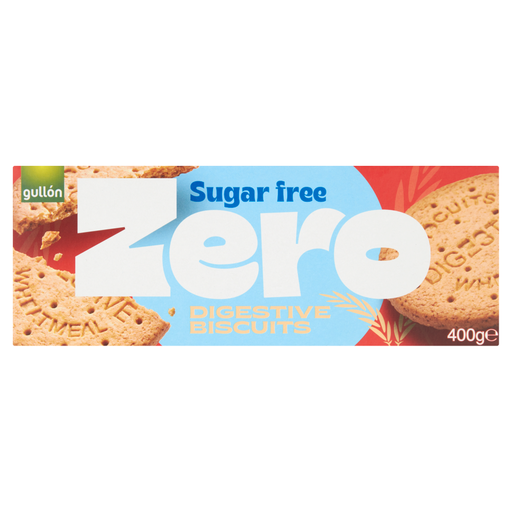
Gullon Zero Sugar Free Original Digestives 400g
Consider this 400g pack if a digestive biscuit would suit your weekly shop instead of shortbread. Check the pack’s sugars per 100 g, ingredients, allergens and sweetener warnings before buying it for a shared household.
View on Joybuy
 No image available
Oreo Zero Sugar Sandwich Cookies 97g
This 97g pack is a sandwich biscuit, not shortbread, so choose it only if that change of style works for your shop. Check the current pack’s sugars per 100 g and its ingredient and allergen information.
View on Joybuy
Questions about sugar-free biscuits
Does ‘no added sugar’ mean the same as sugar-free?
No. Legislation.gov.uk sets out separate conditions for the two claims. For a sugar-free shortbread purchase in Great Britain, check that the exact product declares no more than 0.5 g sugars per 100 g; a ‘no added sugar’ product name alone does not establish that.
Is sugar-free shortbread also low in carbohydrate?
Not necessarily. A UK seller lists 68 g total carbohydrate per 100 g for Gullón Sugar Free Shortbread. If you count carbohydrate, check the total carbohydrate figure and your intended portion, not just sugars; this follows the label-reading advice from Worcestershire Acute Hospitals NHS Trust.
What should I check for allergies when buying biscuits online?
Check the exact pack’s ingredients, allergen declaration and any cross-contact warning before anyone eats the biscuits. The checked Gullón shortbread listing includes wheat and a milk ingredient, while Farmhouse Biscuits lists wheat and a ‘may also contain’ warning for its Viennese Shorties. A sugar-free description does not answer an allergen question.
Do sugar-free biscuits need special preparation or storage?
The checked products are ready-to-eat biscuits and need no preparation. Follow the storage directions on the pack you receive rather than assuming that biscuits with different recipes or packaging have identical instructions.


