Hosts serving a sugar-free option
Check the sugars declaration on the exact biscuit you plan to serve. A “free from” label can refer to something other than sugar.


If the biscuit needs to be both sugar-free and sold as shortbread, start with the Gullon Sugar Free Shortbread listing: retailer Nutz4Nuts declares less than 0.5 g sugars per 100 g. Farmhouse Biscuits declares 0.2 g per 100 g for its Sugar Free Viennese Shorties, but describes them as shortcake biscuits. For either option, check the pack’s carbohydrate, ingredients and allergen information before serving.
Check the sugars declaration on the exact biscuit you plan to serve. A “free from” label can refer to something other than sugar.
Keep the pack available so guests can see total carbohydrate as well as sugars. A sugar-free claim does not describe the total carbohydrate content.
Check each pack’s ingredients and precautionary allergen information. Sugar-free, gluten-free and milk-free describe different product properties.
Choose the type of biscuit first, then check the nutrition and ingredient information for the exact pack you will put out.
| Priority | What to check | Your needs |
|---|---|---|
| Sugar-free claim | Check sugars per 100 g on the exact product. The sugar-free claim condition published on legislation.gov.uk is no more than 0.5 g sugars per 100 g of food; “no added sugar” and “free from” are not interchangeable with that claim. | I need a biscuit that meets the sugar-free request, not one chosen solely for its packaging wording. |
| Carbohydrate and sweeteners | Read total carbohydrate alongside sugars. Nutz4Nuts lists 68 g carbohydrate per 100 g for Gullon Sugar Free Shortbread; Farmhouse Biscuits lists 67.6 g per 100 g for its Viennese Shorties and warns that excessive consumption may cause laxative effects. | If a guest asks about carbohydrate or sweeteners, I want the pack information available without assuming the sugars figure answers their question. |
| Ingredients and allergens | Check the ingredients and precautionary statements on each pack. The Gullon retailer listing includes wheat and milk-derived ingredients; do not infer allergy suitability from a sugar-free claim. | With several biscuits on the table, I want guests to be able to tell which ingredient information belongs to each one. |
| Biscuit type | Read the product description as well as its sugars declaration. Nutz4Nuts calls the Gullon product shortbread, while Farmhouse Biscuits calls its sugar-free Viennese Shorties shortcake biscuits. | Is shortbread specifically requested, or would a sugar-free shortcake-style biscuit also suit the gathering? |
Sainsbury’s lists 23.5 g sugars per 100 g for its milk- and gluten-free shortbread. The claims address different ingredients or nutritional properties.
Check sugars per 100 g and the ingredients on the exact product before buying it for a sugar-free request.
The listed Gullon shortbread and Farmhouse Viennese Shorties contain 68 g and 67.6 g total carbohydrate per 100 g respectively, according to their retailer and manufacturer listings.
Keep the pack’s carbohydrate information available for guests who need it; do not promise suitability based on sugars alone.
The products have their own ingredient information, and Farmhouse warns about laxative effects from excessive consumption of its maltitol-sweetened Shorties.
Keep packs available and make it clear which biscuits belong to each pack.
These examples illustrate why a shortbread label, a sugar-free claim and other “free from” claims need to be checked separately for each product.
Nutz4Nuts lists Gullon Sugar Free Shortbread Biscuits 330g.
Its Sugar Free Viennese Shorties are described by the manufacturer as shortcake biscuits.
Walker's Shortbread Fingers provide a conventional shortbread comparison, rather than a sugar-free option.
Dean's lists traditional shortbread formats, including all-butter varieties, rounds and squares.
Its Made Without Wheat All Butter Shortbread Rounds address a different ingredient consideration.
Its Free From Strawberries & Cream Flavour Shortbread is another example of a “free from” product that should not be read as sugar-free.
Tesco lists several shortbread formats in its biscuit range.
Its Free From Shortbread 160g is listed as milk- and gluten-free.
These Joybuy options are labelled as sugar-free biscuits, but they are digestives and sandwich cookies, not shortbread. Consider them only if a different biscuit type would suit your garden party, and check the pack before serving.
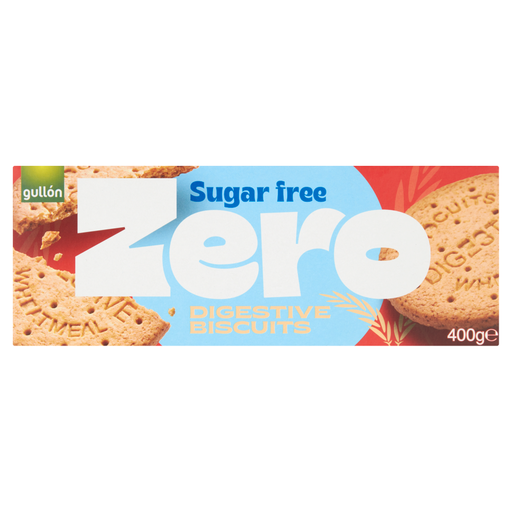 No image available
A digestive biscuit rather than shortbread. If that change of biscuit type works for your guests, check the pack’s sugars per 100 g, ingredients and allergen information before serving.
 No image available
A sandwich cookie rather than shortbread. If you choose it as a separate biscuit option, check the pack’s sugars per 100 g and ingredients so guests can identify what is being served.
No. They are different claims. For a sugar-free biscuit, check its sugars declaration against the condition published on legislation.gov.uk: no more than 0.5 g sugars per 100 g of food.
No. Worcestershire Acute Hospitals NHS Trust advises checking total carbohydrate, not just sugars, when reading labels for diabetes-related carbohydrate intake. The listed Gullon shortbread and Farmhouse Viennese Shorties declare 68 g and 67.6 g total carbohydrate per 100 g respectively.
Check the ingredients and precautionary allergen statements on each actual pack, and keep it available when serving. A sugar-free claim does not establish whether a biscuit is suitable for a guest with a particular allergy.
Follow the instructions on the chosen pack. Walker's says to keep its Shortbread Fingers in a cool, dry place; another product may give different directions, including after opening.