Late-night shoppers looking for sugar-free shortbread
Check the sugar-free claim and sugars per 100 g on the individual pack. A gluten-free label or a lower-sugar description does not answer the same question.


For a late-night supper where sugar-free shortbread is the requirement, check the sugar-free claim and sugars per 100 g: Gullón describes its ZERO Sugar Free Shortbread as sugar-free, and Buy Snacks UK lists less than 0.5 g sugars per 100 g. It contains sweeteners and wheat, while conventional all-butter and gluten- or wheat-free shortbreads serve different needs. The Joybuy biscuits below are digestives and sandwich cookies, not shortbread.
Check the sugar-free claim and sugars per 100 g on the individual pack. A gluten-free label or a lower-sugar description does not answer the same question.
Look beyond the sugar-free claim to the full nutrition panel and serving size. Diabetes UK notes that sugar-free foods can still contain fat and calories and may still affect blood glucose.
Check ingredients and allergen statements separately from the sugar claim. Gullón ZERO Sugar Free Shortbread contains wheat; its product information also calls for attention to milk and soya.
Start with the requirement that determines the choice—sugar-free or a particular ingredient exclusion—then compare the nutrition panel and the serving you intend to have.
| Priority | What to check | Your needs |
|---|---|---|
| Sugar-free claim | Check the claim and sugars per 100 g. The sugar-free claim condition published by legislation.gov.uk is no more than 0.5 g sugars per 100 g for a solid food; a gluten-free or no-added-sugar label is a different claim. | I want shortbread that meets a sugar-free requirement, rather than a conventional biscuit or one labelled only as free from gluten. |
| Late-night serving | Compare energy, carbohydrate and fat on the nutrition panel, alongside the serving size. Diabetes UK cautions that sugar-free foods can still contain fat and calories. | For a biscuit with supper, I want to decide on a portion without treating “sugar-free” as permission to ignore the rest of the label. |
| Sweeteners | Read the ingredient list for the sweetener used. Gullón lists maltitol and isomalt in its ZERO Sugar Free Shortbread; Diabetes UK notes that some sugar-free foods can have a laxative effect. | I want to know what gives the biscuit its sweetness before choosing it. |
| Allergens | Check the current pack for wheat, milk and soya information. Treat gluten-free or wheat-free labelling as a separate question from sugar content. | If I avoid a particular ingredient, the biscuit must meet that requirement as well as any sugar-free preference. |
Free-from labels refer to particular ingredients, not automatically to sugars. Tesco lists sugar in its Free From Shortbread and reports 5.4 g sugars per biscuit.
Check the sugar-free claim and sugars per 100 g first, then assess any gluten, wheat or other ingredient restriction separately.
Diabetes UK notes that sugar-free foods can still contain fat and calories and may still affect blood glucose. The claim alone does not describe the whole serving.
Read the full nutrition panel and decide how much you intend to have with supper.
Gullón lists maltitol and isomalt in its ZERO Sugar Free Shortbread, which contains wheat. Its product information also identifies milk and soya as ingredients to check for.
Read the ingredient and allergen information on the current pack before buying, particularly if you avoid those ingredients.
These examples illustrate different biscuit requirements; a brand’s other products need their own label checks.
Its 330 g Sugar Free Shortbread is a sweetener-based shortbread-style option.
Its Assorted Shortbread Tin is a conventional all-butter option when sugar-free is not the requirement.
Traditional Shortbread Fingers offer a conventional shortbread format.
Its Free From shortbreads address particular ingredient requirements, which differ between products.
Made Without Wheat All Butter Shortbread Rounds address a wheat-free requirement.
Its shortbread listings include conventional products and Free From Gluten Butter Shortbread.
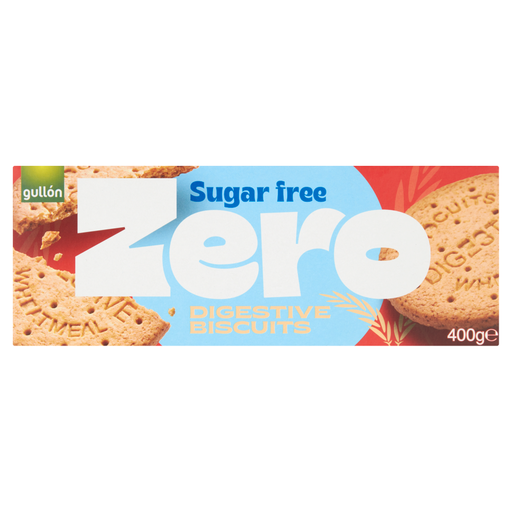
These Joybuy options are a digestive biscuit and a sandwich cookie for shoppers open to a different type of biscuit. Neither is shortbread, so keep the type of biscuit in mind if shortbread itself is essential.
 No image available
If a digestive will do instead of shortbread for supper, compare its nutrition and ingredient information with your requirements. This is a 400 g pack of digestives, not shortbread.
 No image available
If you want a sandwich cookie rather than shortbread, check the full nutrition panel and ingredients when planning a serving. The pack is 97 g.
The condition published by legislation.gov.uk sets a maximum of 0.5 g sugars per 100 g for a solid food described as sugar-free. “No added sugar” and “gluten-free” are different claims, so check the wording and sugars value on the individual pack.
The Walker’s Assorted Shortbread Tin and Dean’s Traditional Shortbread Fingers are not sugar-free choices. Their respective published nutrition panels report 18.6 g and 17.1 g sugars per 100 g; check other products individually rather than applying those figures to an entire brand.
No. Diabetes UK notes that sugar-free foods can still contain fat and calories, may still affect blood glucose and can sometimes have a laxative effect. The full nutrition panel, ingredients and serving size matter alongside the sugar claim.
Check the current pack for the ingredients you avoid and any relevant precautionary statement. Gullón ZERO Sugar Free Shortbread contains wheat, and its product information also calls for attention to milk and soya; being sugar-free does not remove those checks.
Consider the serving size rather than assuming a sugar-free biscuit has a particular effect on sleep. Oxford Health NHS Foundation Trust advises avoiding big meals and sugary snacks late at night.