For a sugar-free holiday biscuit in a shortbread style, check the exact product’s sugar-free claim and sugars per 100 g: Farmhouse Biscuits lists 0.2 g sugars per 100 g for its Viennese Shorties, but describes them as shortcake biscuits rather than traditional all-butter shortbread. If the biscuit must specifically be shortbread, check the nutrition and ingredients on the offered pack; either way, consider carbohydrates, sweeteners, allergens and storage before taking it away.
Who is this for?
Shoppers looking for a sugar-free holiday biscuit
If you want something close to shortbread to take away, distinguish a sugar-free shortcake-style biscuit from conventional shortbread fingers. The name of the biscuit alone does not answer the sugars question.
Shoppers checking carbohydrates
A sugar-free claim addresses sugars, not the biscuit’s total carbohydrate or energy declaration. Read the nutrition panel and the portion information for the particular pack.
People sharing biscuits with others
Check the exact pack’s ingredients and allergen statements for each person who may eat it. A sugar-free claim says nothing about wheat, milk or other allergens.
What should you check?
Decide whether sugar-free is a requirement and whether a shortcake-style biscuit will do, then compare the offered packs rather than relying on a brand or category name.
Sugar-free shortcake style
Consider it when: A Viennese shortie suits you in place of an all-butter shortbread finger; Farmhouse Biscuits lists 0.2 g sugars per 100 g for its Sugar Free Viennese Shorties.
Trade-off: Farmhouse calls this product a shortcake biscuit, and its nutrition panel also lists carbohydrate and energy.
Shortbread labelled sugar-free
Consider it when: The biscuit needs to be called shortbread; Gullón names a sugar-free shortbread product, which a UK retailer lists in a 330 g pack.
Check before choosing: Read the offered pack’s sugars declaration and ingredients rather than applying information from a pack sold in another market.
Traditional all-butter shortbread
Consider it when: Sugar-free is not a requirement for the person eating the biscuits and all-butter fingers are the preferred style.
Trade-off: The particular fingers listed by Walker’s Shortbread, Dean’s, M&S, Tesco and Sainsbury’s contain sugar; they are not substitutes for a sugar-free choice.
| Priority | What to check | Your needs |
|---|
| Sugars and biscuit style |
Read the exact pack’s sugar-free claim and sugars per 100 g. Check whether it is shortbread, shortcake-style or another type of biscuit. Farmhouse Biscuits lists 0.2 g sugars per 100 g for its Viennese Shorties. |
I need the biscuit to be sugar-free, but I also want to know whether it has the shortbread style I had in mind. |
| Carbohydrates and sweeteners |
Compare carbohydrate and energy per 100 g separately from sugars. Read the sweetener ingredients and any excessive-consumption warning; Farmhouse Biscuits lists maltitol for its Viennese Shorties. |
When planning how much to take, I want the whole nutrition panel, not just the sugar-free wording. |
| Allergens |
Check ingredients and precautionary allergen statements on the chosen pack, including those concerning wheat or milk. Do not treat a sugar-free claim as an allergen claim. |
If I am sharing the biscuits, everyone who might eat them needs to be considered. |
| Storage and pack format |
Follow the product’s storage directions, including instructions after opening. Check the pack format if carrying or dividing the biscuits matters. |
I want a pack I can carry and store as directed while I am away, without assuming the biscuits are individually wrapped. |
Common buying mistakes
-
Treating “no added sugar” as “sugar-free”
“No added sugar” concerns what was added during production; it does not tell you the finished biscuit’s sugars per 100 g.
If sugar-free is your requirement, check that claim and the sugars declaration on the exact product.
-
Reading “sugar-free” as “carbohydrate-free”
Farmhouse Biscuits declares 67.6 g carbohydrate and 491 kcal per 100 g for its Sugar Free Viennese Shorties, alongside 0.2 g sugars per 100 g.
Read the full nutrition panel and portion information. If you need individual diabetes advice, discuss your circumstances with your healthcare team.
-
Assuming the biscuit is free from allergens
Sugar-free describes a sugars claim, not the presence of wheat, milk or other allergens. Ingredient and precautionary statements differ between products.
Read the exact pack before offering the biscuits to someone else.
Product lines to compare
Farmhouse Biscuits
Farmhouse Biscuits describes its Sugar Free Viennese Shorties as shortcake biscuits made with sweetener, rather than traditional all-butter shortbread.
- For this product, Farmhouse Biscuits lists 0.2 g sugars, 67.6 g carbohydrate and 491 kcal per 100 g.
- Its ingredients include maltitol, and the maker warns that excessive consumption may cause laxative effects. Check the pack for allergens too.
Gullón
Gullón names a Zero Sugar Free Shortbread product, and UK retailer Mullaco Online lists a 330 g sugar-free shortbread pack.
- The Gullón manufacturer page names wheat flour and the sweeteners maltitol and isomalt for the product it describes.
- Check the ingredients and sugars declaration on the particular UK pack offered; the manufacturer page concerns a different national market.
Walker’s Shortbread
Walker’s Shortbread Fingers are a conventional butter-containing option, not the sugar-free route.
- The listed ingredients for these fingers include butter and sugar.
- Walker’s Shortbread declares 16.2 g sugars per 100 g for this product; that figure does not describe every Walker’s biscuit.
Dean’s
Dean’s Traditional Shortbread Fingers provide another conventional shortbread option.
- The checked 125 g product lists butter and sugar among its ingredients.
- Dean’s declares 17.1 g sugars per 100 g for these fingers, so this product is not a sugar-free choice.
M&S
M&S Scottish All Butter Shortbread Fingers are a conventional butter-containing product.
- The listed ingredients for these fingers include wheat flour and butter.
- M&S declares 17.0 g sugars per 100 g and states that this product is not suitable for people with a nut or peanut allergy.
Tesco
Tesco Finest Scottish Shortbread Fingers are a conventional all-butter shortbread example.
- The listed ingredients for the checked fingers include butter and sugar.
- Tesco declares 16.1 g sugars per 100 g for this product and advises that product information can change; check the pack you buy.
Sainsbury’s
Sainsbury’s Highland All Butter Shortbread Finger Biscuits offer a conventional shortbread option.
- The product directions say to store the biscuits in a cool, dry place and, after opening, in an airtight container for best quality.
- Sainsbury’s declares 14.8 g sugars per 100 g for these fingers; they are not a sugar-free choice.
Joybuy biscuit options
These Joybuy options are a digestive biscuit and a sandwich biscuit labelled sugar-free. Neither is shortbread or the shortcake-style product discussed above, so choose one only if a different type of biscuit suits your holiday plans.
 No image available
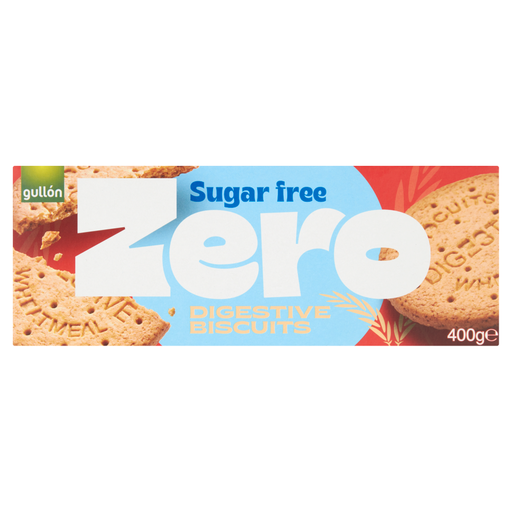
Gullon Zero Sugar Free Original Digestives 400g
Consider these if a digestive biscuit would suit you instead of shortbread. Joybuy describes this product as wholemeal biscuits with sweeteners; check the offered pack’s sugars, carbohydrate, ingredients and allergens before sharing it.
View on Joybuy
 No image available
Oreo Zero Sugar Sandwich Cookies 97g
These are sandwich biscuits rather than shortbread, so they suit a different biscuit preference. If you are taking them away or sharing them, check the exact pack’s sugars declaration, ingredients, allergens and storage directions.
View on Joybuy
Frequently asked questions
Is “no added sugar” the same as “sugar-free”?
No. “No added sugar” concerns what was added during production; it does not establish the finished biscuit’s sugars content. If sugar-free is essential, check the exact product’s claim and sugars per 100 g.
Does sugar-free shortbread automatically suit someone managing diabetes?
No. A sugar-free claim does not describe the biscuit’s total carbohydrate content. Diabetes UK notes that polyols contain carbohydrates and calories; read the product’s nutrition and portion information, and seek individual advice from your diabetes healthcare team where needed.
How should I store shortbread while away?
Follow the directions on the pack you take. For example, Sainsbury’s says to keep its Highland All Butter Shortbread Finger Biscuits in a cool, dry place and to store them in an airtight container after opening for best quality.


