Strict sugar-free shoppers
Choose only a product meeting the UK sugar-free threshold of no more than 0.5g sugars per 100g, rather than a fruit muesli that simply has no added sugar. The threshold is set out in UK nutrition-claims rules.


Choose a genuinely sugar-free muesli only when the current pack confirms no more than 0.5g sugars per 100g. Alpen No Added Sugar and Dorset Cereals Wonderfully Organic each list 18g sugars per 100g, so they may suit shoppers avoiding added sugar but do not meet the strict sugar-free threshold.
Choose only a product meeting the UK sugar-free threshold of no more than 0.5g sugars per 100g, rather than a fruit muesli that simply has no added sugar. The threshold is set out in UK nutrition-claims rules.
Look for a clear no-added-sugar claim if sugars naturally present in dried fruit or milk ingredients are acceptable, then compare the nutrition panel, fibre declaration and portion before making it a regular breakfast.
Check the exact pack for cereals containing gluten, milk, tree nuts and any cross-contact statement, as these details differ between recipes.
Choose it when: the current nutrition panel confirms no more than 0.5g sugars per 100g.
Key trade-off: fruit-based mueslis can contain naturally occurring sugars, even when no sugar has been added.
Choose it when: you want to avoid added sugar but accept sugars naturally present in fruit or milk ingredients.
Key trade-off: the claim does not show the total sugars in the portion or whether the recipe suits your dietary exclusions.
Choose it when: ingredient variety, organic certification, plant-based suitability or texture matters more than a verified no-added-sugar claim.
Key trade-off: dried fruit and nuts require a close check of sugars and allergen information on the current pack.
| Priority | What to check | Your needs |
|---|---|---|
| Sugar claim | Compare sugars per 100g with the 0.5g-per-100g sugar-free threshold. Read no-added-sugar wording alongside the nutrition panel. | I need a genuinely sugar-free product, not one that only avoids added sugar. Alpen No Added Sugar and Dorset Wonderfully Organic each list 18g sugars per 100g. |
| Total sugars and portion | Compare total sugars per 100g and per stated serving. Check ingredients for dried fruit, honey, syrups and milk-derived ingredients. | I want to understand what is in the breakfast bowl, including sugars naturally present in fruit or milk. The NHS notes that these sugars still appear in the total-sugars figure on labels. |
| Fibre and grains | Compare declared fibre values on a like-for-like basis. Check which grains are used and whether they suit your requirements. | A repeat weekday breakfast should have a clearly labelled recipe. Alpen lists 8.0g fibre per 100g and Dorset Wonderfully Organic lists 7.6g per 100g. |
| Allergens | Read the current ingredients, emphasised allergens and may-contain statement. Check cereals, milk and nuts on the exact SKU. | I need a recipe that fits my exclusions. Muesli can contain wheat, oats, barley, milk and nuts, while cross-contact information is product-specific. |
The UK sugar-free threshold is no more than 0.5g sugars per 100g. Alpen No Added Sugar and Dorset Wonderfully Organic both list 18g sugars per 100g, despite their no-added-sugar positioning.
When a strict sugar-free requirement matters, compare the current per-100g sugars value with the 0.5g threshold before buying.
Total sugars include sugars naturally present in fruit and milk as well as sugars from other ingredients. A dried-fruit muesli can therefore show a substantial total-sugars figure while carrying a no-added-sugar claim.
Read the claim, ingredients list and nutrition panel together. Use the ingredients list to identify dried fruit, honey, syrups or other sweetening ingredients.
The recipes considered here contain different combinations of cereals, milk and nuts, and some products also state possible traces.
Check the current SKU’s ingredients, emphasised allergens and may-contain statement whenever the recipe or pack changes.
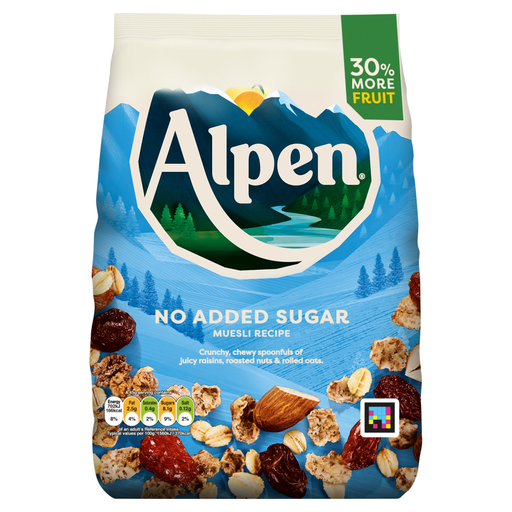
Alpen No Added Sugar is a wholegrain muesli with raisins, nuts and dairy ingredients for shoppers seeking a no-added-sugar option.
Wonderfully Organic is an organic muesli with fruit, seeds and nuts and a stated no-added-sugar claim.
Jordans Natural Muesli is a wholegrain recipe with oats, wheat flakes, barley, dried fruit and nuts, stated by the manufacturer to contain no added salt or sugar.
Tesco lists Swiss Style No Added Sugar Muesli in its UK grocery catalogue.
Ultimate Muesli is a fruit-and-nut muesli for organic, plant-based and ingredient-variety preferences rather than a verified no-added-sugar route.
Lizi's is relevant to lower-sugar breakfast-cereal shoppers, although its current brand information focuses on granola rather than a comparable muesli nutrition panel.
Joybuy product options for a weekday breakfast where avoiding added sugar is the priority.
 No image available
A ready-to-serve muesli for weekday breakfasts where a no-added-sugar claim is preferred.
Lists 18g sugars and 8.0g fibre per 100g, with a stated 45g serving. Contains wholegrain wheat and rolled oats, raisins, milk, almonds and hazelnuts.
It does not meet the strict sugar-free threshold of no more than 0.5g sugars per 100g. Check the current pack for ingredients, allergens and nutrition information.
No. Under the UK sugar-free claim threshold, a food must contain no more than 0.5g sugars per 100g or 100ml. No-added-sugar recipes can still contain naturally occurring sugars from dried fruit or milk; Alpen No Added Sugar and Dorset Wonderfully Organic each list 18g total sugars per 100g.
First decide whether you are avoiding added or free sugars, or need a strict sugar-free product. Then compare total sugars per 100g and per stated serving, and read the ingredients list for dried fruit, honey, syrups and milk ingredients. The NHS notes that naturally occurring sugars in fruit and milk appear in total sugars but are not classed as free sugars.
Yes. Dried fruit can contribute naturally occurring sugars. Alpen No Added Sugar lists 18g sugars per 100g, and Dorset Wonderfully Organic also lists 18g per 100g, despite both products carrying no-added-sugar wording.
Read the current pack rather than relying on the product name. Muesli recipes can contain wheat, oats, barley, milk, almonds, hazelnuts, Brazil nuts or other nuts, and may also carry cross-contact statements.
Yes, when ingredients, nutrition or allergen details matter to you. Tesco notes that food products can be reformulated, so check the current pack label before purchase or consumption.