Survey scorers with scarce computer ports
If you enter ratings on a laptop or compact keyboard, a separate Bluetooth pad can leave a USB port free—but only when the computer already supports Bluetooth.


If computer USB ports are scarce, choose a Bluetooth numeric keypad only if the computer already supports Bluetooth; the keypad will not need a permanent USB cable or receiver, but it will need a battery. For repeated survey codes or shortcuts, consider programmable keys after checking the survey software and configuration requirements. A wired USB keypad avoids battery upkeep but occupies a compatible port and leaves a cable at the scoring station.
If you enter ratings on a laptop or compact keyboard, a separate Bluetooth pad can leave a USB port free—but only when the computer already supports Bluetooth.
Programmable, labelled keys may suit recurring codes or commands if the survey application accepts the keystrokes you want to assign.
A wired pad suits a scoring station where a compatible USB port and a cable are acceptable, and avoiding battery upkeep matters more.
Start with the connection your computer can accommodate, then decide whether repeated survey actions justify programmable keys or whether a wired, battery-free pad is simpler for your desk.
| Concern | What to check | Who this matters to |
|---|---|---|
| Keeping USB ports free | Confirm that the computer has Bluetooth and that the keypad supports its operating system; do not assume every wireless model connects without a USB receiver. | If I score surveys on a laptop with few spare ports, I want a separate pad without occupying one. Around 42% of consumers put port access first. |
| Recurring score codes | Check the number of programmable keys, configuration-software requirements and whether the survey application accepts the intended shortcuts. | When the same codes or commands come up repeatedly, I want keys I can assign to those actions. For around 33% of consumers, recurring-code entry is the primary concern. |
| Battery-free desk use | Check for a free USB-A or USB-C port that matches the wired keypad, along with any operating-system limits on shortcut keys. | At a fixed scoring station, I may prefer a cable to keeping track of batteries. Avoiding battery upkeep comes first for around 25% of consumers. |
A Bluetooth keypad needs Bluetooth on the computer. Adding a USB Bluetooth adapter to a computer without it would occupy the port you hoped to keep free.
Check the computer’s Bluetooth capability and the keypad’s connection type before buying; a model supplied with a USB receiver is not the same as a Bluetooth model.
A wired keypad avoids battery upkeep, but its cable occupies a compatible computer port.
Choose wired only if you can spare that port and want a cable at the scoring station.
Assigned keys help only if the survey application accepts the commands you intend to use. HP’s programmable keypad also requires HP Accessory Center for configuration.
List your repeated actions and, if possible, test the required keystrokes in the survey application before choosing a programmable pad.
Basic number entry and additional shortcut functions can have different compatibility limits; Kensington notes that some keys on its wired pad are Windows-only.
Check the exact functions you need against both the keypad and your computer’s operating system.
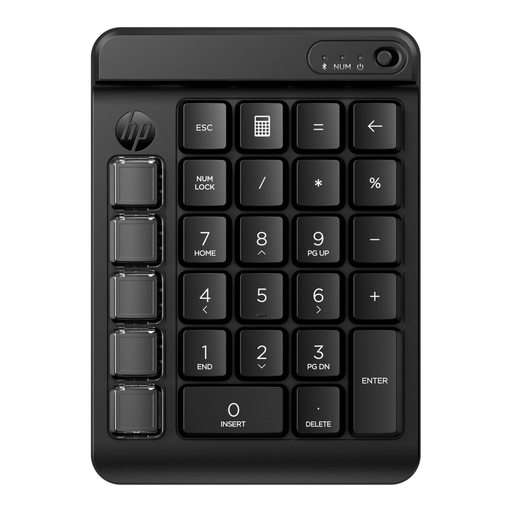
The HP 430 is relevant when survey entry involves repeated codes or shortcuts as well as numbers.
Microsoft Number Pad is a compact Bluetooth option for compatible Windows computers.
Kensington’s wired numeric keypad is an option for a fixed scoring station with a free USB-A port.
This programmable Bluetooth keypad is worth considering when you need to keep a computer USB port free and regularly enter survey codes or shortcuts. Check Bluetooth support and your survey application’s shortcut behaviour before relying on those functions.
 No image available
Consider this keypad for survey scoring when your computer has Bluetooth and you have recurring codes or shortcuts to assign.
It connects by Bluetooth and has nine programmable keys with swappable keycaps. Configuring those keys requires HP Accessory Center, and the intended shortcuts must work in your survey application.
It uses one AA battery; HP states battery life of up to 24 months.
Yes, if the computer already has working Bluetooth and the keypad connects directly over Bluetooth. If the computer needs a USB Bluetooth adapter, that adapter will occupy a port.
Put the pad into its pairing mode, then add it through Windows Bluetooth settings. Follow the instructions for your exact model, and check its Windows and Bluetooth requirements before buying; Microsoft specifies Windows 10 or 11 and Bluetooth 4.0 or later for Microsoft Number Pad.
They will work for your planned actions only if the application accepts the assigned keystrokes or shortcuts. HP’s nine programmable keys require HP Accessory Center for configuration, so check both the software requirement and your survey workflow.
Yes, provided you have a free, compatible USB port and can accommodate a cable. Kensington states that its wired USB-A numeric keypad needs no batteries or driver installation.