Shoppers checking fishery certification
If sustainable sourcing leads your decision, look for the MSC ecolabel on the product you intend to buy. A stated catch method, such as pole-and-line, can help you make a more specific choice.


Start with the exact tin: an MSC ecolabel gives you a product-specific certification signal, while catch-method wording adds detail if that matters to you. Then compare salt on the same nutrition basis, the amount of tuna after draining, and whether the opening format and storage instructions suit the household.
If sustainable sourcing leads your decision, look for the MSC ecolabel on the product you intend to buy. A stated catch method, such as pole-and-line, can help you make a more specific choice.
If you compare nutrition panels, check the salt figure and whether it refers to drained tuna. Spring-water tins should not be treated as interchangeable: Sainsbury’s and Tesco list different salt values for the spring-water products described here.
If opening or draining a tin is difficult, inspect the mechanism on the exact pack rather than relying on its format name alone. The drained quantity and instructions for opened tuna also matter when planning smaller meals.
For a retirement-focused household, settle the sourcing requirement first, then compare the nutrition label and the practicalities of using the pack.
| Concern | What to check | Who this matters to |
|---|---|---|
| Certified sourcing | Look for the MSC ecolabel on the exact pack. Check its catch-method wording if you have a specific preference. | If I want a certification signal I can identify on the tin, a general brand sourcing policy is not enough for my choice. About 33% of consumers would put independently certified sourcing first. |
| Salt and filling medium | Compare salt per 100g drained where stated, and read the ingredients for the exact spring-water or oil-packed variant. | When salt is my priority, I need the nutrition figures on a comparable basis rather than assuming spring water settles the question. Roughly 27% of consumers would make nutrition-label comparison their primary concern. |
| Opening, portions and storage | Inspect the opening format, drained quantity and instructions for keeping opened tuna. | If handling a lid or draining tuna is awkward, I need a pack I can use comfortably and an amount that suits the meal. Around 20% of consumers would prioritise ease of use and portion management. |
| Pack-size planning | Compare the number of tins and their net and drained weights; check that the sourcing claim applies to the chosen pack. | For a household using small amounts at a time, a multipack is only practical if its portions and storage requirements fit. About 20% of consumers would put pack-size planning first. |
A brand-wide sourcing commitment and an MSC ecolabel on a particular tin tell you different things. Catch methods can also vary between products in the same range.
Check the exact pack for the ecolabel and any stated fishing method before deciding which claim meets your requirement.
Sainsbury’s lists 0.12g salt per 100g drained for its cited spring-water multipack, while Tesco lists 0.90g per 100g drained for its cited spring-water pack.
If salt matters to your choice, compare current labels using the same per-100g basis and check the portion you expect to use.
The quantity of tuna available after draining can differ from the weight printed most prominently on a tin or multipack.
Check both net and drained weight, then consider whether the pack size fits how the household will use and store it.
Tuna is fish, and product information may warn that bones remain. Instructions for storing unused contents also differ by product.
Read the allergen and safety information on the exact pack, and follow its directions for transferring, refrigerating and using leftovers.
These ranges offer different sourcing statements and pack formats. Check the individual product rather than applying a brand’s claims to every variant.
Its range includes standard tuna tins and No Drain formats. A John West spring-water variant listed by Sainsbury’s carries MSC wording.
Its tuna range includes chunks, steaks and other formats for comparing fillings and pack sizes.
The cited own-label spring-water chunks carry MSC certification wording and specify FAD-free purse-seine fishing on free schools.
The cited own-label spring-water multipack states pole-and-line sourcing from MSC-certified fisheries.
Its tuna category offers a place to compare brands and formats.
Its cited spring-water tuna is described as pole-and-line caught under the retailer’s Forever Fish sourcing policy.
These two tuna products give households different formats to consider: a No Drain multipack in sunflower oil and fillets in an olive-oil jar. Check the exact packaging and sourcing label against your priorities.
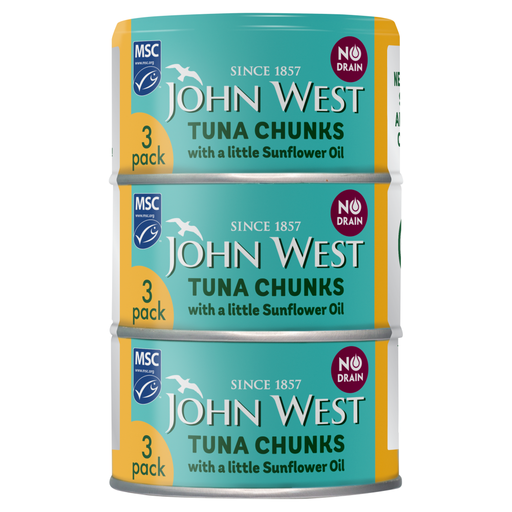 Image unavailable
If draining tuna is a concern, consider this No Drain format and inspect its opening mechanism before buying. The pack contains three 100g tins in sunflower oil; check the exact tins for an MSC ecolabel and follow their storage directions after opening.
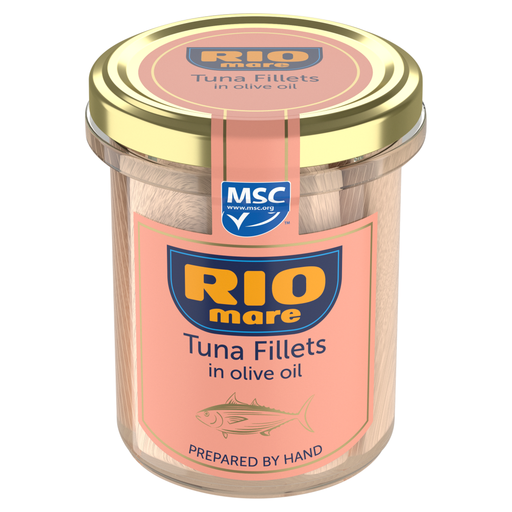 Image unavailable
If you prefer tuna in olive oil, this 180g jar gives you a defined pack quantity for meal planning. Check the jar’s sourcing label, lid and opened-product storage directions; the glass-jar format alone does not establish that it will be easy for everyone to open.
Look for the MSC ecolabel on the exact product if independently certified fishery sourcing is your requirement. You can then check its stated species and catch method; a retailer’s general sourcing policy is not the same as certification on that tin.
No. Sainsbury’s lists 0.12g salt per 100g drained for its cited spring-water multipack, while Tesco lists 0.90g per 100g drained for its cited spring-water pack. Compare the current nutrition labels on the same basis.
Follow the instructions on that product. The cited Sainsbury’s pack directs shoppers to transfer unused tuna to a non-metallic container, refrigerate it and use it within one day; the cited Tesco and M&S products specify transfer and use within two days. Do not apply one pack’s period to another.
In its November 2024 guidance, the Food Standards Agency states that Great Britain has a maximum mercury level of 1.0 mg/kg for tuna and other specified species. This is a requirement for food businesses, not a mercury measurement shoppers can read from a particular tin’s label.