
24/7 Customer Support

Free returns

Same-day & Next-day Delivery

Quality Guaranteed

Unlock Your Welcome Offers: FREE Delivery | Up to 80% OFF | Free 30-day JoyPlus trial
Download the APP
Replacing a dim interior or number plate bulb sounds simple until the new bulb flickers, triggers a dashboard warning or fails to fit the socket. Search results often group T10 W5W 194 LED bulbs, 168 LED bulbs, 2825 LED bulbs and 501 LED bulbs together, but matching names do not always guarantee a suitable replacement.
This guide explains the checks that matter before ordering, including socket size, voltage, colour, brightness and Canbus error-free LED bulb compatibility.
T10, W5W, 194, 168, 2825 and 501 are commonly used cross-reference numbers for wedge-style bulbs. However, vehicle housings can differ in available space, contact design and bulb orientation. A bulb may share the same reference number but still be too long or wide for a particular lamp.
Compare the original bulb with the replacement dimensions and check the vehicle handbook before purchase. For example, one 24-SMD bulb listed here measures approximately 26.1mm long by 11.4mm wide.
A Canbus-compatible bulb is designed to reduce common problems such as warning messages, flickering or rapid bulb-out alerts. It does not guarantee fault-free operation in every vehicle. Some cars monitor lighting circuits more sensitively than others and certain installations may still require a resistor, decoder or a different bulb design.
Look for a built-in Canbus specification, but test the bulb after installation. If a dashboard warning remains, consult the vehicle manual or a qualified automotive professional rather than adding components without checking heat and wiring requirements.
White LED bulbs can give a clean appearance for interior, boot and number plate lighting. Amber yellow may suit indicator-related or warm interior applications, while red is generally intended for rear-facing or decorative applications where permitted. Blue LED bulbs are usually selected for styling, but blue lighting should not be used as a substitute for legally required road lighting.
For exterior applications, check the Road Vehicles Lighting Regulations, the vehicle handbook and MOT requirements. Colour, position and lamp function all matter; a bulb that looks suitable in a product photograph may not be lawful for use on public roads.
Start with the original bulb marking, not just the online title. Common related terms include:
Check the bulb’s length, width and base shape. A plug-and-play car bulb should insert into the existing socket without trimming, drilling or altering the housing.
Most cars use a nominal 12V system, although the electrical charging voltage is higher when the engine is running. Some products are rated for 12–24V, making them suitable for a wider range of cars, vans and other vehicles. Do not assume a 12V-only bulb is appropriate for a 24V vehicle.
LEDs generally use less power than comparable halogen or incandescent bulbs. This can reduce electrical load, but the lower resistance is also why some vehicles detect an apparent bulb fault. Canbus circuitry is intended to address this issue, although compatibility remains vehicle-dependent.
Lumens provide a useful indication of light output, but the result also depends on the reflector, lens and bulb position. The products below list outputs ranging from 280LM to 450LM per bulb, depending on the design. These figures should be treated as product specifications rather than a guarantee of how bright the lamp will appear in every housing.
Aluminium bodies can help transfer heat away from the LED components. Even so, allow the original bulb to cool before removal, avoid touching LED chips and ensure the replacement does not press against surrounding plastic.
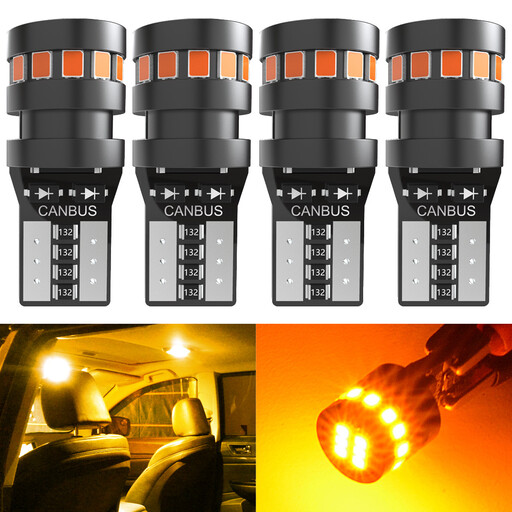
Why This Fits Their Persona: A straightforward option for drivers upgrading several interior, boot, courtesy or number plate positions at once.
The listing specifies T10, W5W, 501, 194, 168 and 2825 compatibility, plus a 12–24V rating and built-in Canbus design. Vehicle fit should still be confirmed before ordering.
Pack of four, 300LM per bulb, aluminium construction and a claimed 60,000+ hour service life.
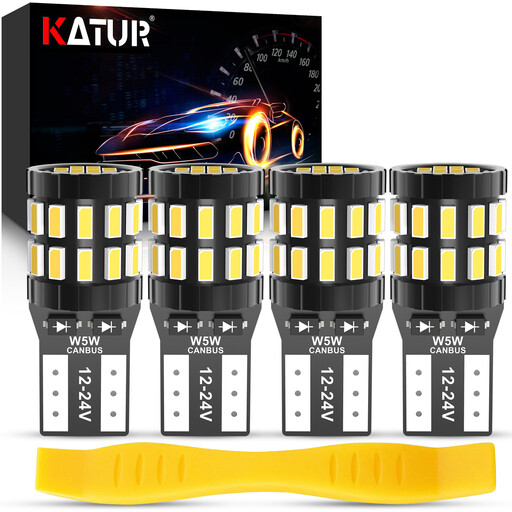
Why This Fits Their Persona: Suits drivers wanting a cooler white appearance for cabin, map, boot or number plate lighting while retaining a compact wedge format.
Its listed 12–24V operating range and Canbus error-free design address two common selection concerns, while the 1:1 plug-and-play format helps avoid housing modification.
30 3014 SMD chips, 450LM listed output, 360-degree viewing angle and 6063 aluminium alloy body.
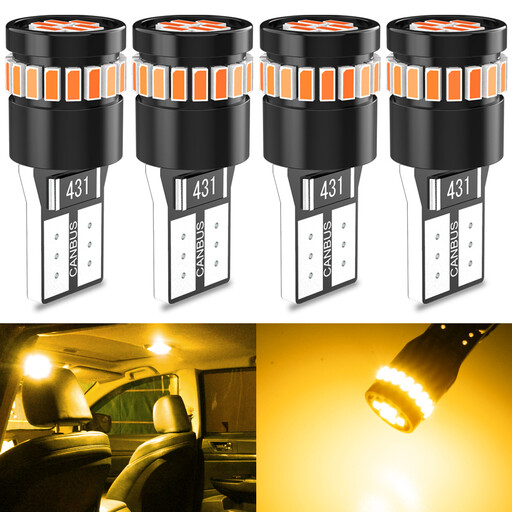
Why This Fits Their Persona: A practical match for frequent-use interior, cargo, courtesy and licence plate positions where a broad 360-degree spread is preferred.
The stated dimensions make physical checking easier, while the product listing identifies Canbus support, 12V operation and direct OEM socket installation.
24 3014 SMD LEDs, 280LM listed output, 360-degree illumination and a stated two-year warranty for qualifying manufacturer defects.
We have compiled a complete, real-time list of products that fully satisfy these strict selection criteria and UK safety regulations.
They are commonly cross-referenced, but not automatically interchangeable in every vehicle. Confirm the original marking, dimensions, voltage and socket clearance before ordering.
Several listed products specify a service life of up to or over 60,000 hours. Actual life can vary with heat, voltage stability, vibration, usage and housing ventilation, so this figure should not be treated as a guaranteed duration.
It depends on the lamp position, function and colour. Blue lighting is generally unsuitable for normal road use, while red, amber and white have specific permitted applications. Check the vehicle handbook, MOT requirements and applicable UK lighting regulations before fitting coloured bulbs to exterior lamps.