
24/7 Customer Support

Free returns

Same-day & Next-day Delivery

Quality Guaranteed

Unlock Your Welcome Offers: FREE Delivery | Up to 80% OFF | Free 30-day JoyPlus trial
Download the APP
Replacing dim halogen lamps with T10 W5W 194 LED bulbs can refresh your vehicle’s interior, parking lights or number-plate illumination. However, compatibility is not determined by appearance alone. A bulb may fit the socket but still cause dashboard warnings, poor light distribution or an unsuitable colour for road use.
This guide explains the key checks for UK car owners, from bulb codes and voltage to CANbus compatibility and colour selection. It also highlights practical options available in four-packs, helping you avoid paying for features that do not suit your vehicle.
T10, W5W, 194, 501, 168 and 2825 are commonly associated with wedge-base bulbs, but vehicle fittings can still vary in length, width, contact position and housing clearance. Some listings also include extensive cross-reference numbers, yet that does not guarantee a suitable fit for every car.
Check the code printed on the original bulb, your owner’s manual or the vehicle’s parts catalogue. If possible, compare the replacement’s dimensions with the existing lamp before ordering.
A CANbus error-free car bulb includes circuitry designed to reduce compatibility problems such as bulb-out warnings or flickering. It does not mean every vehicle will recognise every LED replacement without issue. Some cars use sensitive monitoring systems, while others may require an additional load resistor or decoder.
The product specifications supplied for the options below describe CANbus compatibility, but vehicle behaviour can differ. Test one bulb first where practical and retain the original bulb until the replacement has been confirmed.
A bright interior lamp may be comfortable for reading, but the same colour may not be appropriate for an exterior road lamp. Xenon white LED bulbs provide a cool, modern appearance, while amber yellow LED bulbs and red LED bulbs are more suitable for specific marker or styling applications.
For exterior lighting, ensure the colour and function comply with UK road-use requirements. In particular, do not use coloured bulbs where they could make required lamps appear the wrong colour to other road users.
Look for a clear match such as T10 W5W 194, 501 168 LED bulbs or 2825 LED bulbs. These references describe commonly related wedge-style fittings, but the actual bulb dimensions still matter. One listed compact design measures approximately 26.1mm by 11.4mm, which is useful when checking a tight dome-light or number-plate housing.
Also confirm whether the bulb is a straight or offset design. An offset LED may position its light-emitting chips differently within the housing, affecting illumination.
UK passenger cars generally use a 12V electrical system, while some commercial vehicles and other applications use 24V. A 12V 24V car LED bulb can offer broader vehicle compatibility, but always confirm the vehicle’s electrical system first.
The products featured here list either 12V or 12–24V operation, with power ratings between 2.5W and 3W per bulb. Lower wattage can reduce electrical consumption compared with a halogen lamp, but the bulb must still work correctly with the car’s monitoring system.
Lumens provide an indication of stated light output, although the visible result also depends on the reflector, lens and bulb position. The listed KATUR options specify 30 3014 SMD chipsets and 450LM per bulb, while selected compact versions specify 24 3014 chips and 280LM. OUSHI options list 300LM per bulb.
An aluminium body can assist heat dissipation, while a 360-degree viewing angle may help reduce dark areas in housings designed for filament bulbs. These features are particularly relevant for car interior LED bulbs, dome light LED bulbs and map light bulbs.
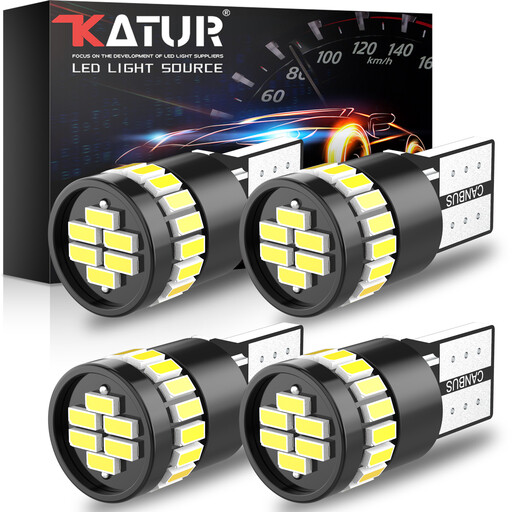
Why This Fits Their Persona: A practical four-pack for someone replacing several standard bulbs in a car interior, number-plate housing or compatible parking-light position.
The listing identifies the T10, W5W, 194, 168 and 2825 fitments, plus a compact 26.1mm by 11.4mm size. Still verify these details against the original bulb.
6000K white output, 24 3014 SMD chips, 280LM stated output and plug-and-play installation.
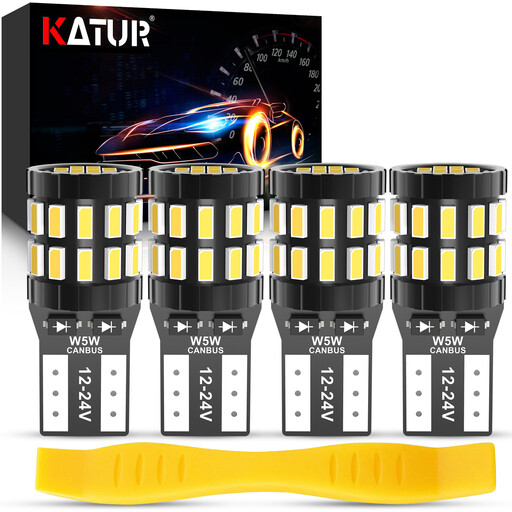
Why This Fits Their Persona: Suits drivers wanting a cooler white appearance across dome, map, courtesy or number-plate lighting where the fitment is confirmed.
Its stated 12–24V range and CANbus design address two common selection concerns, although no compatibility description should replace a vehicle-specific check.
30 3014 SMD chips, 450LM stated output, aluminium construction and a 360-degree viewing angle.
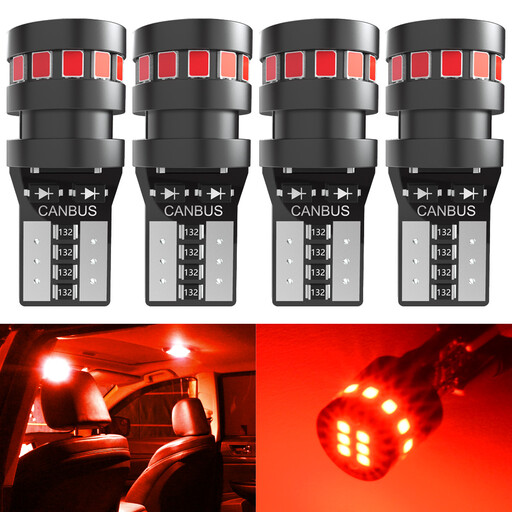
Why This Fits Their Persona: Designed for owners planning a colour-specific installation in compatible interior, marker, tail-light or other listed applications.
The listing states its fitment range and advises checking the owner’s manual, reducing the risk of using a red bulb in an unsuitable lamp position.
12–24V operation, 300LM stated output, 2.5W power rating and an aluminium body for heat dissipation.
We have compiled a complete, real-time list of products that fully satisfy these strict selection criteria and UK safety regulations.
Most compatible products use a plug-and-play LED replacement bulb format:
Do not touch hot lamps immediately after use. For exterior applications, confirm that the light remains visible through the lens and that the output colour is suitable for that position.
No. These codes commonly refer to related wedge fittings, but socket dimensions, polarity and vehicle monitoring systems vary. Confirm the original bulb code and physical size before purchase.
Not necessarily. CANbus-compatible circuitry is intended to reduce warning messages and electrical issues, but vehicle systems differ. A warning may still appear and some cars may need an additional decoder.
The supplied product specifications state lifespans of up to 60,000 hours for several listed models. Actual service life can depend on heat, voltage stability, operating hours and the condition of the vehicle’s light housing. Lower electrical consumption does not remove the need for correct installation and ventilation.