
24/7 Customer Support

Free returns

Same-day & Next-day Delivery

Quality Guaranteed

Unlock Your Welcome Offers: FREE Delivery | Up to 80% OFF | Free 30-day JoyPlus trial
Download the APP
Replacing a tired interior or number plate bulb should be straightforward. Yet many motorists buy the wrong size, choose a colour unsuitable for road use or discover that a supposedly CANBUS-compatible bulb still triggers a dashboard warning. The product name may list several codes, but that does not automatically confirm a fit for every vehicle.
This guide explains what to check before buying T10 W5W 194 LED bulbs Canbus error-free, then matches several options to different driving and installation needs.
T10, W5W, 194, 168 and 501 are commonly used reference numbers for wedge-style bulbs, while 2825 is another closely related designation. However, socket depth, bulb length and the available space inside the housing can differ between vehicles.
A bulb may fit the socket but be too long for a map light or number plate enclosure. Check the original bulb marking, owner’s manual and available clearance before ordering. If possible, compare the original bulb’s dimensions with the listed replacement.
A CANBUS LED replacement bulb is designed to reduce the likelihood of bulb-out warnings by using an integrated circuit or load-management design. It cannot guarantee compatibility with every vehicle. Some cars monitor lighting circuits particularly closely and others may require an additional resistor or decoder.
After installation, test the bulb with the vehicle switched on and check for warning messages, flickering or delayed shut-off. A product described as CANBUS-compatible is a useful starting point, not a substitute for vehicle-specific checking.
Blue and ice-blue bulbs can suit decorative interior lighting, but they are not appropriate for every external application. In the UK, lighting colour and placement matter: front-facing lamps generally use white, rear lamps red and indicators amber. Blue lighting may be restricted to authorised emergency vehicles or unsuitable for road-facing use.
For legal and practical reasons, check the vehicle handbook and relevant UK lighting requirements before fitting coloured bulbs to parking, indicator, tail or number plate positions. Blue products are more suitable for decorative applications where permitted.
Look for the exact socket family: T10, W5W, 194, 168, 501 or 2825. These codes often overlap, but the physical dimensions still need checking. A listed 1:1 plug-and-play design should fit the original wedge socket without wiring changes, although polarity can occasionally matter.
Many LED bulbs can be reversed if they do not illuminate on the first attempt. Turn off the vehicle and allow the original bulb to cool before removal.
Most UK passenger cars use a 12V electrical system, while some listings support 12-24V car LED bulbs. A 12V-only bulb may be adequate for a standard car, whereas a 12-24V option offers broader stated voltage compatibility.
LEDs generally use less power than incandescent bulbs. For example, the supplied product specifications include 2.5W and 3W options. Lower power consumption may reduce electrical load, but it does not remove the need to confirm CANBUS compatibility.
Lumens provide a useful indication of stated light output, but housing design also affects the visible result. A 360-degree viewing angle can help distribute light around a dome, map or courtesy-light housing rather than concentrating it in one direction.
For a neutral modern appearance, look for 6000K white LED bulbs or a listed 6500K xenon-white option. Amber yellow LED bulbs are more appropriate where an amber appearance is required, while red LED bulbs can be considered for suitable rear or decorative applications. Do not use coloured bulbs simply because they appear brighter in a product photograph.
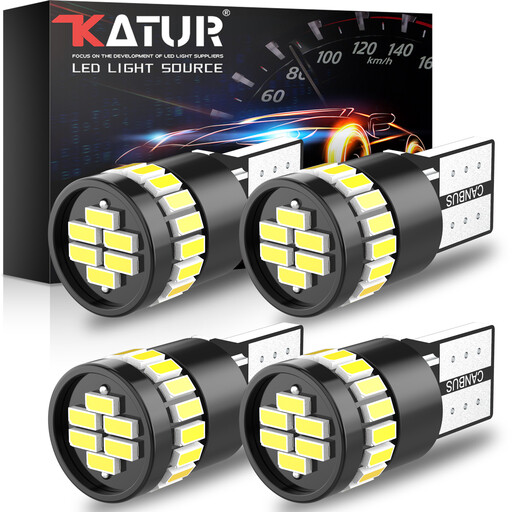
Why This Fits Their Persona: A four-pack of neutral white bulbs suits motorists upgrading several interior, dome or number plate positions without choosing a coloured finish.
The listed 168, W5W, T10, 194 and 2825 references make comparison easier, while the 1:1 plug-and-play format helps avoid modification work.
24 3014 SMD chips per bulb, stated 280 lumens, 12V operation and a 6000K-style white appearance.
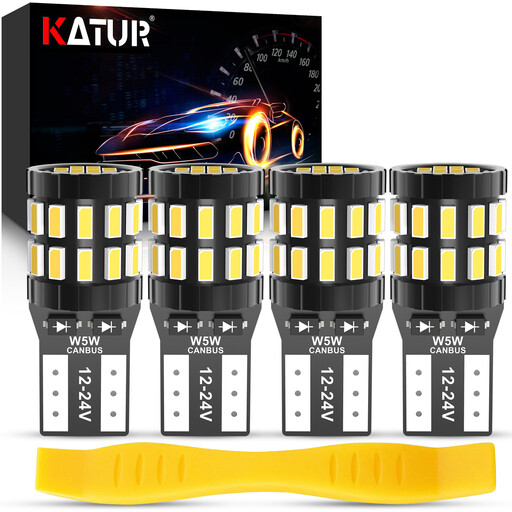
Why This Fits Their Persona: This option suits drivers wanting a brighter white finish across 12V or stated 12-24V applications, including cabin and number plate lighting where permitted.
The listed voltage range and CANBUS design address two common concerns, although the vehicle circuit should still be checked after fitting.
The listing specifies 30 3014 LEDs, 450 lumens, 3W power and an aluminium body with 360-degree light distribution.
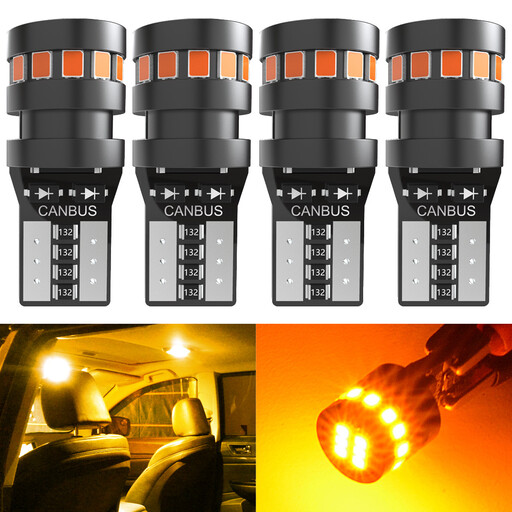
Why This Fits Their Persona: A useful match for motorists replacing several courtesy, map, cargo or suitable marker bulbs and those who specifically want an amber yellow finish.
The 12-24V listing and broad bulb-code references help with selection, while the amber colour makes the intended visual result clear before purchase.
The product specifies 300 lumens per bulb, 2.5W power, 18 LED chipsets and an aluminium body for heat dissipation.
We have compiled a complete, real-time list of products that fully satisfy these strict selection criteria and UK safety regulations.
They are commonly used for similar wedge sockets, but they are not a guaranteed universal match. Compare the original bulb code, dimensions, voltage and intended location before buying.
Several supplied listings state a lifespan of up to 60,000 hours. This is a product specification rather than a guarantee of service life. Heat, voltage variation, frequent switching and the condition of the vehicle’s electrical system can affect durability.
No. CANBUS-compatible designs are intended to reduce bulb-out warnings, but vehicle monitoring systems differ. Test each bulb after installation and retain the original bulb until compatibility is confirmed.