
24/7 Customer Support

Free returns

Same-day & Next-day Delivery

Quality Guaranteed

Unlock Your Welcome Offers: FREE Delivery | Up to 80% OFF | Free 30-day JoyPlus trial
Download the APP
Replacing a tired halogen bulb sounds simple, but choosing the wrong T10 W5W 194 LED bulbs can lead to flickering, dashboard warnings, poor light distribution or a bulb that does not fit the housing. UK drivers may also encounter confusing compatibility lists, exaggerated brightness figures and colour descriptions that do not match the intended use.
This guide explains what to check before buying 501 LED bulbs, 168 LED bulbs or 2825 LED bulbs, followed by product recommendations matched to different vehicle owners and lighting needs.
T10, W5W, 194, 501, 168 and 2825 are commonly used cross-reference numbers, but socket depth, bulb length and housing design can still vary. A bulb listed as compatible may not suit every vehicle position.
Before ordering, compare the old bulb with the replacement listing. Check:
A product described as a plug-and-play car bulb should connect directly to the existing socket, but physical clearance remains your responsibility to confirm.
Canbus error-free car bulbs are designed to reduce dashboard warnings, flickering or bulb-out messages in vehicles that monitor lighting circuits. However, vehicle electronics vary between models, trims and lighting positions. A bulb described as error-free may still require a load resistor or decoder in some cars.
Look for an integrated intelligent IC or equivalent circuit design, and retain the original bulbs until the new units have been checked. If a warning appears, do not assume the bulb is defective; the vehicle may need a compatible decoder.
Advertised brightness is only one part of performance. The number of LED chips, viewing angle, reflector shape and lens position affect how light appears inside a lamp housing. A very bright bulb can create glare or uneven illumination if it is poorly aligned.
For car interior LED bulbs, map lights and dome lights, a wide viewing angle can help reduce dark spots. For a licence plate or side-marker application, colour, housing design and legal suitability should also be considered.
The most important specification is physical compatibility. Many of the products in this guide reference T10, W5W, 501, 194, 168 and 2825 sockets. Some listings also mention 192, 175, 147, 152, 158, 159, 161, 184, 193 and 160.
Do not rely on the cross-reference list alone. Measure the original bulb where possible and check the product dimensions. One compact option listed at 26.1mm by 11.4mm is designed for direct replacement in several small wedge-style applications.
Most passenger vehicles use a 12V electrical system, while some replacement bulbs are rated for 12–24V. A wider operating range may suit vehicles with different electrical systems, but the bulb must still be appropriate for the fitting.
Lower wattage can reduce electrical load compared with a halogen bulb. For example, the OUSHI models list 2.5W per bulb, while several KATUR models list 3W per bulb. These figures should be treated as product specifications rather than a promise of identical real-world brightness in every housing.
LEDs produce less heat at the light source than many conventional bulbs, but heat still needs to be managed. Aluminium housings can help transfer heat away from the LED chips. The products below list either a full aluminium body or 6063 aviation aluminium construction.
A wide 360-degree lighting angle is useful where the original bulb illuminates in several directions, such as an interior dome or courtesy lamp. It may also help provide more even coverage in a licence plate housing.
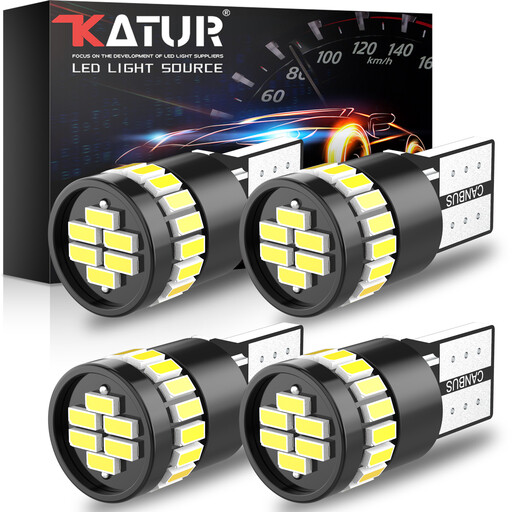
Why This Fits Their Persona: A straightforward option for drivers upgrading standard interior, map or number plate lighting without selecting a specialist colour. Each pack contains four compact bulbs.
The listing identifies the bulb codes, 12–24V operating range and 26.1mm by 11.4mm size, making fit checks more practical than relying on the word “universal”.
24 SMD 3014 chipsets, 280LM listed output, 360-degree lighting and direct plug-and-play installation.
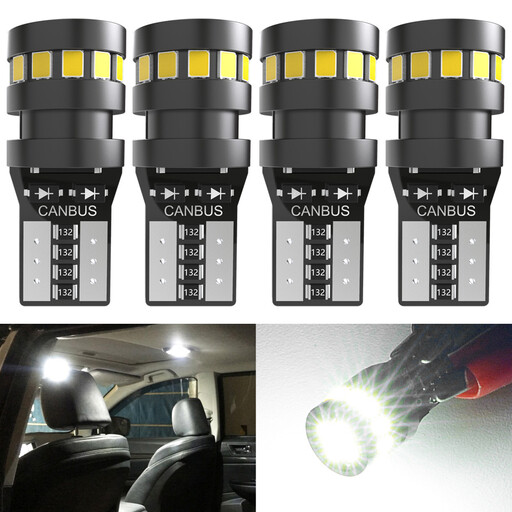
Why This Fits Their Persona: Suits owners who want a cool white appearance across dome, map, door or courtesy lighting and prefer an aluminium-bodied replacement with a wider voltage specification.
Its listing states an integrated Canbus design and identifies the 12V–24V range, 2.5W rating and recommended applications. Vehicle compatibility should still be confirmed before purchase.
6500K xenon white colour, 300LM listed output per bulb, full aluminium body and a pack of four.
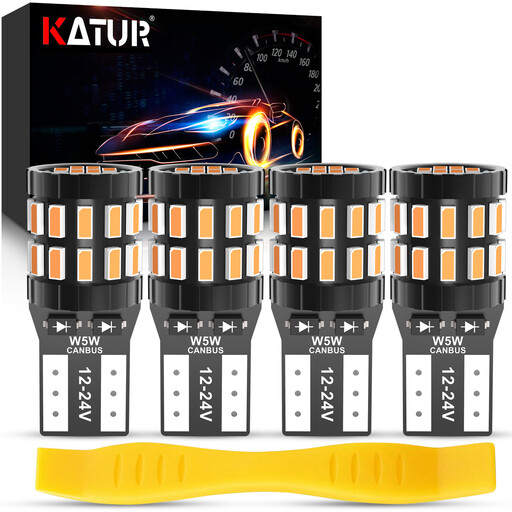
Why This Fits Their Persona: A practical colour choice for owners replacing amber marker, parking or courtesy bulbs, or creating a coordinated warm-toned appearance in selected fittings.
The product specifies 30 high-power 3014 SMD chips, aluminium construction and a 12–24V range, rather than presenting colour alone as the main feature.
Amber yellow output, 450LM listed output, 360-degree viewing angle and stated Canbus compatibility.
We have compiled a complete, real-time list of products that fully satisfy these strict selection criteria and UK safety regulations.
Before fitting car interior LED bulbs, switch off the ignition and lighting circuit. Remove the old bulb carefully, as recently used halogen bulbs can be hot. Insert the LED replacement without forcing it. If it does not illuminate, remove it, rotate it 180 degrees and refit; some wedge LEDs are polarity-sensitive.
For LED dome light bulbs, LED map light bulbs and door lamps, check that the lens closes without pressing against the bulb. For LED licence plate bulbs, confirm that the light is white where required and does not create excessive glare. Amber yellow and red LED bulbs should only be used where the lamp position and vehicle lighting requirements permit that colour.
Keep the original bulbs in the vehicle as emergency spares and test each replacement for flicker, warning messages and secure fit before replacing the trim.
They are commonly used cross-reference codes for similar wedge-style bulbs, but they are not an automatic guarantee of fit. Check the original code, dimensions, voltage and intended position in your vehicle before ordering.
No lighting product can be assumed to work identically in every vehicle. Canbus-compatible designs aim to reduce errors, but some cars monitor current very closely. Test the bulbs before final installation and check whether a decoder is needed if a warning appears.
LEDs commonly use less electrical power for a comparable lighting application. The products featured here list ratings between 2.5W and 3W per bulb, but actual running cost depends on usage time, the number of bulbs fitted and your vehicle’s electrical system.