
24/7 Customer Support

Free returns

Same-day & Next-day Delivery

Quality Guaranteed

Unlock Your Welcome Offers: FREE Delivery | Up to 80% OFF | Free 30-day JoyPlus trial
Download the APP
Replacing a dim halogen bulb sounds straightforward until the new bulb flickers, triggers a dashboard warning or does not fit the housing. T10 W5W 194 LED bulbs are sold under several numbers, including 501 LED bulbs, 168 LED bulbs and 2825 LED bulbs, which makes product descriptions difficult to compare.
A sensible purchase starts with the socket, voltage and intended location rather than the brightest-looking specification. This guide explains the common traps and highlights suitable options for different types of UK driver.
T10, W5W, 194, 168 and 501 commonly describe bulbs with a similar wedge-base format, but vehicle housings can vary in length, width and available clearance. Some listings also include wider compatibility lists containing numbers such as 175, 2821, 2827 and 912.
Treat these references as a starting point, not a guarantee. Check the original bulb marking, owner’s manual or the vehicle’s parts catalogue before ordering. Comparing the replacement bulb’s dimensions with the original can also prevent problems in compact map-light or number-plate housings.
Canbus error-free T10 bulbs include an integrated circuit intended to work with vehicles that monitor bulb load. However, electrical systems differ between models. A bulb described as error-free may still produce a warning, flicker or faint glow in some vehicles.
For this reason, look for a clearly stated operating range and a return or support policy. If the vehicle is particularly sensitive, an additional decoder or resistor may be required. Do not install external resistors without considering heat generation and safe mounting.
A high lumen figure may be useful for a boot or interior light, but it is not automatically suitable for every position. Excessive glare can be inconvenient inside the cabin, while coloured bulbs may not be appropriate for every exterior lamp position.
Select the colour and brightness for the job: xenon white LED bulbs for a neutral modern appearance, amber yellow LED bulbs for selected marker or indicator applications, and red or blue bulbs only where the vehicle’s design and local road-use requirements permit them.
The most important check is whether the bulb uses the correct T10 wedge base and fits the housing. W5W car bulbs are commonly used for interior, parking, side-marker and number-plate applications. The terms 194, 168, 501 and 2825 may indicate equivalent or closely related fitments, but socket compatibility should still be confirmed.
One compact KATUR option lists dimensions of 26.1 mm by 11.4 mm, which may suit tighter housings. Larger multi-chip designs can provide more light but may have less clearance behind the lens.
Many UK cars use a nominal 12V system, although the electrical voltage can vary while the engine is running. Some 12V and 12-24V car LED bulbs are designed for a wider operating range, making them a practical consideration for vehicles with different electrical requirements.
Power ratings in the supplied options range from 2.5W to 3W per bulb, while listed outputs range from 280LM to 450LM. These figures are useful for comparison, but real-world appearance also depends on the reflector, lens and bulb orientation.
LEDs generally use less electrical power than comparable halogen bulbs, but they still produce heat around the chip and driver. Aluminium bodies, such as the listed full-aluminium designs and 6063 aviation-aluminium construction, are intended to help dissipate heat.
A 360-degree lighting angle can reduce dark areas in dome-light bulbs, map-light bulbs and door courtesy-light bulbs. Before fitting, check that the LED faces the right direction and that the housing does not obstruct the chips.
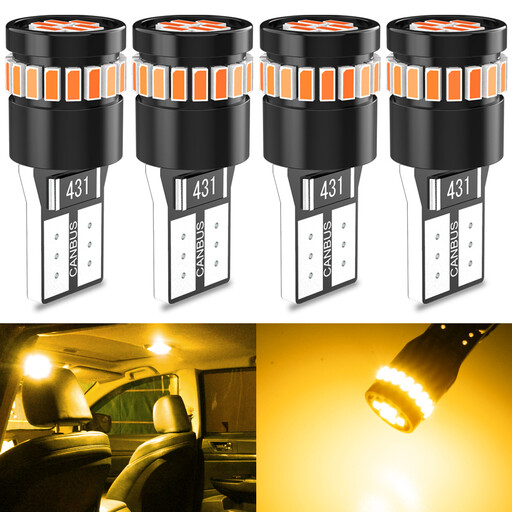
Why This Fits Their Persona: A four-pack with a compact 1:1 design is a straightforward starting point for replacing several interior or number-plate bulbs.
Its listed dimensions and supported bulb references make fit checking more practical than relying on appearance alone.
24 3014 SMD LEDs per bulb, 12V operation and a listed 280LM output.
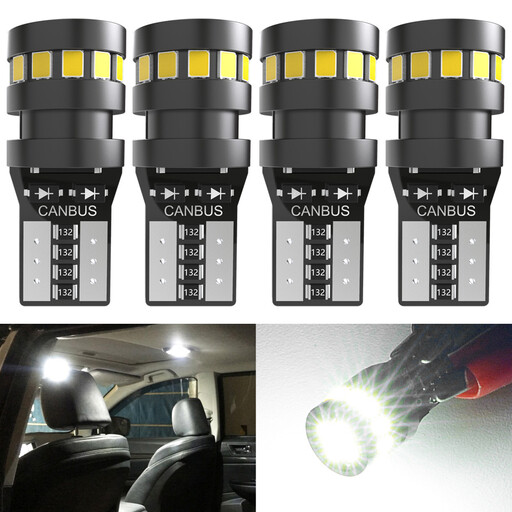
Why This Fits Their Persona: Suitable for drivers wanting a crisp white cabin or registration-light appearance with an aluminium body.
The listing states its voltage, power and Canbus design, while still advising buyers to verify vehicle compatibility.
6500K xenon white colour, 300LM per bulb and listed 12V, 2.5W operation.
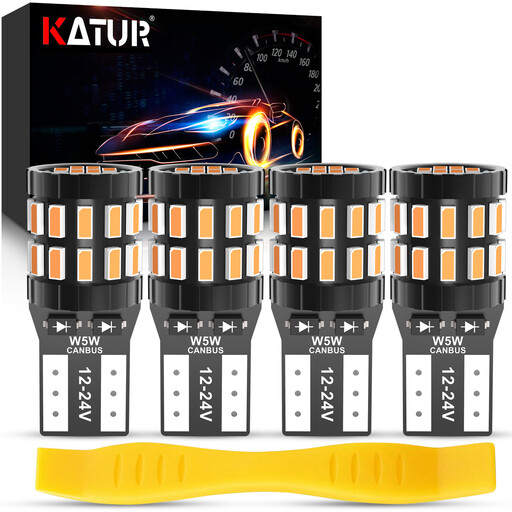
Why This Fits Their Persona: The wider 12-24V specification suits owners who want a versatile option for different vehicle electrical systems and exterior positions.
Its stated operating range and aluminium construction address two practical concerns: electrical variation and heat management.
30 3014 SMD chips, 450LM listed output and 360-degree viewing angle.
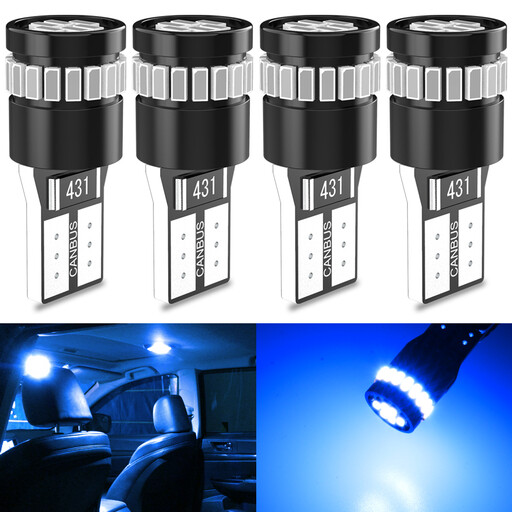
Why This Fits Their Persona: A coloured option may suit private interior styling or selected show-focused applications where blue light is appropriate and permitted.
It is presented as a specific colour and fitment, rather than suggesting that one bulb colour suits every vehicle location.
24 3014 SMD chips, 280LM listed output and plug-and-play installation.
Before fitting plug-and-play car bulbs:
LED replacement bulbs can reduce power consumption compared with halogen bulbs, but a claimed service life such as 60,000 hours is a listing specification rather than a guarantee of identical performance in every vehicle. Heat, vibration, voltage variation and frequent switching affect service life.
We have compiled a complete, real-time list of products that fully satisfy these strict selection criteria and UK safety regulations.
They often refer to closely related wedge-style applications, but not every bulb is identical in dimensions or electrical behaviour. Check the original bulb number, physical size and vehicle manual before ordering.
They are designed to reduce compatibility warnings by managing the vehicle’s bulb-monitoring system. No design can be assumed to work with every model, so test the bulb after installation and choose a listing with suitable support or returns.
The listed LED options use around 2.5W to 3W per bulb, which is lower than many traditional halogen replacements. Actual running-cost savings depend on how often the lights are used and the vehicle’s electrical system.