
24/7 Customer Support

Free returns

Same-day & Next-day Delivery

Quality Guaranteed

Unlock Your Welcome Offers: FREE Delivery | Up to 80% OFF | Free 30-day JoyPlus trial
Download the APP
Replacing a small car bulb can seem straightforward until the new lamp flickers, triggers a dashboard warning or fails to fit behind the housing. T10 W5W 194 LED bulbs are sold under several reference numbers, including 501 LED bulbs, 168 LED bulbs, 2825 LED bulbs and 175, 192 or 194. These labels often describe compatible bulb families rather than a guarantee that every version fits every vehicle.
For UK motorists, the main buying traps are usually:
The following checks can help you avoid buying twice.
Check the removed bulb, owner’s manual or vehicle parts list for the original reference. T10, W5W, 501, 194, 168 and 2825 are frequently cross-referenced, but the fitting can vary by vehicle.
Measure or compare:
A listed size of approximately 26.1mm by 11.4mm is provided for some compact KATUR bulbs. This can suit tight housings, but the original bulb should still be compared before ordering.
Most 12V car LED bulbs are intended for standard passenger vehicles. Some products support a wider 12–24V car LED bulbs range, which may be useful for vehicles with different electrical systems, but it does not remove the need to verify the vehicle specification.
Brightness is commonly shown in lumens. The products in this guide list outputs from 280LM to 450LM per bulb, depending on the model. A higher lumen figure may provide more visible illumination, but excessive brightness can create glare or an unsuitable appearance in some housings.
A 2.5W or 3W LED bulb generally uses less electrical power than a comparable filament bulb according to the supplied product specifications. However, wattage should not be used as the only measure of light output.
For a neutral modern appearance, xenon white LED bulbs around 6000K–6500K are commonly selected for interior, number plate or permitted exterior applications. Amber yellow LED bulbs can suit indicator, side-marker or styling applications where that colour is appropriate. Red LED bulbs are generally chosen for red-light applications, while blue bulbs require particular caution because blue lighting may be restricted for road use and can resemble emergency lighting.
For longevity, look for a metal heat-dissipating body rather than relying only on a large LED chip count. Several listed models use an aluminium body and state a service life of up to 60,000 hours. This is a product specification, not a guarantee of actual lifespan in every vehicle, as heat, voltage fluctuations and usage patterns affect performance.
For newer cars, Canbus error-free LED bulbs with an integrated IC may help prevent bulb-out warnings. The supplied OUSHI specification states that its design is error-free on 99% of vehicles, but this should be treated as a product claim rather than a universal outcome. Keep the original bulbs until the replacement has been installed and checked.
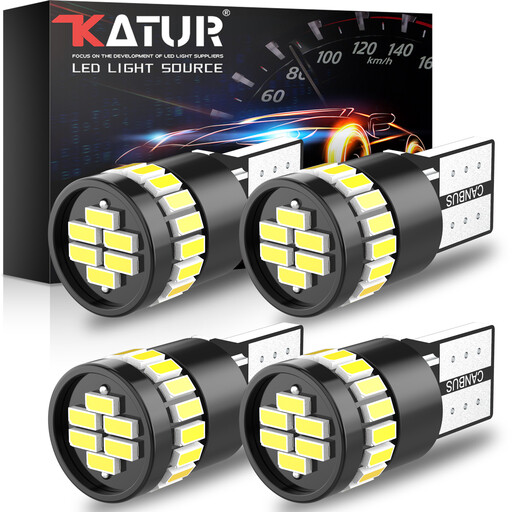
Why This Fits Their Persona: A four-pack of compact white bulbs suits drivers starting with interior, dome or map light upgrades without selecting a more specialised colour.
The listed fitment covers T10, W5W, 501, 168, 194 and 2825, while the compact 26.1mm by 11.4mm size helps with clearance checks.
6000K white colour, 280LM listed output, 24 3014 SMDs and plug-and-play installation.
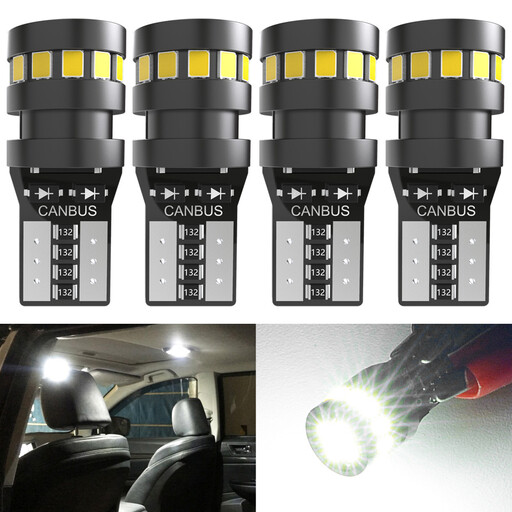
Why This Fits Their Persona: Drivers wanting a bright, uniform interior finish may prefer the stated 360-degree lighting design and aluminium construction.
Its built-in IC and stated Canbus design address common warning-light concerns, although vehicle compatibility should still be checked.
6500K xenon white, 300LM per bulb, 2.5W power rating and an aluminium heat-dissipating body.
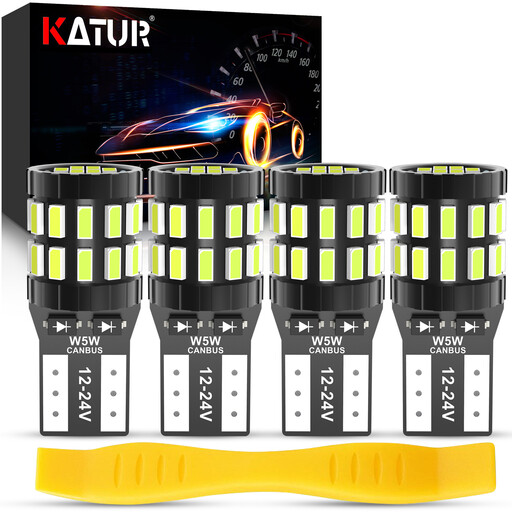
Why This Fits Their Persona: A suitable choice for motorists selecting a distinctive colour for a permitted interior or private-use lighting project.
The 12–24V rating and 360-degree viewing angle are clearly listed, making key electrical and illumination details easier to compare.
30 3014 SMDs, 450LM listed output, 3W power rating and an aluminium body.
We have compiled a complete, real-time list of products that fully satisfy these strict selection criteria and UK safety regulations.
Most of these products are described as plug-and-play car bulbs, but installation should still be carried out with the lights switched off and the bulb allowed to cool. Avoid touching exposed LED surfaces unnecessarily, and check that the replacement is seated firmly before refitting the lens.
After installation:
For exterior lighting, colour and positioning matter. Check the vehicle handbook and current UK roadworthiness requirements before using coloured bulbs for licence plate, parking, side-marker, tail or backup lights. Blue lighting can be unsuitable for public-road use, while amber or red lamps should only be used where the vehicle’s design and applicable rules permit them.
They are commonly used as cross-reference numbers, but they are not an automatic fit for every vehicle. Check the original bulb designation, dimensions, socket and housing clearance before ordering.
They are designed to reduce compatibility warnings by incorporating suitable circuitry. However, vehicle electronics differ, so no product should be assumed to work without errors in every car. If a warning appears, an additional decoder or a different bulb specification may be required.
Many listed LED models have a lower wattage than the filament bulbs they replace. That can reduce electrical load while the light is operating, but the actual saving depends on the number of bulbs, usage time and the vehicle’s electrical system. Compare the stated wattage rather than relying only on brightness language.