
24/7 Customer Support

Free returns

Same-day & Next-day Delivery

Quality Guaranteed

Unlock Your Welcome Offers: FREE Delivery | Up to 80% OFF | Free 30-day JoyPlus trial
Download the APP
Replacing tired halogen lamps with T10 W5W 194 LED bulbs can refresh a vehicle’s interior and reduce power consumption. However, choosing purely by lumen claims or colour photographs can lead to poor fitment, dashboard warnings or lighting that is unsuitable for its intended position.
This guide explains the key codes, specifications and practical differences to check before buying W5W LED replacement bulbs for a UK vehicle.
T10, W5W, 194, 501, 168 and 2825 are commonly associated with the same general wedge-bulb family, but vehicle sockets and housings can still vary. Some bulbs listed under these codes may differ in length, width, polarity or contact design.
Before ordering, compare the original bulb with the replacement dimensions and check the vehicle handbook. A bulb described as compatible with 501 168 LED bulbs may still be unsuitable if the housing is unusually shallow.
Canbus error-free LED bulbs are designed to reduce compatibility issues such as bulb-warning messages, flickering or a light that does not switch off correctly. Nevertheless, vehicle electrical systems differ. A bulb that works without an error in one car may still require a decoder or resistor in another.
Look for a built-in intelligent IC or clearly stated vehicle compatibility, but keep the original bulbs until the installation has been checked.
A high-lumen bulb is not automatically suitable for every application. A very cool white light can produce glare inside a reflective housing, while amber yellow or red LED bulbs may be intended for styling or specific signal functions rather than general illumination.
For exterior lighting, check the vehicle handbook and applicable UK lighting and MOT requirements before changing the colour. Coloured bulbs may not be appropriate for every front, rear, marker or licence plate position.
The most important starting point is the original fitting. Common cross-reference codes include:
Check both the code and physical size. For example, some compact bulbs measure approximately 26.1 mm by 11.4 mm, while larger multi-chip designs may need more clearance. LED wedge bulbs can also be polarity-sensitive. If the bulb does not illuminate, switching it around in the socket may resolve the issue.
Most cars use a 12V car LED bulb, although many products are rated for a wider 12–24V operating range. This can be useful for vehicles with varying charging voltages, but it does not remove the need to confirm the correct application.
Several bulbs in this range use around 2.5W or 3W per bulb, compared with a higher-wattage incandescent equivalent. Lower electrical demand may reduce the load on the lighting circuit, but brightness and beam distribution still depend on the number and arrangement of LED chips.
Product listings may quote figures such as 280LM, 300LM or 450LM per bulb. These figures are useful for comparison, but real-world appearance also depends on the lens, reflector and position of the lamp.
Useful colour choices include:
An aluminium body can help conduct heat away from the LED chips. Some products also specify a 360-degree viewing angle to reduce dark spots inside dome, map or courtesy-light housings.
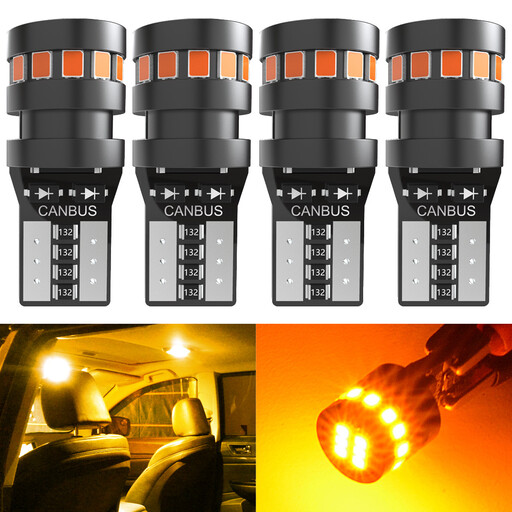
Why This Fits Their Persona: A four-bulb pack offers a practical starting point for replacing several interior or courtesy lamps without selecting separate fittings.
The listing identifies the T10, W5W, 501, 194, 168 and 2825 codes, while advising buyers to confirm the original bulb or handbook first.
12–24V rating, 2.5W per bulb, 300LM per bulb and an aluminium body are stated specifications.
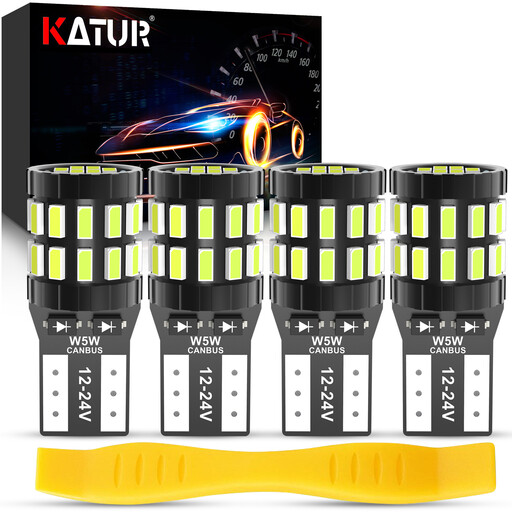
Why This Fits Their Persona: Suitable for motorists who prioritise a distinctive cool-toned appearance for compatible interior applications.
Its stated size-family compatibility and 360-degree lighting design help buyers compare fit and coverage rather than relying only on appearance.
30 SMD 3014 chips, 450LM per bulb and a stated 60,000-hour lifespan.
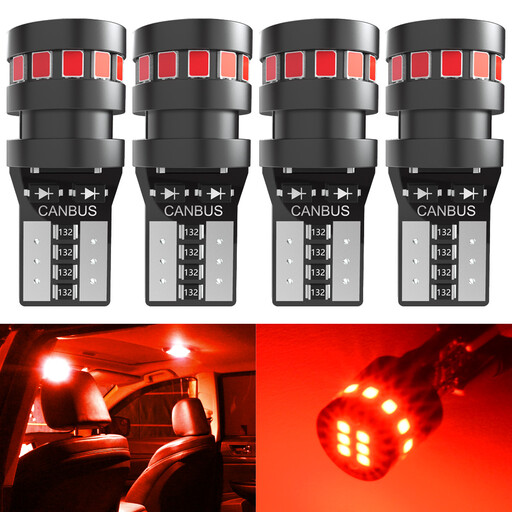
Why This Fits Their Persona: A practical option for owners selecting red lighting for a compatible interior or approved rear application.
The listing provides application guidance and asks buyers to verify the owner’s manual, which is particularly important when changing exterior light colour.
12–24V operation, 2.5W per bulb, 300LM per bulb and a stated Canbus-compatible design.
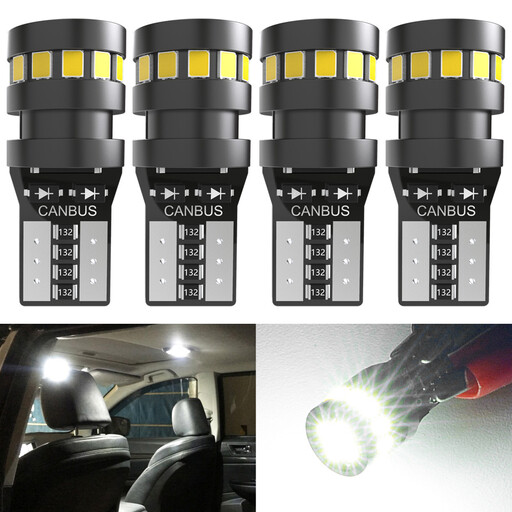
Why This Fits Their Persona: A straightforward choice for dome lights, map lights, door courtesy lights or licence plate housings that accept a W5W-style fitting.
The stated 12V rating, multiple cross-reference codes and plug-and-play format make the basic checks clear before installation.
6500K colour specification, 2.5W per bulb and an aluminium heat-dissipation body.
We have compiled a complete, real-time list of products that fully satisfy these strict selection criteria and UK safety regulations.
Switch off the vehicle and remove the key before accessing a lamp. For interior lights, use a trim tool carefully and avoid touching hot halogen bulbs. Insert the LED firmly, then test the lamp and check for flickering, delayed shut-off or a dashboard warning.
LEDs generally use less power than comparable incandescent bulbs. The actual saving depends on the number of lamps, wattage and time they remain switched on, so treat low-consumption claims as a specification rather than a guaranteed fuel saving.
They are often cross-referenced within the same wedge-bulb family, alongside 501, 168 and 2825. They are not automatically interchangeable in every vehicle. Confirm the original code, dimensions, voltage and polarity before buying.
No. They are designed to reduce warning and flickering issues, but vehicle monitoring systems vary. If a warning appears, check the bulb seating, polarity and vehicle compatibility. A decoder may be required for some models.
Many product listings state a lifespan of up to 60,000 hours, but actual service life depends on heat, vibration, voltage stability and how the bulb is used. Good ventilation and a correctly sized housing can help the bulb operate within its intended conditions.