
24/7 Customer Support

Free returns

Same-day & Next-day Delivery

Quality Guaranteed

Unlock Your Welcome Offers: FREE Delivery | Up to 80% OFF | Free 30-day JoyPlus trial
Download the APP
Replacing a standard halogen bulb with T10 W5W 194 LED bulbs can refresh your car’s interior or exterior lighting, but compatibility is more complicated than a product title may suggest. UK motorists commonly buy the wrong fitting, choose an unsuitable colour for an exterior position, or assume “Canbus error-free” guarantees that no dashboard warning will ever appear.
This guide explains the practical checks to make before buying, then matches several options to different driving and vehicle-use profiles.
T10, W5W, 501, 194, 168 and 2825 are often used together in listings because they can refer to closely related wedge-style bulbs. However, the physical length, base design, polarity and available space can vary between vehicles.
Before ordering, compare the code printed on the old bulb with the owner’s manual. If possible, measure the original bulb and check the replacement dimensions. A bulb that fits the socket may still be too long for the lamp housing.
Canbus error-free car bulbs include an integrated circuit intended to reduce bulb-out warnings, flickering or compatibility problems in vehicles with lamp monitoring. Even so, vehicle electronics differ. Some cars may still show a warning, require a decoder, or experience a faint residual glow when switched off.
A listing that states compatibility with a percentage of vehicles should be read as a product specification, not a guarantee for every UK car. Keep the original bulbs until the replacement has been installed and checked.
A high-lumen bulb may be suitable for a boot or dome light but uncomfortable as a close-range map light. Similarly, amber yellow LED bulbs, red LED bulbs and blue LED bulbs may be appropriate for certain decorative or signalling applications, but exterior lighting colours are regulated.
The UK’s Road Vehicles Lighting Regulations set requirements for lamp colours and positions. Check your vehicle handbook and the relevant lighting rules before fitting a coloured bulb to a parking, side-marker, tail, reverse or number-plate position. A product that physically fits is not automatically suitable for road use.
Look for the exact original designation, such as W5W, T10, 501, 194, 168 or 2825. Some listings also mention 192, 175, 147, 152, 158, 159, 161, 184, 193, 160, 2821 and 2827. These references can help identify cross-compatible wedge bulbs, but the owner’s manual remains the more reliable starting point.
LEDs are polarity-sensitive. Many plug-and-play car bulbs are designed to work immediately, while others may need to be removed and turned around if they do not illuminate. Check the socket rather than forcing the bulb into place.
Most car lighting systems use approximately 12V, while some products are rated for 12V-24V automotive LED bulbs. A 12V-only replacement should not be assumed suitable for a vehicle with a higher-voltage system.
Power consumption is also worth comparing. The listed products below use between 2.5W and 3W per bulb, according to their product specifications. Lower wattage can reduce electrical load, but it does not by itself confirm compatibility or superior illumination.
LED bulbs still produce heat around the chipset. Aluminium bodies, heat sinks and other thermal designs can help move heat away from the light-emitting components. A 360-degree lighting angle may also help reduce dark areas inside a reflector or enclosed interior fitting.
Several products listed here state a lifespan of up to 60,000 hours. This is a manufacturer-provided specification, and actual service life can vary with operating temperature, vibration, moisture and how often the lights are used.
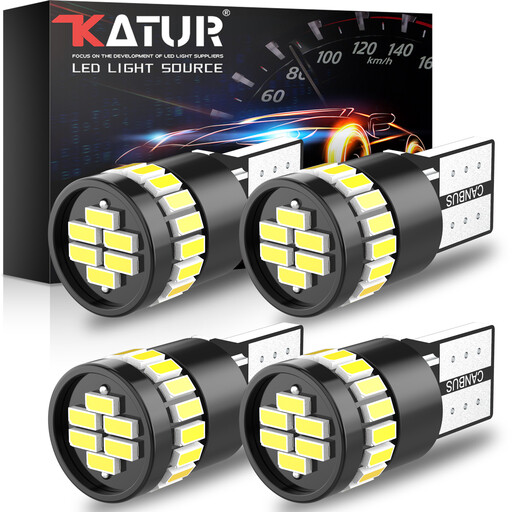
Why This Fits Their Persona: A four-piece pack provides a practical starting point for replacing interior, dome or licence plate bulbs without buying a large quantity.
The listing identifies the fitting codes, 12V operating voltage and Canbus design, making the key purchase checks easier to compare.
6000K white colour, 280-lumen listed output, 24 SMD 3014 chips and a stated 60,000-hour lifespan.
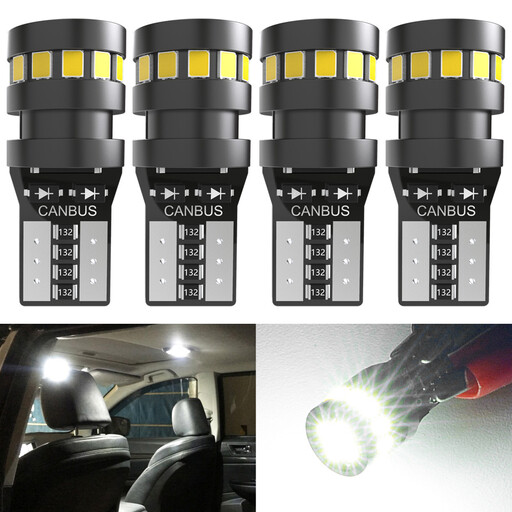
Why This Fits Their Persona: Suitable for motorists wanting a cooler xenon-white appearance across several cabin or number-plate positions.
Its stated 12V specification helps avoid mixing it with products intended for wider voltage ranges, while the fitting codes support a direct comparison.
2.5W per bulb, 300 lumens per bulb as listed, aluminium construction and a 360-degree lighting angle.
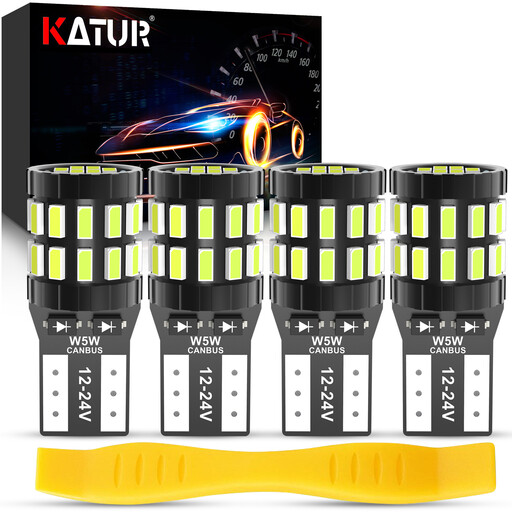
Why This Fits Their Persona: A choice for enthusiasts styling cabin or permitted auxiliary lighting and needing a bulb rated across 12-24V systems.
The voltage range, bulb codes and stated Canbus design are clearly specified, reducing guesswork when comparing alternatives.
450-lumen listed output, 30 SMD 3014 chips per bulb, aluminium body and plug-and-play installation.
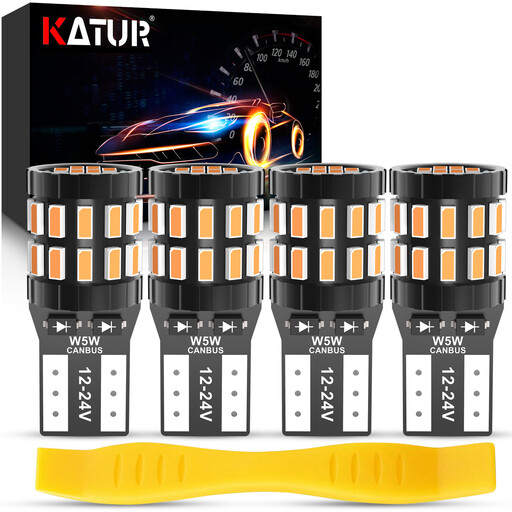
Why This Fits Their Persona: Amber output can suit drivers who prefer a warmer appearance for interior, courtesy or selected marker-light applications.
It makes the colour choice explicit, helping prevent the common mistake of ordering a white bulb when a warmer appearance is intended.
450-lumen listed output, 3W power rating, 30 SMD 3014 chips and 360-degree illumination.
We have compiled a complete, real-time list of products that fully satisfy these strict selection criteria and UK safety regulations.
They are commonly grouped together for wedge-style automotive applications, but they are not a substitute for checking the original bulb. Verify the socket, dimensions, voltage and vehicle handbook before buying.
No. Canbus-compatible designs are intended to reduce warning messages and flickering, but vehicle monitoring systems vary. Some cars may still need a separate decoder or load resistor. Test the bulb before disposing of the original.
Many replacement products use lower wattage than their halogen equivalents. The actual saving depends on the vehicle, number of bulbs, usage time and electricity generated by the alternator. Compare the stated wattage rather than relying on brightness wording alone.