
24/7 Customer Support

Free returns

Same-day & Next-day Delivery

Quality Guaranteed

Unlock Your Welcome Offers: FREE Delivery | Up to 80% OFF | Free 30-day JoyPlus trial
Download the APP
Replacing a dim interior or number plate bulb sounds straightforward, but the wrong T10 W5W 194 LED bulbs can lead to poor fitment, dashboard warnings or an unsuitable colour for the intended position. Names such as 501 LED bulbs, 168 LED bulbs and 2825 LED bulbs are often used for closely related wedge-style fittings, but matching the label alone is not enough.
This guide explains the practical specifications to check before buying and highlights suitable options for different UK driving needs.
T10, W5W, 194, 501, 168 and 2825 usually describe compatible wedge bulb formats, but vehicle housings can vary in depth, contact position and available space. A bulb may fit the socket yet still be too long for the lens or fail to make reliable electrical contact.
Check the original bulb, owner’s manual or vehicle-specific fitment information before ordering. Comparing the replacement dimensions with the existing bulb is particularly important for compact map lights and licence plate housings.
A Canbus error-free car bulb includes circuitry intended to reduce warning messages, flickering or bulb-out alerts. However, vehicle electrical systems differ. A product described as error-free may still produce an error on a particularly sensitive car, or require an additional load resistor or decoder.
For this reason, treat “Canbus error-free” as a design feature rather than a guarantee for every UK vehicle. If your car has bulb monitoring, retain the original bulbs until the LED replacements have been installed and checked.
A brighter bulb is not automatically more suitable. Amber yellow LED bulbs can provide a warm appearance for interior or marker applications, while xenon white LED bulbs create a cooler, modern-looking light. Red LED bulbs and blue LED bulbs may suit certain decorative or vehicle-specific applications, but colour requirements can vary for exterior lamps.
For road-facing lighting, always check the vehicle handbook and relevant UK requirements. Interior lighting, dome lights and courtesy lights offer more flexibility than exterior lamps, where colour, position and visibility are important.
Confirm that the vehicle uses a wedge-style 12V car LED bulb with the required base. T10 W5W bulbs are commonly cross-listed as 194, 501, 168 and 2825. Some listings also mention 192, 175, 147, 152, 158, 159, 161, 184 and 193.
These cross-references are useful starting points, not a substitute for checking the original bulb. If the vehicle operates at a voltage range rather than a fixed 12V system, a product rated for 12–24V may offer broader compatibility.
Look beyond phrases such as “super bright”. Check the stated lumen output, wattage and LED configuration. The products featured below list outputs ranging from 280LM to 450LM per bulb, with power ratings between 2.5W and 3W.
A 360-degree lighting angle can help spread light around the housing and reduce dark spots. Multi-chip arrangements, such as 24-SMD or 30-piece 3014 chipsets, are also useful details when comparing products, although brightness figures should be compared only where the measurement conditions are consistent.
LEDs generally use less power than comparable halogen bulbs, but they still produce heat at the chip and driver. Aluminium bodies or heat-dissipating designs can help manage this inside enclosed housings.
A plug-and-play car bulb should connect directly to the original socket without wiring changes. If it does not illuminate, switch it around in the holder: wedge LEDs can be polarity-sensitive. Turn the ignition and lights off before replacing bulbs, and avoid touching hot halogen bulbs immediately after use.
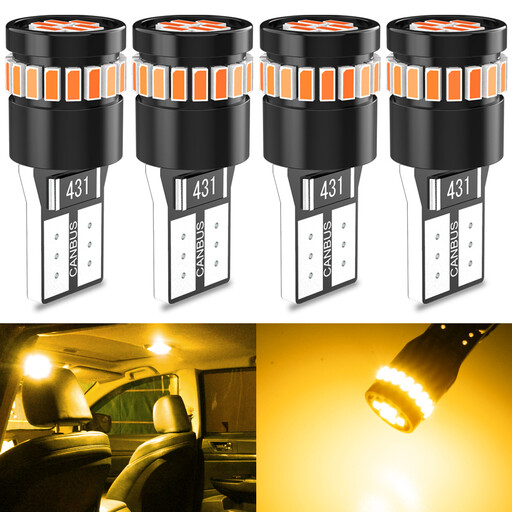
Why This Fits Their Persona: A four-bulb pack provides a practical starting point for upgrading interior, courtesy or licence plate lighting without buying a larger quantity.
The listing clearly identifies 168, W5W, T10, 194 and 2825 compatibility, plus a stated 12V operating voltage and plug-and-play design.
24 SMD 3014 LEDs, 280LM stated output, 360-degree lighting and a two-year warranty for confirmed manufacturing defects.
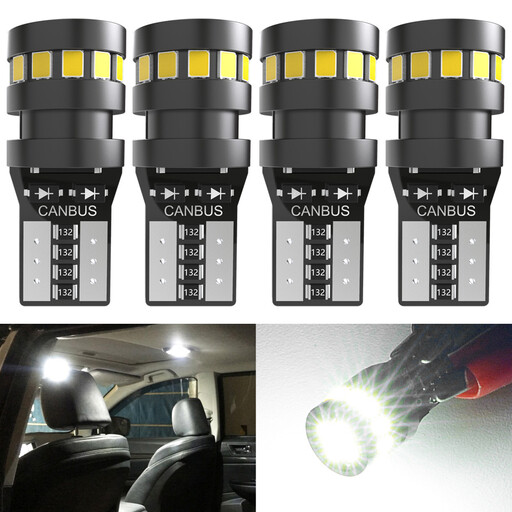
Why This Fits Their Persona: Suitable for shoppers seeking a cooler white appearance across map, dome, door courtesy or number plate applications where the fitting is confirmed.
Its aluminium body is specified for heat dissipation, while the integrated Canbus design is intended to reduce installation-related warning issues.
6500K colour, 300LM stated output, 2.5W per bulb, 12V–24V rating and 360-degree illumination.
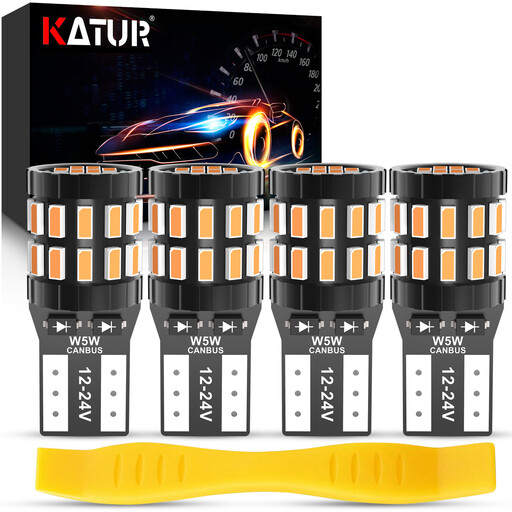
Why This Fits Their Persona: The 12–24V range and higher stated 450LM output suit owners replacing several frequently used interior or marker bulbs.
The product information specifies 30 3014 chipsets, aluminium construction and Canbus circuitry, rather than relying only on a “bright” description.
The listing states 60,000 hours, 3W per bulb, 360-degree light distribution and broad cross-reference coverage.
We have compiled a complete, real-time list of products that fully satisfy these strict selection criteria and UK safety regulations.
They are commonly used as cross-reference names for similar wedge bulb applications, but physical dimensions and vehicle sockets can differ. Check the original bulb, dimensions and owner’s manual before purchase.
No. They are designed to reduce compatibility problems, but some vehicle monitoring systems remain sensitive. Test the bulb after installation and check whether an error message, flicker or rapid flashing appears.
LED replacements commonly use a lower wattage for their stated output. For example, the products above list 2.5W or 3W per bulb. Actual savings depend on the number of bulbs, how long they are switched on and the vehicle’s electrical system.